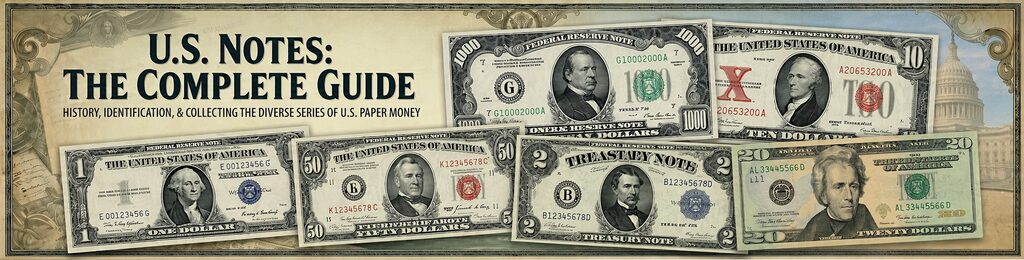
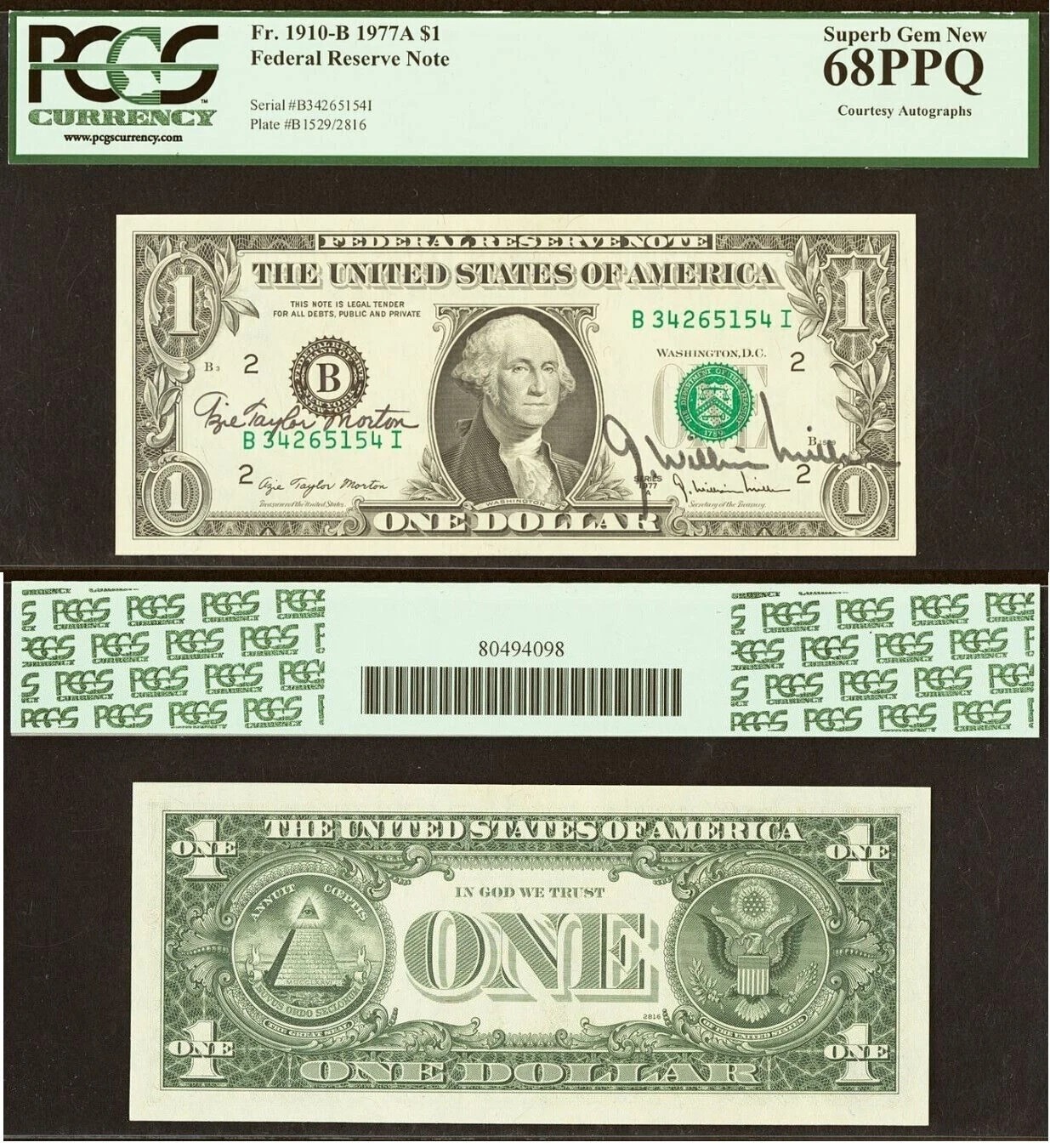
📷 Image source: eBay. Images are selected by AI to represent the article topic and may not depict the exact note(s) described.
Pull a Series 1977A $1 Federal Reserve Note from an old coin envelope and you might think you’re holding one of the most ordinary pieces of American paper money ever produced. In raw numbers, you’d be right. The BEP printed hundreds of millions of these notes across all twelve Federal Reserve districts between 1977 and the early 1980s, making them among the most abundant small-size notes of the modern era. But spend enough time behind a loupe and under a good light source, and the 1977A dollar reveals a quietly complex personality rooted in transitional printing technology, shifting seal characteristics, and back plate numbering patterns that mark the boundary between early and late production with surprising clarity.
Signatures and Context: Morton and Miller Take the Helm
The 1977A series carries the signatures of Treasurer Azie Taylor Morton and Secretary of the Treasury G. William Miller. Morton had already signed the Series 1977 notes alongside Secretary W. Michael Blumenthal, so the “A” suffix signals the sole change: Miller replaced Blumenthal in August 1979 following Blumenthal’s resignation. This is a crucial point for collectors building signature sets. Morton’s signature remained constant across both series, but pairing her name with Miller’s gives the 1977A notes a brief signing window tied to the final years of the Carter administration. Notes bearing this combination were delivered to Federal Reserve banks from late 1979 through approximately 1981, with some districts receiving deliveries that bridged the early printing runs of the Series 1981 notes.
The political and economic context matters here too. The late Carter years saw significant inflation and currency circulation demands that pushed BEP production to high volumes. That pressure on the presses is part of why back plate wear becomes a visible variable across 1977A production, and why collectors who track plate numbers can map the lifecycle of individual printing plates with some precision.
The Green Seal: Shade Variations Between Early and Late Runs
All Series 1977A $1 notes carry the standard green Federal Reserve seal to the left of Washington’s portrait and matching green serial numbers. What is not standard, however, is the precise shade of that green ink across the full production run. Early deliveries of 1977A notes tend to exhibit a slightly deeper, more saturated green on the Treasury seal, a characteristic collectors sometimes describe informally as “rich” or “bottle green.” Later production notes, especially those printed as the series wound down and BEP ink formulations subtly shifted in preparation for the Series 1981 transition, can show a slightly lighter or more yellow-tinged green.
This is not an officially catalogued variety in the sense of separate Friedberg numbers, but it is observable under consistent lighting conditions and is documented in specialist literature including Bart’s Federal Reserve Notes reference guides. The difference is most pronounced when comparing early Boston (A) or New York (B) district notes against late-run Dallas (K) or San Francisco (L) notes, where the BEP’s scheduling of district print runs sometimes aligned later-series dates with adjusted ink batches.
When comparing seal shades across 1977A notes, use a consistent daylight-balanced light source rather than incandescent or fluorescent bulbs. Warm light sources will make all seals appear slightly more yellow, masking the real difference between early deep-green and late lighter-green production. A 5000K LED lamp is ideal for side-by-side comparisons.
Back Plate Numbers: The Collector’s Roadmap to Production Sequence
The back plate number printed in the lower right corner of every Federal Reserve Note is one of the most underappreciated tools available to $1 collectors. For the Series 1977A, back plate numbers generally fall in ranges that overlap with the tail end of Series 1977 production and the very beginning of Series 1981 plate assignments. Early 1977A production typically shows lower back plate numbers continuing from the Series 1977 runs, while later production pushed into higher plate number territory as older plates wore out and new ones were engraved.
Collectors who systematically record back plate numbers on 1977A notes from sealed BEP packs or bank-wrapped blocks can observe the numerical progression and, with reference to known delivery schedules documented by the Federal Reserve Bank and BEP production records, assign approximate print windows to specific notes. Plate numbers in the range of roughly 1 to 1,800 on the back of 1977A notes are broadly consistent with earlier production runs. Plate numbers above 2,000 on back plates, which do appear on some 1977A examples, suggest later pressings as the series approached its retirement.
Face plate numbers on the obverse follow a similar logic. The face plate governs the sharpness and registration of Washington’s portrait and surrounding design elements. Heavy-use plates from late in the series sometimes show marginally softer impression on fine portrait details, though this is rarely dramatic enough to affect grade on a certified note. It is, however, a point of interest for collectors who prefer the crispness of early-production plate impressions.
Build a simple spreadsheet logging back plate numbers, face plate numbers, district letters, and serial number prefixes for every circulated or uncirculated 1977A note you acquire. Over time, patterns emerge that let you identify early versus late production blocks and can spotlight potentially scarce plate-number combinations worth researching further.
District Frequency and the Hidden Scarcity Within Common Notes
All twelve Federal Reserve districts issued Series 1977A $1 notes, but the quantities were far from equal. The New York (B) and Chicago (G) districts, which serve the highest-volume currency-demand regions, account for a disproportionate share of total 1977A production. By contrast, the Minneapolis (I) and Richmond (E) districts, and especially the Kansas City (J) district for certain prefix blocks, printed considerably smaller quantities. This imbalance is not always reflected in casual price guides, which often treat “Series 1977A $1” as a single undifferentiated commodity. Collectors who work at the district level know better.
Star notes multiply this scarcity dramatically. Every district issued star replacement notes for the 1977A series, but the run sizes varied enormously. Minneapolis star notes and Richmond star notes from this series were printed in quantities that would be considered modest even by the standards of earlier small-size issues, with some documented star runs under 640,000 notes. Compare that to New York or Chicago star runs that could reach into the millions, and you begin to see why district-specific star collecting for this series has genuine depth.
Certified Population Considerations
PCGS Currency and PMG have both encapsulated significant quantities of Series 1977A $1 notes, primarily in gem uncirculated grades of 65 and 66 EPQ. The EPQ (Exceptional Paper Quality) designation matters here because many 1977A notes in older collections suffered humidity toning or minor handling from cash register use before being set aside. A true gem EPQ example with bright white paper, sharp corners, and full original sheen commands a meaningful premium over a straight 65 without the qualifier, even for common district issues. For star notes, the population reports reveal some surprises: certain district stars in PMG 66 EPQ or higher are genuinely condition rarities regardless of their catalog status as merely “scarce” rather than “rare.”
Before submitting a 1977A star note for grading, check the current PMG and PCGS population reports for that specific district. If the pop report shows fewer than five examples in gem EPQ grades, your cost of grading is almost certainly justified by the potential premium a certified top-pop star note commands from specialist collectors.
Serial Number Collecting Within the 1977A Series
Beyond varieties, the 1977A $1 offers fertile ground for serial number collectors. Low serial numbers from the initial print runs of each district (such as B00000001A through the first thousand) are legitimately scarce in uncirculated condition because early notes in any production run often enter circulation immediately. Radar notes, repeater notes, and “super repeaters” are collected across all series, but the 1977A’s high production volume paradoxically makes finding these in gem condition easier than for rarer series, since the sheer number of notes printed increases the statistical chance of survivors reaching collectors unspent. Solid-number notes (all digits the same, such as B11111111A) in gem condition for this series do trade at meaningful premiums in specialist auctions.
| District | Type | Approx. Print Run | Rarity |
|---|---|---|---|
| New York (B) | Regular Issue | 1.5+ billion | Common |
| Chicago (G) | Regular Issue | 900+ million | Common |
| San Francisco (L) | Regular Issue | 700+ million | Common |
| Minneapolis (I) | Regular Issue | Approx. 80 million | Scarce |
| Kansas City (J) | Regular Issue, select blocks | Approx. 60 million (certain blocks) | Scarce |
| New York (B*) | Star Note | Approx. 3.2 million | Common |
| Chicago (G*) | Star Note | Approx. 2.56 million | Common |
| Richmond (E*) | Star Note | Approx. 640,000 | Scarce |
| Minneapolis (I*) | Star Note | Approx. 640,000 | Rare |
| Kansas City (J*) | Star Note | Approx. 640,000 | Rare |
| Any District | Gem EPQ Star, pop 1 or 2 | N/A (condition rarity) | Key Date |
Completing a District Set: A Realistic and Rewarding Goal
One of the most satisfying collecting goals for the Series 1977A $1 is assembling a complete twelve-district set in gem uncirculated condition. Unlike assembling a complete set of, say, Series 1928 Legal Tender Notes, a 1977A district set is financially accessible to collectors at nearly every budget level. The common districts can be acquired from currency dealers or auction for a few dollars each in gem grades. The challenge and the reward come from tracking down the Minneapolis, Kansas City, and Richmond issues in consistently high grade, and then deciding whether to pursue a matching set of star notes from each district as a parallel collection. Many collectors find the star note set more compelling precisely because the difficulty curve rises sharply after the first six or seven districts are filled.
When assembling a district set of 1977A $1 notes, aim for consistent grade levels rather than mixing gem 66 EPQ notes with straight 64s. A visually uniform set is far more appealing for display or eventual resale, and the marginal cost of upgrading the common-district notes to match your best examples is usually small compared to the overall set value.
Conclusion: Rewarding Depth in a Deceptively Common Note
The Series 1977A $1 Federal Reserve Note rewards patience and close observation in ways that its ubiquity at first conceals. The Morton-Miller signature combination ties it to a specific and interesting moment in American monetary history. The seal shade variations, back plate number progressions, and district print run disparities give collectors genuine variety to pursue without the intimidating price barriers of pre-war currency. And the star note landscape, particularly for Minneapolis, Kansas City, and Richmond, offers real scarcity for those willing to look beyond face value. Whether you are filling a folder with twelve district representatives or hunting for a gem EPQ Minneapolis star to anchor a specialist collection, the 1977A dollar is proof that extraordinary numismatic interest is often hiding inside the most ordinary-looking pieces of American paper money.