📷 Image source: U.S. Currency Education Program (uscurrency.gov). Images are selected by AI to represent the article topic and may not depict the exact note(s) described.
Walk into any major currency auction and the moment a Series 1905 $20 Gold Certificate appears on screen, the room shifts. Even seasoned collectors who have handled thousands of notes tend to lean forward. Nothing else in the entire canon of United States paper money looks quite like it. The obverse shimmers with a rich golden ink that seems almost metallic under proper lighting, and then you flip it over and the deep, saturated orange of the reverse hits you like a burst of sunlight. Collectors have called it many things over the decades: the Technicolor Note, the Rainbow Note, the Orange Back. Whatever you call it, the Series 1905 $20 Gold Certificate is one of the most breathtaking pieces of currency ever produced by the Bureau of Engraving and Printing.
A Brief History of Gold Certificates in America
Gold Certificates were not a new idea in 1905. The United States first authorized them under the Act of March 3, 1863, initially for use between banks rather than for everyday commerce. It was not until the Series of 1882 that Gold Certificates began circulating widely among the public, and even then they were primarily the currency of large transactions and wealthy individuals. The certificates represented a direct claim on gold coin deposited with the Treasury, making them a promise backed by the most tangible asset imaginable.
By the early twentieth century, the Bureau of Engraving and Printing was constantly refining its printing technologies and experimenting with new inks and designs intended to make counterfeiting more difficult. The Series 1905 $20 represents one of the boldest experiments of that era: a note printed in multiple vivid colors at a time when most currency stuck to green, black, and simple red or blue serial numbers. The thinking was straightforward. More colors meant more complexity, and more complexity meant greater deterrence against counterfeiters who had to match every element precisely.
The Design: Obverse Splendor
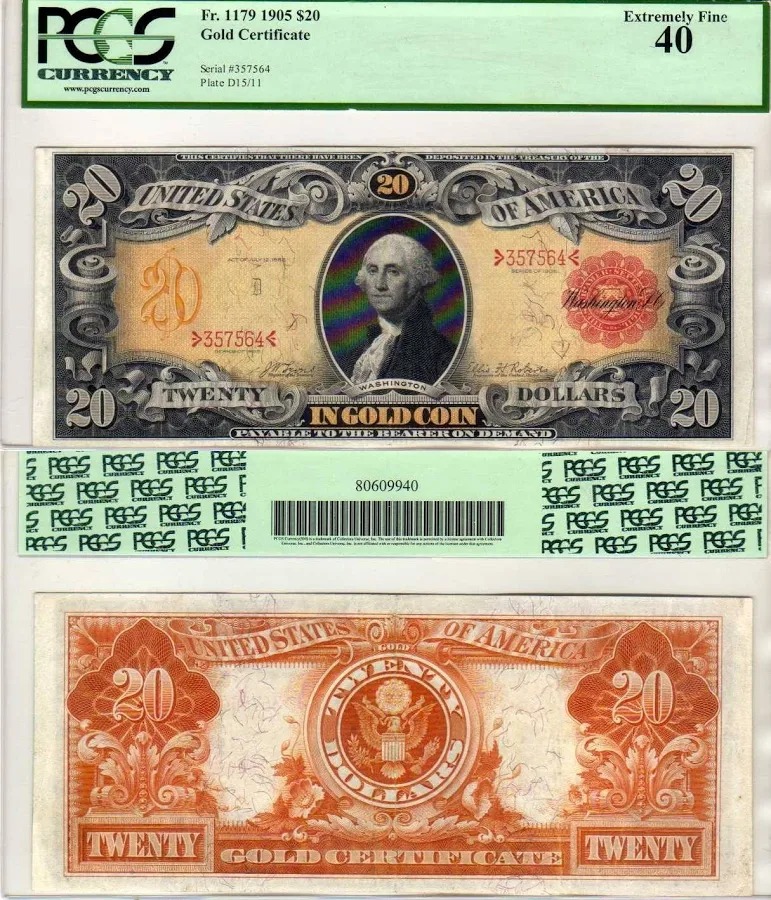
The face of the Series 1905 $20 Gold Certificate features a portrait of George Washington at center, engraved with extraordinary detail. Washington appears in this denomination for Gold Certificates of the era, framed by elaborate scrollwork and lathe-work patterns that were the hallmark of BEP craftsmanship in the Gilded Age and Progressive Era. The background printing on the obverse is executed in a warm golden-yellow ink, setting it immediately apart from the green-tinted Federal Reserve Notes that most Americans associate with paper money even today.
The Treasury seal is printed in a distinctive gold color, relatively small and ornate compared to the large red or blue seals seen on other contemporary currency types. The serial numbers are printed in a deep reddish-gold ink. Running across the top of the note is the legend “GOLD CERTIFICATE” and the redemption clause clearly states the note is payable in gold coin. The signatures appearing on Fr. 1179 are those of Register of the Treasury Judson W. Lyons and Secretary of the Treasury Leslie M. Shaw, a combination that dates the note’s printing to the period between 1902 and 1907.
When examining a Series 1905 $20 Gold Certificate, check the golden obverse ink under a UV light source. Genuine notes show a particular fluorescence pattern consistent with the period inks used by the BEP. Altered or repaired notes often reveal inconsistencies in this area that are invisible under standard lighting.
The Reverse: America’s Most Colorful Currency Back
If the obverse is remarkable, the reverse is genuinely jaw-dropping. The entire back of the Series 1905 $20 is printed in a deep, saturated orange ink, occasionally described in auction catalogs as orange-gold or burnt orange depending on the specific printing impression and the degree of oxidation over time. Large ornate numerals spelling out “20” dominate the corners, and the central design carries elaborate geometric and floral guilloche work typical of BEP engraving at the turn of the century.
This orange reverse was unique among circulating United States currency of its time. No other regularly issued note of the era used such a bold color on its back. The BEP printed the reverse in this manner specifically to add another layer of printing complexity, but the aesthetic result was something far beyond a mere anti-counterfeiting measure. It produced what many collectors and currency historians now consider the single most visually exciting reverse ever put on a piece of American paper money.
The color itself has proven somewhat variable across surviving examples. Notes that remained in high grade storage show a more vivid, almost reddish orange, while circulated pieces that were handled extensively in commerce tend toward a slightly more muted, brownish-orange tone as the ink aged. This makes condition a particularly important factor when evaluating the visual appeal of any individual specimen.
The vibrancy of the orange reverse is one of the most important aesthetic factors affecting the value of this note beyond its technical grade. Two notes graded identically, say PMG 35 Choice Very Fine, can differ substantially in price if one has a bright, saturated orange back and the other shows significant fading or toning. Always request a high-resolution scan of the reverse before purchasing.
Printing Numbers and Survival Rates
The Bureau of Engraving and Printing produced the Series 1905 $20 Gold Certificate in a single signature combination, the Lyons-Shaw pairing cataloged as Friedberg 1179. Estimated print runs for early twentieth century Gold Certificates are notoriously difficult to pin down with precision, since BEP production records from this period were not always preserved in the detail that later runs were. Numismatic researchers working from Treasury records and population report data suggest that somewhere in the range of 1.08 million notes were printed for this series across all deliveries.
Of that original production, survival into the present day is extremely limited. The recall of Gold Certificates following President Franklin D. Roosevelt’s Executive Order 6102 in April 1933 was devastating for the survival of all gold-backed currency. Americans were required to surrender gold certificates along with gold coin and gold bullion, and the vast majority complied. Many Gold Certificates of all series were redeemed and subsequently destroyed by the Treasury. The Series 1905 $20 suffered accordingly. Population reports from the major grading services, specifically PMG and PCGS Currency, show only a few hundred certified examples across all grades combined, with genuinely uncirculated or near-uncirculated survivors numbering in the low dozens at best.
Grading Challenges and What to Look For
Grading the Series 1905 $20 Gold Certificate presents several challenges that collectors must understand before entering the market. First, the golden obverse ink is susceptible to rubbing and wear in a way that standard black ink is not. Even light handling can remove tiny amounts of the surface golden printing, creating what graders call “ink rubs” that reduce a note’s technical grade. Notes with full, unrubbed golden ink are notably scarcer than the overall population might suggest.
Second, paper quality matters enormously. The Treasury paper of this era was high quality but not immune to the effects of moisture, folding stress, and the chemicals used in everyday handling. Many surviving examples show edge tears, corner folds, or staining consistent with circulation. Finding a note with four sharp corners, bright paper, and bold color on both sides is the benchmark of a truly premium specimen.
Third, collectors should be aware that some unscrupulous sellers have attempted to pass off Series 1906 $20 Gold Certificates, which bear the more conventional green reverse, as the rarer 1905 orange-back variety after fraudulent alterations. Always purchase from reputable dealers or through certified holders from PMG or PCGS Currency. Never buy a raw example of this note unless you have deep expertise in authentication.
Population reports from PMG and PCGS Currency are your best starting point for understanding market supply. As of recent counts, PMG has certified fewer than 250 examples of Fr. 1179 in all grades combined, with fewer than 30 grading VF-30 or better. Use these numbers as context when evaluating asking prices, particularly for higher-grade specimens.
Market Values and Auction Highlights
The Series 1905 $20 Gold Certificate commands serious money at auction, and prices have trended upward over the past two decades as collector demand for visually stunning, historically significant notes has intensified. In circulated grades such as VG-10 or Fine-15, examples typically sell in the range of $1,500 to $4,000 depending on color intensity and paper quality. Moving up into the Very Fine range, prices jump considerably, with VF-25 to VF-35 examples regularly fetching between $5,000 and $12,000.
The truly exceptional examples command prices that reflect their status as genuine rarities in the finest known category. A PMG-graded Extremely Fine-45 example sold through a major Stack’s Bowers auction for over $20,000. Uncirculated examples, when they appear, can exceed $50,000. Heritage Auctions and Stack’s Bowers have both handled notable specimens over the years, and each sale generates significant attention from serious collectors of large-size currency.
| Friedberg No. | Series / Signatures | Est. Print Run | Rarity |
|---|---|---|---|
| Fr. 1179 | 1905, Lyons-Shaw (Orange Reverse) | ~1,080,000 | Key Date |
| Fr. 1179 (Gem CU) | 1905, Lyons-Shaw, MS-65 or better | Fewer than 10 known | Key Date |
| Fr. 1179 (VF or better) | 1905, Lyons-Shaw, VF-20 and above | Approx. 30 certified | Rare |
| Fr. 1180 | 1906, Lyons-Shaw (Green Reverse) | ~3,600,000 | Scarce |
| Fr. 1181 | 1906, Lyons-Roberts (Green Reverse) | ~2,400,000 | Scarce |
| Fr. 1182 | 1906, Vernon-Shaw (Green Reverse) | ~1,920,000 | Scarce |
| Fr. 1183 | 1906, Vernon-McClung (Green Reverse) | ~3,120,000 | Common |
| Fr. 1184 | 1906, Napier-McClung (Green Reverse) | ~2,520,000 | Common |
Why Collect It? A Note That Earns Its Place
Some notes are collected primarily for their rarity. Some are collected for historical significance. The best notes in any serious collection check both boxes and then add a third element: pure visual impact. The Series 1905 $20 Gold Certificate does exactly that. It exists at the intersection of American monetary history, BEP printing artistry, and the dramatic story of gold-backed currency in a country that would ultimately abandon the gold standard entirely.
For collectors building a type set of large-size currency, the 1905 $20 is an essential inclusion. For specialists in Gold Certificates, it is the crown jewel of the entire series. And for collectors who simply appreciate currency as wearable art, as a physical record of American ambition and craftsmanship, this note stands in a category essentially by itself. No image on a screen fully captures what it looks like to hold one under proper lighting, to watch the golden obverse shimmer while that deep orange reverse waits on the other side.
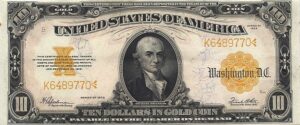
If your budget does not yet extend to a certified example of the Series 1905 $20, consider starting your Gold Certificate collection with a Series 1922 $10 Gold Certificate (Fr. 1173), which is far more available in circulated grades and shares the same golden-ink obverse aesthetic. It makes an excellent companion piece and helps you develop an eye for genuine gold ink versus reproductions before you step up to the 1905 $20.
Conclusion: A Masterpiece That Outlasted Its Era
The Series 1905 $20 Gold Certificate was bold when it was printed, and it is bold more than a century later. The BEP’s decision to use that extraordinary orange reverse was never repeated in exactly the same way on any other widely circulated American note, making the 1905 $20 a genuine one-of-a-kind artifact in the long history of United States paper money. Its survival in any grade is a minor miracle given the mass redemptions of the 1930s. Its survival in high grade is something close to a numismatic miracle.
Whether you are an advanced collector pursuing finest-known examples or a newer enthusiast encountering this note for the first time, the Series 1905 $20 Gold Certificate rewards attention. Study it, pursue it, and if the opportunity and resources align, acquire it. Few pieces of American currency will give you more to look at, more to think about, and more to be proud of in a collection built to last.