📷 Image source: National Numismatic Collection, National Museum of American History (via Wikimedia Commons). Images are selected by AI to represent the article topic and may not depict the exact note(s) described.
Pick up an original Series 1862 or 1863 United States Note and hold it carefully by the edges. Before you read the denomination, before you check the signatures or the seal color, your eye will almost certainly travel to the eagle. Wings fully extended, talons gripping a shield or a cluster of arrows and an olive branch, the bird stares with an intensity that seems almost alive. This was entirely intentional. The engravers employed by the American Bank Note Company and later the nascent Bureau of Engraving and Printing understood that paper money had to project authority with the same conviction as a warship or a battle flag. In the fractured, desperate years of the 1860s, when the Union was fighting for its existence and its paper currency was backed by little more than political will, every line cut into a steel die was a political act.
The Political Context: Why the Eagle Mattered So Much
The Legal Tender Act of February 25, 1862, signed by President Lincoln, authorized the Treasury to issue $150 million in non-interest-bearing notes that would be legal tender for all debts public and private. These were the first true United States Notes, distinct from the earlier demand notes of 1861, and their visual design was assigned enormous political weight. Treasury Secretary Salmon P. Chase understood that ordinary citizens, many of whom had never trusted paper money and whose grandparents remembered the worthless Continental Currency, needed to be convinced. The eagle, the most potent symbol in the American heraldic vocabulary since the Great Seal was adopted in 1782, was the logical centerpiece of that visual argument.
The spread eagle used on the 1862 and 1863 series drew directly from the iconographic tradition established by the Great Seal, but the bank note engravers did not simply copy the official design. They reinterpreted it through the lens of fine-art steel engraving, a discipline that had reached remarkable technical heights in mid-nineteenth-century America. The result was a bird that was simultaneously heraldic and naturalistic, formal and fierce.
The Master Engravers Behind the Steel Dies
Three names stand above all others when discussing the eagle vignettes of the 1860s United States Notes. Charles Burt, born in Edinburgh in 1823 and trained in the finest Scottish tradition of line engraving, had emigrated to New York and joined the American Bank Note Company by the late 1840s. His portrait work was justly celebrated, but his vignette engraving, particularly his treatment of feathers and talons in the eagle compositions, showed a depth of cross-hatching and burnishing that created genuine three-dimensional illusion on flat steel. Burt was responsible for several of the eagle vignettes that appear on the higher denomination notes, including elements of the majestic eagle seen on the Series 1862 $100 Legal Tender Note.
When examining 1860s United States Notes under 5x to 10x magnification, look for the micro-fine cross-hatching in the eagle’s breast feathers. Notes printed from fresh, unworn dies will show crisp, individual lines. Heavily circulated notes or those printed from worn dies will show muddy, merged lines in this area, which directly impacts technical grade and eye appeal.
Frederick Girsch, a German-born engraver who had trained in Frankfurt before arriving in America, contributed several vignettes to the early Legal Tender series. His eagles tend to display a slightly more Romantic European sensibility, with the wing feathers rendered in longer, sweeping strokes that emphasize drama and movement. James Smillie, from yet another dynasty of engraver-immigrants, was responsible for some of the landscape and allegorical vignettes that appear alongside the eagle on multipart compositions, creating the visual hierarchy that guided the viewer’s eye across the note’s face.
These men were not government employees in 1862. The Bureau of Engraving and Printing as a formal institution did not fully assume currency production until 1877. In the early years, private security printing firms, primarily the American Bank Note Company and the National Bank Note Company, held the contracts. This means the eagles on the earliest United States Notes were commercial art produced under government contract, with all the competitive pride and professional rivalry that implies.
Anatomy of the Vignette: Reading the Design
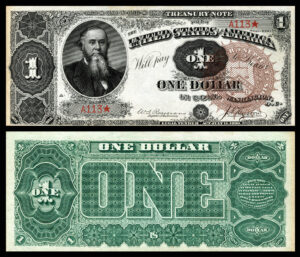
The spread eagle vignettes across the 1862 and 1863 series are not identical, and understanding the distinctions is essential for serious collectors. On the Series 1862 $1 Legal Tender Note, the eagle appears in a relatively compact oval vignette on the left side of the face, wings raised in the classic heraldic pose, with the shield of the United States overlaid on its breast. The engraving is necessarily smaller in scale than on higher denominations, but the detail is not compromised. Under magnification, the individual primary feathers are distinguishable, and the eye of the eagle, a remarkably expressive element given the tiny scale, carries genuine intensity.
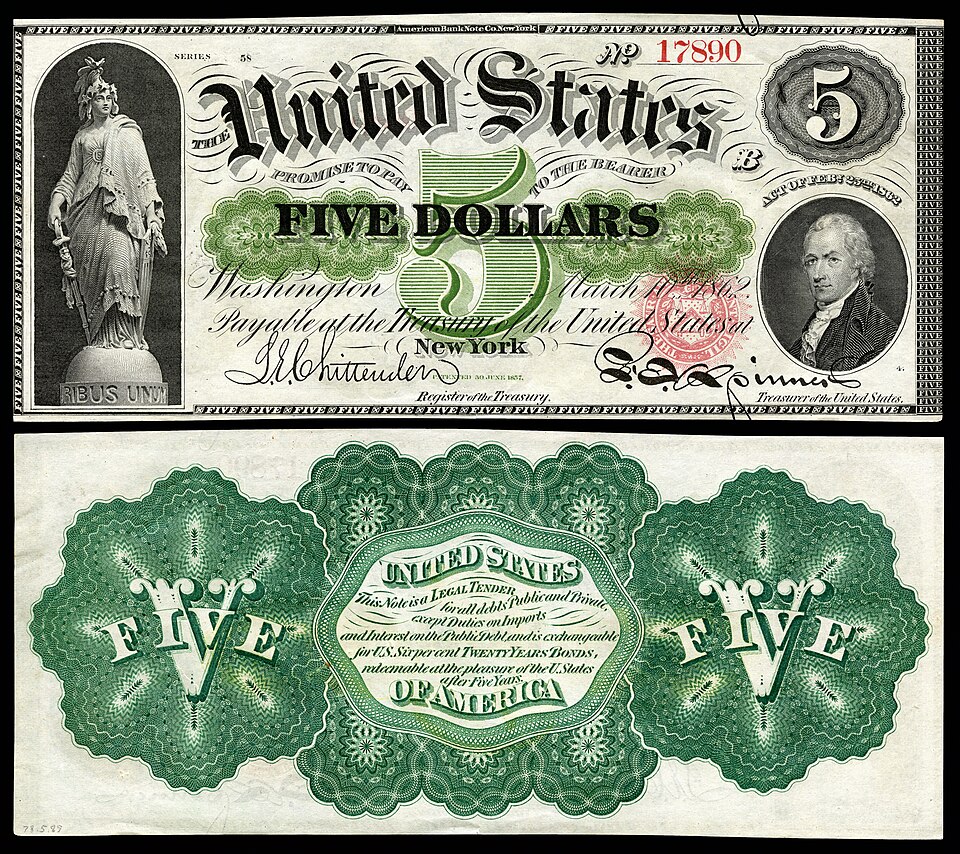
The $5 Series 1862 note, which collectors know as the first type with a small red seal and the signatures of Chittenden and Spinner (Lucius E. Chittenden serving as Register of the Treasury and Francis E. Spinner as Treasurer), features a more elaborate eagle on the upper left. Here the bird is shown with the arrows of war in one talon and the olive branch of peace in the other, the precise iconographic balance prescribed by the Great Seal. The engraver, almost certainly working from a wax model or a detailed ink study provided by the Treasury, has given the olive branch genuine botanical specificity. The leaves are not generic. They have the correct ovate shape of Olea europaea, and the small drupes, the olive fruits, are visible in high-grade examples.
Signature combinations are critical for identifying specific types within the 1862 and 1863 series. The Chittenden-Spinner combination covers the First Obligation notes, while the Colby-Spinner pairing appears on the Second Obligation reverse varieties. Always verify signatures before assigning a type designation, as misidentified notes are surprisingly common in dealer inventories.
The Higher Denominations: Eagles as Monuments
As the denominations rise, the eagle vignettes grow correspondingly in ambition. The Series 1862 $50 Legal Tender Note, one of the genuinely scarce issues in any condition, features an eagle of almost monumental scale occupying a substantial portion of the note’s face. The bird here is more than a symbol. It is an architectural element, as imposing as a carved stone eagle above a courthouse door. The feathers in the wing coverts are rendered with a painterly gradation from dark at the base to light at the tips, a technique that required the engraver to vary the pressure on the burin continuously as he worked, or to use multiple tools of different gauge in succession.
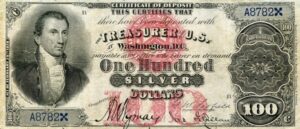
The $100 Series 1862 note, bearing the eagle and shield vignette attributed to Charles Burt’s workshop, is arguably the finest example of this art on any Civil War-era government issue. In uncirculated examples, the depth of the impression, the result of the intaglio printing process forcing damp paper into the recesses of the engraved plate, creates a tactile relief that you can feel with a fingertip. The eagle’s breast shield, with its vertical stripes representing the original states, is a separate compositional element nested within the larger vignette, and Burt’s ability to maintain consistent ink density across two visually distinct design elements in a single composition is a technical achievement that modern observers tend to underestimate.
Typological Variations Across the Series
The 1862 and 1863 United States Notes are divided by collectors into types primarily based on the reverse obligation wording and the seal configuration, but the eagle vignettes themselves went through subtle evolutionary changes. Early printings show crisper, more deeply impressed eagles because the steel dies were fresh. As the war dragged on and print runs expanded to meet the government’s insatiable need for currency, the dies wore, and the resulting impressions became shallower and less defined. By the time the Series 1863 notes were being printed, some plates had seen enough impressions that the finest detail in the feather rendering had been lost.
This die-wear progression is not merely an aesthetic consideration. It is a grading factor with direct economic consequences. A Series 1862 $5 note printed from a fresh die, showing full feather detail in the eagle’s primaries and secondaries and crisp, clean lines in the shield’s striping, will command a premium over an example from a worn die even if both notes are technically in the same circulated grade. PCGS Currency and PMG examiners are trained to note eye appeal separately from technical grade, and die quality is a significant component of that assessment.
When building a type set of 1860s United States Notes, prioritize die quality over technical grade for the lower denominations where fresh-die examples are attainable at reasonable cost. For the $50 and $100 denominations, any genuine example in a problem-free holder represents a significant acquisition, and die quality becomes a secondary consideration given overall scarcity.
Comparing the Eagle to Contemporary Issues
The United States Notes of the 1860s did not exist in a visual vacuum. Confederate Treasury Notes, National Bank Notes, and various state bank issues were all competing for public acceptance during the same period. A comparison is instructive. Confederate notes, particularly the earlier issues of 1861 and 1862, often featured engraved eagles of genuine quality, some produced by the Southern Bank Note Company using pre-war dies. But the Confederacy’s progressive loss of access to skilled engravers and quality steel meant that its eagle imagery deteriorated rapidly across the war years.
The Union’s Legal Tender Notes, by contrast, maintained consistent engraving quality because they drew on the full resources of the New York security printing industry, the most sophisticated in the Western Hemisphere at the time. This visual consistency was itself a form of monetary policy. A note that looked authoritative and permanent was more likely to be accepted at face value by a skeptical merchant or a suspicious soldier.
| Series / Type | Denomination and Signature | Estimated Survivors | Rarity |
|---|---|---|---|
| 1862 Type 1 | $1 Chittenden-Spinner, First Obligation | 600-900 known | Scarce |
| 1862 Type 1 | $2 Chittenden-Spinner, First Obligation | 400-600 known | Scarce |
| 1862 Type 1 | $5 Chittenden-Spinner, First Obligation | 300-500 known | Scarce |
| 1862 Type 1 | $10 Chittenden-Spinner, First Obligation | 200-350 known | Rare |
| 1862 Type 1 | $20 Chittenden-Spinner, First Obligation | 150-250 known | Rare |
| 1862 | $50 Chittenden-Spinner, Any Type | 50-100 known | Key Date |
| 1862 | $100 Chittenden-Spinner, Any Type | 40-80 known | Key Date |
| 1863 Type 2 | $1 Colby-Spinner, Second Obligation | 800-1,200 known | Scarce |
| 1862-63 | $500 and $1,000 Any Signatures | Under 20 known each | Key Date |
| 1862 Type 2 | $5 Chittenden-Spinner, Second Obligation | 700-1,000 known | Common |
Preservation and the Collector’s Responsibility
Because the intaglio printing process creates genuine paper relief, the highest-grade examples of 1860s United States Notes are uniquely vulnerable to handling damage. The raised ink of the eagle vignette, particularly at the wing tips and talon area where the ink deposit is thinnest, will flatten and lose crispness with even gentle contact. This is why serious collectors never slide notes against each other within a currency album and why Mylar holders rather than PVC-containing plastics are essential. The conservation standards that apply to these notes are essentially the same as those for old master prints and etchings, and collectors who approach them with that level of care will preserve both the art and the investment.
Store 1860s United States Notes in archival-quality Mylar D or equivalent polyester holders, never in PVC currency sleeves. PVC off-gasses plasticizers over time that can migrate into the paper and cause irreversible staining and embrittlement. Keep notes flat in a stable environment of 65 to 70 degrees Fahrenheit and 45 to 55 percent relative humidity. Fluctuating humidity is the primary cause of the wave and ripple distortions that cost notes technical grade points at professional grading services.
Conclusion: Art in Service of the Republic
The spread eagle vignettes on 1860s United States Notes represent one of the most successful deployments of visual art in the service of government authority in American history. At a moment when the republic was existentially threatened and its paper currency was regarded by many as an improvised expedient, Charles Burt, Frederick Girsch, James Smillie, and their colleagues cut images into steel that were powerful enough to carry conviction. The notes circulated, the Union endured, and the currency held its value well enough to serve its purpose.
For today’s collectors, these eagles offer something the engravers could never have anticipated: a direct material connection to the most consequential years in American political history, executed with a technical artistry that the mechanized and digital production methods of later centuries cannot replicate. When you examine one of these notes under magnification and trace the individual burin strokes that define a single primary feather, you are reading the handwriting of a craftsman working in 1862 with the full knowledge that his work would circulate in the pockets of soldiers and merchants and farmers across a nation at war. That is not a small thing. It is, in its way, everything.