📷 Image source: Wikimedia Commons. Images are selected by AI to represent the article topic and may not depict the exact note(s) described.
When the Press Room Made History by Mistake
Flip a 1935-E Silver Certificate upside down and you expect the back design to be inverted relative to the face. Now imagine holding a note where the serial numbers and Treasury seal are printed perfectly upside down against an otherwise normal face. That is the reality of an inverted overprint error, and among United States paper money collectors, few mistakes generate more excitement or debate. These notes slipped through quality control at the Bureau of Engraving and Printing during an era when the overprint pass, which added serial numbers, seals, and series designations, was a completely separate mechanical step from printing the primary face and back designs.
Understanding the Three-Pass Printing Process
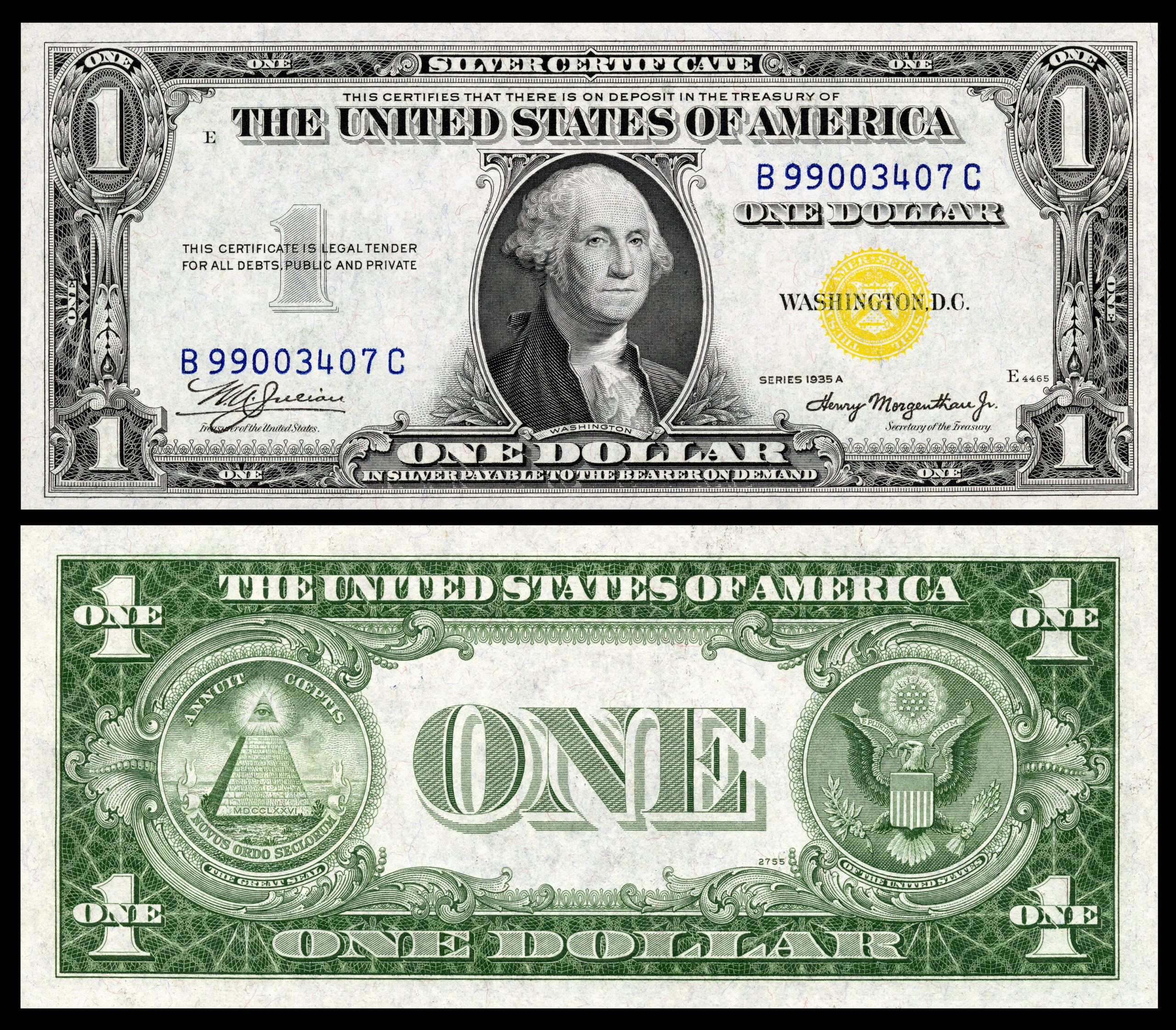
To appreciate why inverted overprint errors exist at all, you need to understand the production sequence at the BEP during the mid-twentieth century. The face and back of every Silver Certificate were printed in separate intaglio passes, producing the deeply engraved imagery we associate with fine currency. After both sides dried and cured, sheets were fed through a third machine for the typographic overprint pass, which applied the blue Treasury seal, the series-specific serial numbers, and the series letter in a single impression.
The critical vulnerability was sheet orientation. Press operators loaded large sheets of 32-subject notes into the overprint press. If a sheet was accidentally fed upside down or rotated 180 degrees, the overprint landed correctly on the paper but appeared inverted relative to the pre-printed face design. Because the serial numbers and seal are typographic rather than intaglio, the error is immediately obvious to any trained eye: the numbers read upside down, the blue seal sits inverted, and the positioning relative to portrait and border is clearly wrong. What is not inverted is everything printed in the first two passes, meaning Washington’s portrait and the “Silver Certificate” and “One Dollar” text appear completely normal.
When examining a suspected inverted overprint Silver Certificate, hold the note face-up and check whether rotating it 180 degrees makes the serial numbers and seal read normally. If yes, you have a genuine inverted overprint. The portrait and surrounding engraved text should remain correctly oriented regardless of how you rotate the note.
The 1935 Series: A Long Production Run with Multiple Opportunities for Error
The 1935 Silver Certificate series had one of the longest production spans of any single denomination design in American currency history, running from initial 1935 printings through the 1935-H suffix in 1962. This extended run meant millions upon millions of sheets passed through BEP overprint presses over nearly three decades, and the probability of occasional misfeeds increased accordingly. Inverted overprints have been confirmed across multiple 1935 suffix varieties, with the 1935-A (Friedberg 1607) and 1935-D (Friedberg 1610) being the most frequently encountered in collector holdings today.
The 1935-A series alone saw production exceeding 8.6 billion notes across its full run, which explains why more examples have survived. However, “more frequently encountered” is strictly relative: genuine confirmed examples in any grade remain genuinely scarce. A 1935-A inverted overprint graded Very Fine-25 by PCGS Currency or PMG typically trades in the $650 to $900 range, while a Gem Uncirculated example, if one can be found, could exceed $2,500 at major auction. The 1935-D inverted overprint commands similar premiums, with circulated examples in Fine-12 to Very Fine-20 range selling for $500 to $750.
The 1935-E, 1935-F, and 1935-G varieties present interesting collecting opportunities because their overall print runs were smaller than the 1935-A and 1935-D. Confirmed inverted overprints from these later suffix series are considerably rarer in population reports. PMG population data shows fewer than a dozen certified examples of 1935-G inverted overprints across all grades, making them legitimate condition rarities worth pursuing aggressively when they appear.
Always insist on notes certified by PMG (Paper Money Guaranty) or PCGS Currency when purchasing inverted overprint Silver Certificates. The error is distinctive but the market has seen altered notes and misrepresented pieces. A certified holder with explicit notation of the error type protects both buyer and seller and supports stronger realized prices at resale.
The 1957 Series: Smaller Window, Equally Dramatic Errors
The 1957 Silver Certificate series, covering the base 1957 (Friedberg 1619), 1957-A (Friedberg 1620), and 1957-B (Friedberg 1621) notes, represented the final chapter of Silver Certificate production before the series was discontinued in 1963 and redemption for silver bullion ended in 1968. The 1957 notes used the same basic $1 face design as the 1935 series but incorporated the new “In God We Trust” motto on the back, making them immediately distinguishable from their predecessors.
Inverted overprint errors from the 1957 series are, by most accounts, somewhat scarcer as a class than their 1935 counterparts, though this reflects the shorter overall production window rather than any special care taken at the BEP. The 1957-A is the most commonly certified inverted overprint from this sub-series, with PMG having certified examples ranging from Fine-15 through Choice Uncirculated-64. The base 1957 inverted overprint is notably harder to locate, and the 1957-B represents the holy grail of this error type across both main series, with a very limited number of authenticated examples known.
Signature combinations matter for 1957 series error notes. The base 1957 carries the Priest-Anderson signature pairing, while 1957-A notes bear Smith-Dillon signatures and 1957-B notes carry Granahan-Dillon signatures. For error specialists who cross-collect by signature variety, the Granahan-Dillon 1957-B inverted overprint is particularly desirable and would be expected to command a significant premium over catalog minimums at auction.
How to Distinguish Genuine Errors from Fakes and Misattributions
The inverted overprint error is one of the more straightforward BEP mistakes to authenticate visually, but collectors still encounter problem pieces. Several key authentication points apply consistently across all genuine examples. First, the blue Treasury seal must be fully inverted, not merely misaligned or shifted. A note with a slightly off-center seal is an interesting variety but not an inverted overprint. Second, both serial numbers (the left and right panels) should be inverted simultaneously and to the same degree, since they were applied in the same overprint pass. Third, the overprint ink should match the characteristic blue used on all Silver Certificate seals of the period, with no color variation suggesting a later alteration.
Watch specifically for notes where someone has chemically treated a damaged note and reapplied overprint elements. Under ultraviolet light, genuine BEP overprint ink on mid-century Silver Certificates shows a specific fluorescent response consistent with period chemistry. Notes with applied or re-inked seals often show brighter or irregularly shaped fluorescence under UV examination, a test any serious buyer should perform before purchasing an uncertified example.
Use a quality UV lamp (365nm wavelength) to check any uncertified inverted overprint Silver Certificate. Genuine BEP blue seal ink from the 1935 and 1957 series shows a muted, consistent glow. Areas showing very bright white or inconsistent fluorescence patterns near the seal or serial numbers warrant serious scrutiny and professional authentication before purchase.
Grading Considerations Specific to Overprint Errors
Grading an inverted overprint Silver Certificate follows the same general standards applied to any currency note, but a few nuances affect collector perception and market value specifically for error notes. Because many of these notes were set aside by curious bank tellers or eagle-eyed recipients shortly after issue, a higher proportion of known examples survived in better grades than typical circulated notes from the same era. This means the grade curve skews slightly toward the Fine-to-Very Fine range for circulated examples and toward the Extremely Fine-to-Uncirculated range for preserved examples, with raw or mid-grade pieces being comparatively less common.
Centering matters significantly for error notes. A well-centered 1935-A inverted overprint graded Very Fine by PMG will consistently outperform a poorly centered example at the same numeric grade. Error collectors tend to be particularly attentive to aesthetics because the note’s value derives largely from its visual drama, and a note with the seal crowding a border undermines the full impact of the error. Ask for high-resolution scans of both faces before purchasing any certified error note sold remotely.
| Series / Friedberg No. | Signature Combination | Known Certified Examples (Est.) | Rarity |
|---|---|---|---|
| 1935 / Fr. 1606 | Julian-Morgenthau | Fewer than 5 | Key Date |
| 1935-A / Fr. 1607 | Julian-Morgenthau | 30 to 50 | Scarce |
| 1935-D / Fr. 1610 | Clark-Snyder | 20 to 35 | Scarce |
| 1935-E / Fr. 1611 | Priest-Humphrey | 15 to 25 | Scarce |
| 1935-F / Fr. 1612 | Priest-Anderson | 10 to 18 | Rare |
| 1935-G / Fr. 1613 | Smith-Dillon | Fewer than 10 | Rare |
| 1935-H / Fr. 1614 | Granahan-Dillon | Fewer than 5 | Key Date |
| 1957 / Fr. 1619 | Priest-Anderson | 10 to 20 | Rare |
| 1957-A / Fr. 1620 | Smith-Dillon | 20 to 30 | Scarce |
| 1957-B / Fr. 1621 | Granahan-Dillon | Fewer than 8 | Key Date |
Market Trends and Where to Find These Notes
The market for inverted overprint Silver Certificates has shown steady appreciation over the past decade, driven partly by broader growth in the error note collecting community and partly by increased mainstream awareness of currency errors through auction house publicity. Heritage Auctions, Stack’s Bowers, and Lyn Knight Currency Auctions have all handled significant examples in recent years, and realized prices have generally trended upward. A 1935-A inverted overprint graded PMG Very Fine-30 that might have sold for $450 in 2010 would likely command $750 to $900 or more today.
For collectors seeking to add an inverted overprint Silver Certificate to their holdings, major auction platforms represent the safest hunting ground because they provide certified notes with full provenance. However, currency shows remain an excellent venue for finding uncertified examples at below-catalog prices from dealers who may not specialize in error notes. The Memphis International Paper Money Show and the Chicago ANA National Money Show both attract dealers with strong error inventory, and having a knowledgeable advisor present for any significant uncertified purchase is worthwhile.
If you find an uncertified inverted overprint Silver Certificate at a show or estate sale, photograph it thoroughly before purchase and cross-reference the serial number prefix against known series production ranges for 1935 and 1957 notes. The serial number prefix should fall within documented ranges for the series identified on the note. Mismatched prefix letters and series years are immediate red flags for altered or misrepresented pieces.
Building a Focused Collection Around This Error Type
Some collectors pursue a type set approach, seeking one example each from the 1935 and 1957 series to represent the error across both major design periods. Others aim for a complete series run, targeting one certified inverted overprint from every suffix letter, which is an ambitious goal given the extreme rarity of 1935, 1935-H, and 1957-B examples. A third approach focuses on condition: building the finest known certified set by targeting only examples grading Extremely Fine-40 or better.
Any of these strategies produces a collection with genuine historical resonance. These notes represent not just printing accidents but windows into mid-century manufacturing processes, quality control standards, and the remarkable fact that small quantities of dramatically flawed currency escaped notice through multiple inspection points before reaching public circulation. Each inverted overprint Silver Certificate tells a complete story in a single object, and that narrative power is precisely why they continue to captivate collectors across all experience levels.
Final Thoughts
Inverted overprint errors on 1935 and 1957 Silver Certificates occupy a special place in American error note collecting, combining visual impact, genuine scarcity, and deep historical context in a single affordable denomination. Whether you are a new collector attracted by the dramatic appearance of upside-down blue seals and serial numbers, or an experienced numismatist filling a specific gap in an advanced error collection, these notes reward careful study and patient pursuit. Know your authentication points, insist on third-party certification for significant purchases, and consult current population reports before committing to catalog-level prices. The right example, properly verified, is a genuinely important piece of United States currency history.