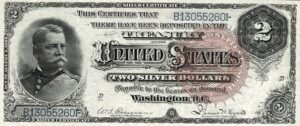
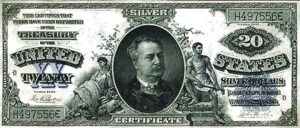
Pick up a Series 1875 $5 United States Note at a coin show and you will almost certainly be drawn first to the reverse. Dominating the green-inked back is an elaborate allegorical vignette sometimes called the “Pioneer Family” or “Family Back” scene: a pioneer family encamped in a frontier wilderness, with a man standing watch, a woman tending to children, and the vast American landscape stretching behind them. It is romantic, optimistic, and absolutely unmistakable. What many collectors do not realize until they dig deeper is that this single series designation covers at least six distinct signature combinations, two distinct seal varieties, and a handful of plate-letter curiosities that can separate a $400 note from a $4,000 one. Understanding those distinctions is the whole game with the 1875 fives.
Setting the Stage: Legal Tender Notes Before 1875
The $5 United States Note, colloquially a “Legal Tender” note, had been in continuous production since the Act of February 25, 1862, which authorized the original Demand Notes’ successors. By the early 1870s, the Bureau of Engraving and Printing was refining both its security printing techniques and its artistic ambitions. The Series 1869 $5 “Rainbow Note” (Fr. 64) had already introduced bold color work, with its distinctive red and black obverse and the Columbus at San Salvador vignette. But the 1875 issue represented a full redesign of the reverse plate, replacing the earlier green lathe-work pattern with the expansive Pioneer Family scene engraved by Charles Schlecht after a painting in the tradition of westward expansion imagery so popular in post-Civil War America.
The obverse of the 1875 $5 retained the portrait of Andrew Jackson at center-left and a vignette of “Pioneer Female” or “Pocahontas” at the right, with the obligation text reading “The United States Will Pay To The Bearer Five Dollars” surrounded by ornate engraving. The small red Treasury seal with spiked rays at the right side of the obverse became the defining visual anchor for the entire 1875 family of notes.
Why “Series 1875” Is More Complicated Than It Looks
Here is where new collectors frequently stumble. Unlike modern Federal Reserve Notes where a series letter simply indicates a new signature combination, the 1875 designation covers notes produced over a span of roughly eight years, from approximately 1875 through the early 1880s. Each time the Treasurer of the United States or the Register of the Treasury changed, a new variety was created. The Friedberg catalog, the standard reference for large-size U.S. paper money written by Arthur L. Friedberg and Ira S. Friedberg, assigns separate catalog numbers Fr. 67 through Fr. 72 to distinguish these combinations.
Always identify the signature combination before pricing a Series 1875 $5. The difference between Fr. 67 (Allison/New) and Fr. 71 (Allison/Gilfillan) can be $800 or more in Very Fine condition. Buy a copy of the Friedberg “Paper Money of the United States” guide and mark the signature plates on pages covering Legal Tender fives. It will pay for itself on your first purchase.
The six primary Friedberg varieties break down as follows. Fr. 67 carries the signatures of John Allison as Register and John C. New as Treasurer, a short-lived pairing from 1875. Fr. 68 pairs Allison with A.U. Wyman, covering 1876 through 1877. Fr. 69 is Allison with James Gilfillan, spanning 1877 through 1878. Fr. 70 features S.B. Colby as Register with Gilfillan, a very brief pairing that produced one of the scarcest varieties in the series. Fr. 71 returns to Allison with Gilfillan but on a different plate series, while Fr. 72 pairs William Allison with Gilfillan in the final production run. Compounding the confusion, some references list additional plate-letter sub-varieties, particularly for Fr. 69 and Fr. 71, where production runs were long enough to require multiple obverse plate groups.
Reading the Note: A Step-by-Step Attribution Guide
When you pick up a Series 1875 $5, follow this sequence. First, confirm it is indeed a Legal Tender note by reading the obligation clause above the serial number. It should state the bearer obligation rather than the National Currency or Silver Certificate language. Second, locate the Treasury seal on the obverse. For all 1875 varieties, this should be a small red seal with pointed rays radiating outward, positioned to the right of center. If you see a large red seal, you are looking at a Series 1880 note, not 1875. Third, read the two facsimile signatures printed on the obverse: the Register signature appears on the left and the Treasurer signature appears on the right. Write them down before consulting your reference.
The small spiked red seal on 1875 Legal Tender notes can sometimes appear orange or brownish due to ink oxidation and washing over the past 140-plus years. Do not confuse a darkened 1875 seal with the larger seal format used on 1880 series notes. Compare the seal diameter and the ray pattern rather than relying on color alone.
Fourth, check the serial number prefix and suffix letters. While not always definitive for attribution, the letter block can help confirm a variety when cross-referenced with known production records. Most 1875 fives carry serials in the A-prefix or early letter blocks without a suffix, though later plate runs pushed into higher letter groupings. Fifth, examine the plate position letter, typically found as a small letter in one of the corners of the obverse. This is a minor detail but useful for specialists tracking specific plate marriages.
The Pioneer Family Reverse: Artistic and Historical Context
The reverse vignette deserves more attention than it typically receives in standard price guides. The scene is printed entirely in green, consistent with the legal tender obligation tradition, and measures roughly 2.5 by 1.5 inches within the overall note format of 7.375 by 3.125 inches standard for large-size currency. The central group shows a seated woman with children, suggesting domesticity and settlement, while a standing male figure at the left holds a rifle, symbolizing protection and the frontier spirit. Trees frame the scene and distant hills suggest the boundlessness of the American West.
This imagery was not accidental. The 1870s were the height of westward expansion mythology in American culture, coinciding with the era of the Homestead Act’s implementation and the completion of the transcontinental railroad in 1869. Treasury officials and Bureau of Engraving and Printing artists were deliberately evoking national themes in currency design, making the Pioneer Family back one of the most thematically coherent designs in 19th-century U.S. paper money.
The design remained in use across the subsequent Series 1878 and Series 1880 $5 Legal Tender issues, with the major change in 1880 being the shift to a larger Treasury seal. This continuity of the reverse design means that dealers sometimes loosely group all “Pioneer Back” fives together, which is a cataloging shortcut that can mislead new collectors about which series they are actually examining.
Condition Realities and Grading Challenges
Series 1875 $5 notes are large-size notes produced over 140 years ago, and survivors in anything above Fine condition are genuinely scarce for all but the most common varieties. The green reverse ink is relatively stable, but the red Treasury seal on the obverse is notoriously prone to fading and can show significant color loss even on technically Uncirculated examples that have been improperly stored. PCGS Currency and PMG, the two leading third-party grading services for paper money, both note seal color as a factor in their grading narratives for 19th-century Legal Tender issues.
When buying a raw (ungraded) Series 1875 $5, pay particular attention to the paper quality along the margins and at the corners. Large-size notes were often folded for storage, and the 1875 fives frequently show a heavy center fold or corner folds that reduce technical grade significantly. A note with a bold red seal and sharp margins in VF or better is worth submitting to PMG or PCGS Currency before selling, as the certification often reveals a premium over the raw asking price.
In terms of market values as of recent auction results and dealer price lists, the common Fr. 67 (Allison/New) in Very Good condition typically trades between $200 and $300, rising to $450 to $600 in Fine and $900 to $1,400 in Very Fine. Genuine Uncirculated examples of common varieties command $3,500 to $6,000 depending on eye appeal and seal strength. The rarer Fr. 70 (Colby/Gilfillan) is dramatically more valuable at every grade level, with even circulated examples in Good to Very Good condition reaching $1,500 to $2,500, and Fine survivors in the $4,000 to $7,000 range based on Heritage Auctions and Stack’s Bowers results from 2019 through 2023.
Serial Number Ranges and What They Tell You
Complete certified production figures for individual 1875 series varieties are difficult to reconstruct precisely because Treasury Department printing records from this period were not preserved with the same detail as 20th-century issues. However, research by Don Kelly and others working from surviving ledger fragments and population report data suggests the following approximate hierarchy: Fr. 68 (Allison/Wyman) and Fr. 69 (Allison/Gilfillan) represent the largest production runs, likely in the hundreds of thousands of notes each. Fr. 67 (Allison/New) had a shorter printing window due to New’s brief tenure, with estimates placing the total below 100,000 notes. Fr. 70 (Colby/Gilfillan) is the key rarity, with total issuance estimated at fewer than 40,000 notes, and surviving population reports from PMG show fewer than 30 certified examples across all grades.
| Friedberg No. | Signature Combination | Est. Print Run | Rarity |
|---|---|---|---|
| Fr. 67 | Allison / New | Approx. 80,000 | Scarce |
| Fr. 68 | Allison / Wyman | Approx. 300,000+ | Common |
| Fr. 69 | Allison / Gilfillan | Approx. 400,000+ | Common |
| Fr. 70 | Colby / Gilfillan | Approx. 35,000 | Key Date |
| Fr. 71 | Bruce / Gilfillan | Approx. 200,000 | Common |
| Fr. 72 | Bruce / Wyman | Approx. 60,000 | Scarce |
| Fr. 70 (VF or better) | Colby / Gilfillan, high grade | Under 30 certified | Rare |
| Fr. 67 (CU) | Allison / New, Uncirculated | Under 10 known CU | Rare |
Building a Type Set Versus a Variety Set
The collecting approach you choose will dramatically affect your budget and hunting strategy. A type collector who simply wants one example of the Pioneer Family back design in their large-size Legal Tender type set should target Fr. 68 or Fr. 69 in Fine to Very Fine condition. These are the most available varieties, they appear regularly at major currency shows and in Heritage, Stack’s Bowers, and Lyn Knight auctions, and they offer excellent value for the historical significance they represent. Budget $400 to $700 for a decent Fine example and you will own a piece of Reconstruction-era American financial history that displays beautifully in a holder.
A variety collector attempting to complete all six Friedberg numbers faces a genuinely formidable task anchored by Fr. 70. Be prepared to wait years for a problem-free Fr. 70 to surface at auction, and budget accordingly. Even a Good or Very Good example of Fr. 70 represents a five-figure acquisition. Most advanced collectors of 19th-century Legal Tender notes consider a complete set of the 1875 $5 varieties to be a major accomplishment, on par with completing the 1869 series or the Large Brown Seal Legal Tender issues of the 1860s.
If you are building a variety set of the 1875 fives, register with Heritage Auctions and Stack’s Bowers for email notifications on U.S. Legal Tender notes. Also monitor the Currency Exchange International and smaller regional currency auctions, where 19th-century Legal Tender notes sometimes surface from estate collections at prices below major-house levels. Patience combined with consistent monitoring beats aggressive bidding at a single auction every time.
Authentication Concerns
The Series 1875 $5 is old enough and valuable enough to attract both altered notes and outright counterfeits, though genuine counterfeits of 19th-century large-size notes are far less common than altered dates or washed notes presented as higher grade. The primary authentication concern with the 1875 fives is cleaning and pressing: notes that have been chemically washed to restore brightness and then physically pressed to reduce folds are unfortunately common in the marketplace. Third-party certification is the most reliable protection. Both PMG and PCGS Currency will note cleaning or pressing in their grading commentary, and a note labeled “Apparent” (PMG) or “Details” (PCGS) for those issues should trade at a significant discount to problem-free examples.
Conclusion: A Worthy Challenge for Serious Collectors
The Series 1875 $5 United States Note rewards the collector who takes the time to understand it fully. The Pioneer Family reverse is one of the genuinely great designs in American currency art, a window into the national mythology of a nation still defining itself after the Civil War. The attribution challenges are real but surmountable with the right references, a methodical approach to signature identification, and the discipline to verify rather than assume. Whether you are adding a single type example or embarking on the full variety run, the 1875 fives offer a depth of numismatic interest that far exceeds their relatively modest collector population. Start with a solid Fine example of Fr. 68, hold it in good light, and let the engraver’s craft do the rest of the convincing.