Pull a note from an old collection binder and hold it up to a light source. If you notice a faint greasy sheen, a yellowish film, or paper that seems oddly brittle despite having sharp corners, you may be looking at a note that has been quietly destroyed by chemistry. Chemical damage to paper currency is insidious precisely because it often develops slowly, invisibly, and irreversibly. A Federal Reserve Note that grades Extremely Fine on its face can harbor internal degradation that will cause it to crumble, discolor, or literally dissolve its own fibers over the next twenty years. Understanding the three primary categories of chemical damage, solvent exposure, PVC migration, and acid deterioration, is not optional knowledge for serious collectors. It is foundational.
Chemical Damage to Currency: How to Identify Solvent Exposure, PVC Migration, and Acid Deterioration in Paper Money
12 min read
Why Chemistry Matters in Currency Collecting
American currency is printed on a specialized cotton-linen fiber blend, approximately 75% cotton and 25% linen, sourced exclusively through Crane and Co. since the 1870s. This substrate is remarkably durable under normal conditions. A circulated note can survive folding, moisture, and general handling for years. What it cannot easily survive is prolonged contact with reactive chemicals. The problem is that reactive chemicals appear in the most mundane collecting supplies: the soft plastic sleeve you bought at a coin show in 1988, the cardboard album with a pleasant vanilla smell, the rubber band your grandfather used to bundle his Silver Certificates.
Third-party grading services including Paper Money Guaranty (PMG) and PCGS Currency issue what collectors call a “body bag,” meaning the note is returned ungradable with a notation, when chemical damage is detected. A body-bagged note carries essentially no premium over face value in most cases. For a note that might otherwise grade PMG 64 Choice Uncirculated and catalog at several hundred to several thousand dollars, that is a catastrophic financial loss. The 1928 $500 Federal Reserve Note, for example, catalogs around $2,500 in PMG 30 Very Fine, but a chemically damaged example of the same note is nearly unsaleable to serious buyers regardless of its visual appearance.
Solvent Exposure: The Collector’s Cleaning Problem
Solvent damage is almost always the result of human intervention. Somewhere along a note’s life, someone decided it needed cleaning. The most common culprits are acetone, lighter fluid (naphtha), rubbing alcohol (isopropyl), and commercial paper-cleaning products marketed directly to collectors in the 1950s through 1980s. These solvents were used to remove stains, brighten paper, lift grime from circulated notes, and, in the worst cases, to artificially “press” crumpled notes to look uncirculated.
Acetone is particularly problematic because it evaporates quickly, leaving little obvious residue, yet it disrupts the surface fibers of the cotton-linen substrate at a microscopic level. Under ultraviolet (UV) light, solvent-cleaned notes often display uneven fluorescence, appearing as dark patches or “dead zones” where the paper’s natural brightening agents were stripped away. A genuine uncirculated note under UV typically glows with a relatively uniform blue-white response. A solvent-cleaned note shows splotchy, inconsistent reaction.
Naphtha-cleaned notes sometimes retain a faint petroleum odor for years, which is itself a diagnostic clue when examining older currency. Notes cleaned with alcohol often show fine fiber disruption along the surface, visible under 10x magnification as a slightly fuzzy or “raised grain” texture rather than the smooth, hard surface of genuine uncirculated paper.
Before purchasing any high-value pre-1950 note from a private seller, examine it under both UV light and a 10x loupe. Solvent damage frequently reveals itself as uneven UV fluorescence or disturbed surface fibers that are invisible to the naked eye but obvious under magnification. This $30 investment in equipment can save you from a $3,000 mistake.
Identifying Solvent Damage in the Field
The visual tells for solvent exposure include: an unnaturally bright or “washed out” appearance to the ink; loss of the subtle color gradients visible in genuine uncirculated intaglio printing; paper that feels slightly stiff or waxy rather than naturally crisp; and in severe cases, actual tide lines or ghost stains where the solvent carried dissolved dirt to the edges of the note before evaporating. Large-size notes from the 1861 to 1923 era are disproportionately affected because collectors of that era routinely cleaned currency with little understanding of the long-term consequences.
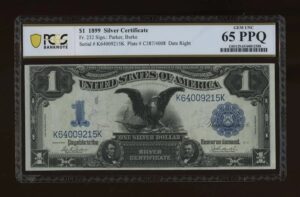
A specific example worth knowing: many of the 1899 $1 Silver Certificates (Fr. 226 through Fr. 236) that appear on the market in grades ranging from Very Fine to Extremely Fine have been lightly cleaned at some point. The series is common enough that genuine examples in original mid-grade circulated condition are easy to find, so any note in this series that looks brighter than expected for its stated grade warrants careful scrutiny.
PVC Migration: The Slow Poison in Your Binder
Polyvinyl chloride, or PVC, is the chemical villain most discussed in currency and coin collecting circles, and for good reason. Soft PVC plastic requires chemical plasticizers to remain flexible, and these plasticizers are not chemically bonded to the plastic matrix. They off-gas and migrate freely, particularly under heat or pressure, transferring directly onto anything they contact for extended periods. Currency stored in soft vinyl album pages, commercial three-ring binder sleeves from the 1970s and 1980s, and many early “currency collecting” products is at serious risk.
The process is slow but cumulative. After five to ten years of contact, a note may develop a faint, slightly greasy film that initially looks like minor surface contamination. After twenty to thirty years, PVC migration manifests as a yellowish to greenish oily film, often described in grading notes as “PVC haze.” The plasticizers chemically react with the cellulose in the paper and with the oil-based inks used in currency printing, causing both to break down. At advanced stages, PVC-damaged paper becomes brittle and discolored, and the damage is irreversible.
The collecting generation that was most active in the 1960s through 1980s frequently stored notes in products by companies like Whitman, H.E. Harris, and various generic album manufacturers that used soft PVC pages. Collections assembled during that era and inherited or purchased today may contain notes that look superficially presentable but are actively degrading. The problem accelerated in climate-controlled storage that ran warm, since heat dramatically increases plasticizer migration rates.
To test whether a holder or album page contains PVC, touch it and notice whether your fingers feel slightly greasy or tacky afterward. Safe materials like Mylar D (biaxially oriented polyester) and polypropylene feel dry and slick. If an album page smells faintly sweet or chemical and feels tacky, remove your notes immediately and store them in inert holders while the notes air out in a controlled environment.
Which Notes Are Most Vulnerable to PVC Damage
In practical terms, PVC migration is most commonly seen on notes from the 1928 to 1969 series range, because these are the notes that were actively collected and stored during the peak PVC-product era. Large-size notes pre-dating 1923 were often stored in paper envelopes or album books with paper pages, which avoided PVC but introduced acid problems (discussed below). Small-size notes from the 1928 through 1963 series, including Gold Certificates, Silver Certificates, United States Notes (Legal Tender Notes), and early Federal Reserve Notes, were heavily collected during the PVC era and are disproportionately affected.
Star notes from the 1934 and 1934-A series of $500 and $1,000 Federal Reserve Notes are a particular concern. These notes are rare enough that collectors sometimes acquire examples without proper examination, and PVC-damaged examples occasionally appear at auction with optimistic descriptions. The 1934-A $1,000 Federal Reserve Note in Chicago (Fr. 2212) has a print run of roughly 48,000 notes across all districts combined, and a PVC-damaged example loses the substantial premium that a clean, original-surface example commands.
Acid Deterioration: The Hidden Enemy in Paper Itself
Acid deterioration operates differently from solvent or PVC damage. Rather than an external chemical attacking the note, acid deterioration often originates from within the storage materials surrounding the note, or in some cases from the note’s own printing components. Wood-pulp-based paper, cardboard album backings, and certain adhesives all contain lignin, which breaks down over time into acidic compounds. These compounds migrate into the cotton-linen substrate of the currency and catalyze a process called hydrolytic degradation, which breaks the cellulose chain polymers that give paper its strength and flexibility.
The visual result is a note that yellows or browns unevenly, often starting at the edges and working inward in a pattern numismatists describe as “foxing” when it appears as small brown spots, or “toning” in the broader sense. More advanced acid deterioration produces paper that is genuinely brittle, tearing easily at folds and crumbling at corners. Notes stored in wooden display frames, in non-archival cardboard boxes, or alongside newspapers or other highly acidic materials for decades frequently show this pattern.
Large-size Demand Notes from 1861 and the early Legal Tender Notes from 1862 to 1863 are particularly at risk, since many survivors have spent over a century in exactly these kinds of storage environments. A Fr. 16 $5 Legal Tender from 1862 in a genuine Fine to Very Fine grade without acid damage is worth approximately $800 to $1,200. An example with significant acid foxing and edge brittleness may sell for under $200 even with an identical visual grade assessment at first glance.
When storing notes long-term, use only archival-quality materials with a neutral pH (7.0) or slight alkaline buffer (pH 7.5 to 8.5). Gaylord Archival, University Products, and Light Impressions all manufacture currency-safe enclosures. Never store currency in wooden boxes, near newspaper clippings, or in standard manila envelopes, all of which are highly acidic. A simple pH testing pen (available for under $10) can tell you whether a storage material is safe before you commit your notes to it.
Diagnosing Acid Damage vs. Natural Age Toning
This is where even experienced collectors sometimes struggle. Natural, even toning on a large-size note can actually add character and, in the opinion of many collectors, authenticity. What distinguishes problematic acid damage from benign age toning is the pattern and structural integrity of the paper. Acid-damaged notes show toning that is irregular, often concentrating near edges and fold lines where paper-to-paper or paper-to-storage-material contact was greatest. The paper itself may feel thin or fragile compared to a similar note without acid exposure. Under a loupe, surface fibers may appear disrupted or separated.
Benign age toning, by contrast, tends to be more even across the note’s surface, and the paper retains its structural integrity. The ink colors remain true, if somewhat subdued. The note bends without cracking. Third-party graders at PMG and PCGS Currency distinguish between these conditions in their grading notes, and buyers should pay careful attention to qualifiers like “toning,” “staining,” and especially “paper issues” or “chemical alteration” in auction lot descriptions.
| Series / Friedberg No. | Denomination and Type | Approx. Known Population | Damage Risk Level |
|---|---|---|---|
| 1899 $1 Silver Certificate (Fr. 226-236) | $1 Black Eagle SC | Common, thousands known | Solvent Risk: High |
| 1928 $500 FRN (Fr. 2200-2200G) | $500 Federal Reserve Note | Scarce, under 1,000 known across districts | PVC Risk: High |
| 1934-A $1,000 FRN (Fr. 2212) | $1,000 Chicago FRN | Rare, approx. 48,000 printed all districts | PVC Risk: High |
| 1862 $5 Legal Tender (Fr. 61-63) | $5 First Issue Legal Tender | Scarce survivors in original condition | Acid Risk: Very High |
| 1861 Demand Note (Fr. 1-5) | $5/$10/$20 Demand Notes | Very rare in undamaged state | Acid Risk: Critical |
| 1934 $10 Silver Certificate (Fr. 1700) | $10 Blue Seal SC | Common, but PVC-era storage common | PVC Risk: Moderate |
| 1922 $50 Gold Certificate (Fr. 1200) | $50 Large-Size Gold Cert. | Scarce, most survivors show acid toning | Acid Risk: High |
| 1928 $1 Legal Tender (Fr. 1500) | $1 Red Seal USTN | Scarce series, PVC storage era common | PVC Risk: High |
What to Do If You Suspect Chemical Damage
First and most importantly, do not attempt to clean or treat the note yourself. Well-meaning DIY remediation attempts, including rinsing with distilled water, applying acetone to remove PVC residue, or using commercial paper-restoration products, almost universally make the damage worse and will guarantee a body-bag result from any grading service. The temptation is understandable: a note with a greasy PVC film looks like it should be washable. It is not, at least not by amateur hands.
If you have a note of significant value that shows signs of chemical damage, the appropriate step is consultation with a professional paper conservator who has experience with archival documents. The American Institute for Conservation (AIC) maintains a directory of certified conservators. For notes of lower value, the realistic answer is often that treatment costs will exceed the note’s market value, and the note should be stored in an inert, archival enclosure to prevent further deterioration, then marketed honestly as a damaged example.
For notes you are considering purchasing, the best protection is buying only from reputable dealers, insisting on third-party graded holders for any note valued above $100, and developing the examination skills described throughout this article. The cost of a UV light and a quality loupe is trivial compared to even a single bad purchase.
Safe Storage: The Practical Checklist
Transitioning an existing collection to safe storage begins with a complete audit of your current holders. Remove all notes from soft vinyl pages immediately. Mylar D sleeves, sold by companies like Lighthouse and Guardhouse under product names like “Supersafe” and “Currency Sleeves,” are the gold standard for individual note storage. For binders, use pages made from polypropylene or polyethylene, not PVC. Store filled binders horizontally to reduce stress on note edges, and keep storage areas at stable temperature below 70 degrees Fahrenheit with relative humidity between 30% and 50%. Fluctuating humidity is particularly damaging because it causes the paper to expand and contract repeatedly, accelerating both mechanical and chemical degradation at fold lines and edges.
Conclusion: Chemistry as a Collecting Discipline
The chemistry of currency damage may seem like an arcane subspecialty, but in practice it is the difference between a collection that appreciates in value and one that quietly destroys itself in a drawer. The collectors who consistently acquire notes at correct prices and maintain their condition over time are invariably those who have taken the time to understand what they cannot see as well as what they can. A 1928-B $2 Legal Tender (Fr. 1502) in PMG 66 Gem Uncirculated with original surfaces commands a strong premium precisely because surviving examples in that condition are scarce, and they are scarce in large part because chemical damage claimed so many others over the past century. Understanding why those notes were lost is the first step toward ensuring yours are not among the next casualties.