On April 2, 1865, as Ulysses S. Grant’s forces finally broke through the Petersburg lines and Jefferson Davis received the telegram that would force him to flee Richmond, the Confederate Treasury Department faced an impossible task. Vaults that had once held tens of millions in paper currency were being hastily emptied, ledgers burned, and plates packed onto railcars headed south. The story of Confederate currency in its final weeks is not merely a footnote to military history. It is a collector’s labyrinth of overprinted notes, emergency issues, partially signed obligations, and ghost-print curiosities that continue to command serious attention at auction more than 150 years later.
George Trenholm: The Banker Who Couldn’t Save the Confederacy
George Alfred Trenholm of Charleston, South Carolina, assumed the office of Confederate Treasury Secretary on July 18, 1864, succeeding Christopher G. Memminger, who had resigned under enormous pressure after years of failed monetary policy. Trenholm was by all accounts a more sophisticated financial mind. As the senior partner of Fraser, Trenholm and Company, one of the most successful blockade-running enterprises in the South, he had genuine experience moving money and goods through hostile conditions. He also had a personal fortune that dwarfed most of his contemporaries in Richmond.
But Trenholm inherited a disaster. By mid-1864, Confederate currency had already undergone one catastrophic devaluation following the Currency Reform Act of February 17, 1864, which forced holders of older notes to exchange them at a rate of two dollars in old currency for one dollar in new. Inflation was severe enough that a barrel of flour in Richmond cost over $300 in Confederate notes by January 1865. The notes Trenholm was responsible for were the Type 70 through Type 72 issues authorized by the 1864 Act, printed by Keatinge and Ball of Columbia, South Carolina, and later by a scattered set of printers as facilities were threatened by Sherman’s march.
When examining Series of 1864 Confederate notes (Criswell Types 63-72), pay close attention to the paper quality and printing registration. Notes printed in the final months of the war often show noticeably uneven ink distribution and rough paper stock compared to earlier Keatinge and Ball issues. This deterioration in production quality can itself be a dating clue and adds historical context that sophisticated collectors appreciate.
The February 1864 Act Issues: What Collectors Actually Hold
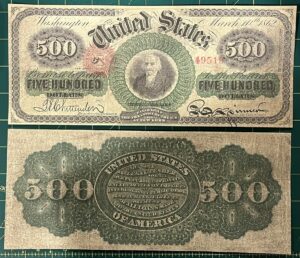
The bulk of late-war Confederate currency that collectors encounter today stems from the February 17, 1864 legislative authorization. These notes were issued in denominations of $500, $100, $50, $20, $10, $5, $2, and $1. The $500 denomination (Criswell Type 64) is particularly notable. Featuring a vignette of General Stonewall Jackson on the left and a Confederate flag vignette, it was authorized but issued in extremely limited quantities. Circulated examples in Very Good (VG-10) condition have sold at Heritage Auctions for $700-$1,200, while problem-free Fine examples can reach $2,000 or more.
The $100 note (Criswell Type 65) bearing the portrait of Lucy Pickens is among the most recognized Confederate notes in the hobby. It was issued in far greater quantities but still represents the cleaner end of late-war printing. The $50 notes of this series (Types 66 and 67) feature Jefferson Davis and were produced in the millions, making circulated examples relatively accessible at $40-$100 in lower grades. What collectors often overlook, however, is the significance of the serial number ranges on these late issues. Serial numbers above approximately 80,000 on the $50 Type 67 notes are believed to represent printings from late 1864 through early 1865, and these can sometimes be tied to specific printing batches through research in the Grover Criswell and Pierre Fricke reference catalogs.
Columbia Burns: The Printer Flees
On February 17, 1865, exactly one year after the Currency Reform Act, General William T. Sherman’s army entered Columbia, South Carolina. The Keatinge and Ball printing facility, which had relocated from Richmond to Columbia in 1862 to escape earlier threats, was either destroyed in the fires that swept the city or hastily abandoned. Some accounts suggest that printing plates for Confederate notes were buried or hidden. A small number of notes believed to have been printed in the chaotic period between January and mid-February 1865 show anomalies consistent with rushed production: missing countersignatures, incomplete serial numbering, and in a handful of documented cases, sheets that were cut but never formally issued.
These transitional notes are among the most intriguing pieces in Confederate numismatics. Pierre Fricke’s comprehensive reference work Collecting Confederate Paper Money (Field Edition) provides the most current scholarship on identifying these late printings and distinguishing genuine production irregularities from post-war alterations or counterfeits.
Confederate notes with missing or incomplete handwritten countersignatures are not automatically more valuable. Authentication is critical. Many unsigned or partially signed notes were the result of post-war souvenir hunting, trimming, or deliberate alteration. Before paying a premium for an unsigned 1864-series note, consult the Professional Currency Dealers Association (PCDA) grader notes or submit the piece to PCGS Currency or PMG for encapsulation with comments.
John H. Reagan and the Fleeing Treasury
George Trenholm’s health collapsed under the strain of the final months. He resigned as Treasury Secretary on April 27, 1865, nearly three weeks after Davis had fled Richmond. The man who stepped into the role was John H. Reagan of Texas, who had served as Confederate Postmaster General throughout the war and was traveling with the Confederate government’s flight south through the Carolinas and into Georgia.
Reagan’s tenure as acting Treasury Secretary lasted only days in any practical sense. By early May, Jefferson Davis had been captured near Irwinville, Georgia on May 10, 1865. The Confederate government ceased to exist as a functioning entity. The currency Reagan theoretically presided over was already being used as wallpaper in Richmond homes and as wrapping paper in Southern shops, a practice well-documented in contemporary diaries and newspapers.
What is numismatically significant about this final period is the set of notes that were literally in transit when the war ended. Treasury officials traveling with the fleeing cabinet carried bags and boxes of unissued currency, including fresh Series of 1864 notes that had never entered circulation. Some of these notes found their way into private hands as the Confederate column dispersed. Notes that can be documented as part of the “treasure train” provenance, through family letters, estate records, or early dealer correspondence, carry substantial premium interest among advanced collectors.
The “Havana” Notes and Last-Gasp Foreign Printing
One of the more obscure threads in late Confederate currency history involves notes printed in England and Canada by Leggett, Keatinge and Ball or contracted through British intermediaries for smuggling through the blockade. While most of these were produced earlier in the war, correspondence in the Confederate Treasury letterbooks (preserved at the National Archives) references discussions as late as December 1864 about obtaining additional printed stock from European sources. None of these last-ditch foreign-printed notes appear to have arrived in quantity before the collapse, but the question of whether small proof or specimen quantities exist in British or Canadian archives remains open. Collectors with access to auction records from Spink or Baldwin’s in London occasionally see Confederate-related items that warrant careful scrutiny for connection to these late contracts.
For serious research into late Confederate currency, three references are indispensable: Grover Criswell’s Confederate and Southern States Currency (for the foundational Criswell type numbers still used by the hobby), Pierre Fricke’s Collecting Confederate Paper Money (for updated rarity data and attribution), and the Confederate Museum in Richmond, which holds original Treasury correspondence and ledgers accessible to researchers by appointment.
The Depreciation Timeline and What It Means for Collector Grades
Understanding how Confederate currency collapsed helps collectors interpret the grade distribution of surviving notes. By January 1864, the exchange rate had reached approximately 18:1 against gold. By January 1865, it had deteriorated to roughly 60:1. By March 1865, some Richmond merchants were quoting rates above 100:1. This means that notes issued in late 1864 and early 1865 circulated intensely and briefly, passing through many hands in rapid succession as people rushed to exchange them for any tangible goods. As a result, high-grade (Extremely Fine or better) examples of Type 68-72 notes, the last issues of the Confederacy, are genuinely scarce in the marketplace despite sometimes large nominal print runs.
By contrast, notes from the very end of the printing cycle that never entered circulation because the government collapsed first survive in Uncirculated condition at a higher rate than one might expect. When these gem-quality late-series notes appear at auction, they often generate competitive bidding from both Confederate specialists and broader American history collectors.
| Criswell Type | Denomination / Description | Est. Print Run | Rarity |
|---|---|---|---|
| Type 64 | $500, Stonewall Jackson vignette | Fewer than 5,000 estimated | Key Date |
| Type 65 | $100, Lucy Pickens portrait | Approx. 500,000+ | Common |
| Type 66 | $50, Jefferson Davis (first variety) | Approx. 1,000,000+ | Common |
| Type 67 | $50, Jefferson Davis (second variety, high serial) | Sub-set, est. under 100,000 | Scarce |
| Type 68 | $20, A.H. Stephens vignette | Approx. 2,000,000+ | Common |
| Type 70 | $10, R.M.T. Hunter / artillery scene | Approx. 1,500,000+ | Common |
| Type 72 | $5, C.G. Memminger / Confederate Capitol | Approx. 1,200,000+ | Common |
| Types 65-72 in Uncirculated (63+) | Any late 1864 printing, unissued remainder | Survivors very limited | Rare |
| Type 64 in any grade above VF | $500, any condition above Very Fine | Fewer than 50 known in VF+ | Key Date |
| Partially Signed / Transit Notes | Any type, missing countersignature, documented provenance | Unknown, fewer than 200 attributed | Rare |
Collecting the Collapse: A Practical Framework
For collectors approaching this material for the first time, the most practical entry point is the Series of 1864 $20 note (Criswell Type 68), featuring the portrait of Vice President Alexander H. Stephens. Circulated examples in Fine-12 to Very Fine-20 condition are widely available through currency dealers and at major shows for $30-$60, providing an authentic piece of late Confederate monetary history at a modest price. Building upward from there, the $100 Type 65 in Very Fine represents a step up in visual appeal and historical resonance, typically priced at $80-$150 in mid-grade from reputable dealers.
Advanced collectors often focus on the intersection of condition and historical narrative. A Type 67 $50 note with a documented high serial number from the last months of Keatinge and Ball’s operation, accompanied by a PMG or PCGS holder noting any production characteristics, is a far more compelling acquisition than a generic example of the same type. The combination of numismatic grade and historical specificity is where serious money is made and lost in Confederate currency collecting.
Why April 1865 Matters More Than the Notes’ Face Values
The collapse of Confederate currency was not a slow decline. It was a cliff edge. Notes that were worth roughly one cent on the gold dollar in early April 1865 were worth nothing at all by the end of the month. Trenholm’s resignation on April 27 was essentially symbolic, a formality imposed on a currency system that had already ceased to function. Reagan’s brief succession was a legal fiction.
What this means for collectors is that the notes surviving from this exact window, printed, issued, or carried during the final weeks of April 1865, represent a uniquely concentrated moment of historical significance. They are not simply old Southern paper money. They are documents of institutional collapse, of a government attempting to maintain the fiction of financial legitimacy even as its armies surrendered and its president rode in shackles to Fort Monroe. Every worn $20 Confederate note, every pristine unissued $100, every partially countersigned $50 carries within it the extraordinary story of a monetary system that lasted exactly four years, and ended within a single chaotic month.
For the collector willing to do the research, to cross-reference serial numbers against Fricke’s attribution tables, to examine paper stocks and printing characteristics under a loupe, and to connect individual notes to the documented history of Confederate Treasury operations, this is some of the richest territory in all of American paper money collecting. The entry cost is low. The depth is almost inexhaustible.