📷 Image source: banknote.ws (World Banknote Gallery). Images are selected by AI to represent the article topic and may not depict the exact note(s) described.
A Tale of Two Seals
Pick up two Series 1934 $1 Silver Certificates side by side and you might notice something subtle but significant: the Treasury seal on one note appears noticeably darker and more saturated than the other. This is not a printing defect or the result of aging. It is a genuine die variety that has been documented, catalogued, and actively collected for generations. The dark green seal and light green seal varieties of the Series 1934 $1 Silver Certificate represent one of the more accessible and rewarding variety hunts in all of small-size US paper money collecting.
Historical Context: Why 1934?
The Series 1934 $1 Silver Certificate did not arrive without precedent. The United States had been issuing Silver Certificates since 1878, with the one-dollar denomination becoming a workhorse of everyday commerce by the early twentieth century. The Series 1928 notes had already established the small-size format adopted in 1929, and by 1934 the Bureau of Engraving and Printing was deep into routine production cycles for the denomination.
What makes 1934 remarkable is the timing. The Silver Purchase Act of June 19, 1934, signed by President Franklin D. Roosevelt, dramatically increased government silver purchases and, as a result, expanded the volume of Silver Certificates in circulation. The BEP ramped up production considerably, cycling through different ink batches and seal dies over the course of the printing run. This is the root cause of the seal color variation collectors prize today.
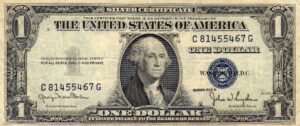
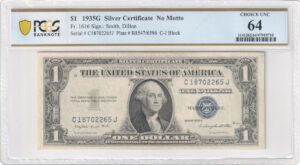
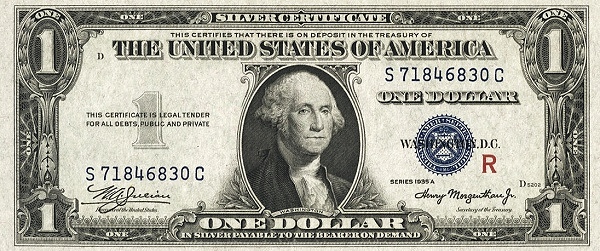
The note itself carries the signatures of Register of the Treasury William A. Julian and Secretary of the Treasury Henry Morgenthau Jr. Julian served from 1933 to 1949, and Morgenthau served from 1934 to 1945, making this signature combination one of the longest-running in small-size Silver Certificate history. The obverse design features a portrait of George Washington centered on the note, with the blue serial numbers and the green Treasury seal flanking the portrait on the left and right respectively.
Distinguishing the Two Varieties
The single most important skill for collectors pursuing this variety is learning to visually distinguish the two seals. The difference is more pronounced than many beginners expect, yet it can still catch an experienced eye off guard in poor lighting or on a heavily circulated note.
Dark Green Seal (Fr. 1606)
The dark green seal variety, catalogued as Friedberg number 1606, features a Treasury seal rendered in a deep, rich green ink. Under good lighting the seal has an almost forest-green quality, and the color saturation is consistent and bold across the entire seal face. The serial numbers on these notes are printed in a matching dark blue-green ink. When you examine the seal under a loupe, the ink coverage is dense and opaque.
This variety was produced during the earlier portion of the Series 1934 print run. Current research, as reflected in the Friedberg Paper Money of the United States reference and updated population data from PMG and PCGS Currency, suggests the dark green seal notes are the scarcer of the two varieties in higher grades, though they are not dramatically rare in circulated condition.
When examining a Series 1934 $1 Silver Certificate, compare the Treasury seal directly against the green ink of the border design. On a dark green seal note, the seal ink is noticeably deeper than the border print. On a light green seal note, the two greens appear far more similar in saturation. This comparison works even on moderately circulated examples.
Light Green Seal (Fr. 1607)
The light green seal variety, catalogued as Friedberg number 1607, shows a significantly paler, more yellow-green Treasury seal. Under side-by-side comparison with Fr. 1606, the difference is immediately obvious. The light green seal has an almost lime-tinged quality, and the ink coverage appears thinner and less saturated. The serial numbers on these notes are printed in a correspondingly lighter blue ink.
These notes represent the later production run of the series, and because they were produced in far greater quantities, they are considerably more common than the dark green seal variety. Most raw $1 Silver Certificates you encounter in dealer stocks, estate sales, or online auctions labelled simply as “Series 1934” will be the light green seal variety.
Print Run Numbers and Rarity Context
Precise BEP production records for individual seal color varieties from this era are not always published with fine granularity, as the BEP recorded aggregate series totals rather than variety sub-totals. However, based on serial number research, auction census data, and the analysis published by collectors such as those in the Society of Paper Money Collectors (SPMC), the dark green seal notes represent a distinct minority of the total Series 1934 $1 print run.
The combined print run for the Series 1934 $1 Silver Certificate exceeded 682 million notes across all delivery periods, making this one of the highest-volume small-size Silver Certificate series produced up to that point. The light green seal variety accounts for the overwhelming majority of that figure. Estimates from serial number surveys suggest the dark green seal variety may represent roughly 15 to 20 percent of the total production, though this remains an area of ongoing research in the collector community.
Star note replacements exist for both seal color varieties of the Series 1934 $1 Silver Certificate. Dark green seal star notes (Fr. 1606*) are genuinely scarce and command substantial premiums in grades of Very Fine and above. If you are building a type set of this issue, budget accordingly for the star replacement.
Star Note Varieties
Both seal color varieties were produced with star replacement notes, and this is where the rarity picture becomes significantly more interesting for advanced collectors. Star notes from the Series 1934 $1 Silver Certificate carry an asterisk preceding the serial number, indicating the note was produced to replace a misprinted or damaged note in a given print run.
The dark green seal star note (Fr. 1606*) is catalogued as genuinely scarce. Published auction records from Heritage Auctions, Stack’s Bowers, and Lyn Knight Currency Auctions show that examples in Very Fine-20 condition regularly bring $200 to $400, with Extremely Fine and better examples reaching $600 to over $1,000 depending on centering and eye appeal. A PMG 64 Choice Uncirculated example sold at a Heritage Auctions sale in 2019 for $840, illustrating the demand from type collectors and variety specialists alike.
The light green seal star note (Fr. 1607*) is considerably more common but still well worth collecting. In circulated grades, examples are available in the $15 to $60 range from most dealers. Uncirculated examples in the PMG 63 to 65 range typically bring $75 to $175.
Grading Considerations Specific to This Issue
Grading Series 1934 $1 Silver Certificates presents a few specific challenges that collectors should understand before purchasing. Because these notes circulated heavily during the 1930s and 1940s, many examples in dealer inventory carry the hallmarks of heavy commercial use: edge wear, folds at the center, and ink smudging from handling. Paper quality on notes from this era can also vary, as wartime paper and ink supply constraints occasionally affected BEP output in adjacent series.
When evaluating eye appeal, pay particular attention to the margins. The Series 1934 $1 Silver Certificates were sheet-cut by hand at the BEP, and margin consistency varies considerably even on technically high-grade notes. A PMG or PCGS Currency graded example eliminates the guesswork on grade, but for raw notes, look for even margins on all four sides, a sharp and centered portrait, and ink that retains its original vibrancy on both seal and serial numbers.
Cleaned or pressed Series 1934 $1 Silver Certificates are more common in the marketplace than many new collectors realize. If a raw note looks suspiciously bright and uncirculated but the paper feels limp or the folds appear artificially removed, treat it with caution. Third-party grading with a “net” grade or “apparent” designation is your protection here, especially when paying premiums for the dark green seal variety.
Current Market Values
The market for Series 1934 $1 Silver Certificates remains active and accessible, which is part of their enduring appeal. The light green seal variety (Fr. 1607) in circulated grades of Fine-12 to Very Fine-30 typically trades in the $3 to $10 range, making it an excellent entry point for newer collectors building a type set. Crisp Uncirculated examples in PMG 63 or better bring $25 to $60 at auction.
The dark green seal variety (Fr. 1606) commands a meaningful premium at all grade levels. Fine examples trade at $15 to $30, Very Fine examples at $30 to $60, and Extremely Fine notes at $60 to $100. Certified Uncirculated examples in PMG 63 to 65 range from $100 to $250, with gem notes occasionally exceeding that depending on originality and eye appeal.
Values as of 2024 reflect a healthy collector market for this series, supported by steady demand from both Silver Certificate specialists and general type collectors working through the small-size US currency series.
| Friedberg No. | Variety | Est. Surviving Examples | Rarity |
|---|---|---|---|
| Fr. 1607 | Light Green Seal, Regular | Very High (millions) | Common |
| Fr. 1606 | Dark Green Seal, Regular | Moderate (hundreds of thousands) | Scarce |
| Fr. 1607* | Light Green Seal, Star Note | Moderate (tens of thousands) | Scarce |
| Fr. 1606* | Dark Green Seal, Star Note | Low (estimated under 10,000) | Rare |
| Fr. 1606* (Gem CU) | Dark Green Seal Star, PMG 65+ | Very Low (under 50 certified) | Key Date |
| Fr. 1607 (Mule) | Light Green Seal, Mule Back Plate | Moderate | Scarce |
| Fr. 1606 (Gem CU) | Dark Green Seal, PMG 66+ | Low (under 100 certified) | Rare |
Building a Complete Set
For collectors who want to take this series beyond a single type note, a complete collection of Series 1934 $1 Silver Certificate varieties represents a rewarding and achievable goal at a moderate budget. A comprehensive set would include the dark green seal regular note (Fr. 1606), the light green seal regular note (Fr. 1607), the dark green seal star note (Fr. 1606*), and the light green seal star note (Fr. 1607*). Housed together in a currency album or archival holders, the four notes tell a complete and visually compelling story of the variety.
Some advanced collectors also pursue mule varieties, where a Series 1934 face plate was paired with an older-style back plate featuring a different plate number size. These mule combinations were documented by Martin Friedberg and add an additional layer of complexity for specialists willing to invest in loupe-level examination of plate numbers.
Where to Find These Notes
The light green seal variety is ubiquitous at coin shows, dealer stocks, and online marketplaces. eBay, Heritage Auctions currency archives, and PCGS CoinFacts currency sections all offer useful sold price data. The dark green seal variety requires more deliberate searching. Specialized currency dealers who focus on small-size type, as well as major auction houses running dedicated paper money sales, are your best sources for certified examples.
Joining the Society of Paper Money Collectors (SPMC) is strongly recommended for anyone serious about this series. The SPMC journal and membership community offer access to variety specialists who have devoted years to serial number research on exactly these kinds of production variations.
Conclusion
The Series 1934 $1 Silver Certificate seal color varieties are a perfect example of what makes small-size US currency so endlessly engaging. On the surface they appear identical. Look closer, and you find a window into the production history of the Bureau of Engraving and Printing during one of the most consequential decades in American monetary history. Whether you are adding your first Silver Certificate to a type set or building a specialized collection of 1934 varieties, understanding the distinction between Fr. 1606 and Fr. 1607 gives you a genuine edge in identifying, valuing, and appreciating these historic notes.