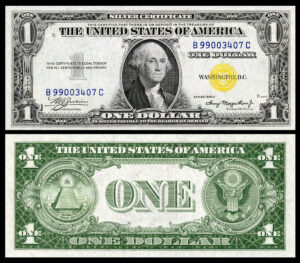
Imagine holding a $20 Federal Reserve Note with a bold “B” prefix on the serial number, unmistakably designating it as a New York district note, yet the green Federal Reserve seal stamped on its face reads “F” with the word “Atlanta” curving beneath it. The numbers do not match the seal. The district identifiers are in direct conflict with each other. What you are holding is one of the most coveted error types in all of US paper money collecting: a Federal Reserve district mismatch error. These notes are not misprints in the casual sense. They are the product of specific, documentable breakdowns in the Bureau of Engraving and Printing’s production process, and understanding exactly how they form is the first step toward collecting them intelligently.
How Federal Reserve Notes Are Identified by District
To appreciate a district mismatch error, you first need to understand how the Bureau of Engraving and Printing encodes district information onto every Federal Reserve Note. Since the Federal Reserve Act of 1913 established twelve regional banks, each note has been tied to a specific district through two redundant identification systems that were specifically designed to make district assignment unmistakable.
The first system is the Federal Reserve district seal, the circular green seal found to the left of the portrait on all small-size FRNs. The seal bears a district letter (A through L, corresponding to districts 1 through 12) and the name of the Federal Reserve Bank city. Boston carries “A-1,” New York carries “B-2,” Philadelphia “C-3,” Cleveland “D-4,” Richmond “E-5,” Atlanta “F-6,” Chicago “G-7,” St. Louis “H-8,” Minneapolis “I-9,” Kansas City “J-10,” Dallas “K-11,” and San Francisco “L-12.”
The second system is the serial number prefix. Every serial number on a Federal Reserve Note begins with a letter that repeats the district designation. A New York note starts with “B,” an Atlanta note with “F,” a Dallas note with “K,” and so on. Both identifiers should always agree. When they do not, a district mismatch error exists.
When examining any Federal Reserve Note, make it a habit to cross-check the serial number prefix letter against the district letter inside the circular seal. On genuine error-free notes these always match. If they disagree even by one letter, you may have something significant worth submitting to a third-party grading service immediately.
The Mechanics of How Mismatch Errors Occur
Modern BEP production divides note printing into three distinct press runs. The first printing applies the backs of notes in large 32-subject sheets. The second printing applies the faces, including the fine-line portrait engraving, the vignettes, and the treasury seal. The third and final printing, the overprint stage, applies the Federal Reserve district seals, the serial numbers, and the Federal Reserve Bank signatures in green ink.
District mismatch errors are exclusively a third-printing phenomenon. What happens is this: sheets of already-printed note faces (with blank spaces reserved for overprint elements) are fed into the overprint press. In a properly functioning production run, the press applies a district seal and a serial number block that agree with each other. A mismatch occurs when sheets destined for one district’s serial number series are run through an overprint press set up with a different district’s seal plate, or less commonly, when a seal plate intended for one district is accidentally loaded onto a press running serial numbers for another district.
The BEP operates what are called “runs” for each Federal Reserve district. Sheets are batched by district before the overprint stage. A mismatch error most commonly arises when a batch of sheets is misrouted, when a press operator loads the wrong seal numbering die, or when an end-of-run sheet from one district is inadvertently left in the feeder and picks up the overprint sequence of the next district’s run. Because QC inspectors check for many defects but may not catch every seal-to-prefix disagreement, a small number of mismatch notes escape into currency bundles and eventually reach Federal Reserve vaults for distribution.
Notable Documented Examples
The numismatic literature records several anchor examples of confirmed district mismatch errors. Among the most studied is a group of Series 1995 $1 Federal Reserve Notes discovered in the mid-2000s bearing Boston “A” serial prefixes combined with Richmond “E” district seals. Approximately 35 to 40 consecutive-serial examples from this error run have been documented, suggesting a short but real press malfunction during a Richmond overprint run that picked up pre-serialized Boston sheets. These notes, when certified by PMG or PCGS Currency in grades from VF-20 through CU-65, have realized prices ranging from $800 to over $3,500 depending on grade and serial position within the run.
A separate and equally compelling discovery involved Series 1988-A $20 notes bearing Chicago “G” serial prefixes but carrying St. Louis “H” district seals. Only a handful of these have been confirmed, with the finest known example grading PMG 64 Choice Uncirculated. That note sold at a Heritage Auctions currency sale for $4,800, a figure that reflects both the rarity of the mismatch type and the desirability of the $20 denomination.
On the $1 denomination, the Series 1985 and Series 1993 issues have produced the most documented mismatch errors, likely because the sheer volume of $1 production and the frequency of district changeovers during those years created more opportunities for batching errors. A well-published Series 1993 $1 note with a Minneapolis “I” prefix bearing a Kansas City “J” seal was encapsulated by PCGS Currency at Gem New 65 PPQ and realized $2,400 at auction in 2019.
District mismatch errors almost always appear in small consecutive runs of 5 to 50 notes rather than as isolated singles. If you find one confirmed example, check whether other notes from the same pack or bundle are available. Consecutive-serial mismatch pairs and runs command a meaningful premium over single examples and tell a more complete story of the production event.
Authentication: Real Mismatches vs. Altered Notes
Because district mismatch errors command strong premiums, they attract sophisticated alterations. The two most common fraud methods are: (1) chemically washing a genuine note and restamping it with a different district seal using a counterfeit rubber stamp or ink pad, and (2) physically cutting and splicing the serial number block from one note onto the body of another district’s note. Both methods, while potentially convincing under casual examination, fail under professional scrutiny.
Genuine mismatch errors show overprint ink that is chemically and texturally identical throughout the entire overprint layer. The green ink on the seal and the green ink in the serial numbers were applied in the same press pass and share the same BEP ink formulation. Under ultraviolet light, the ink fluoresces uniformly. Altered seals typically show a different ink fluorescence pattern, slightly different green hues visible under raking light, or microscopic ink layering inconsistencies where the fraudulent seal sits on top of the note’s paper fibers rather than partially penetrating them as genuine BEP overprint ink does.
Third-party grading is not optional for district mismatch errors. PMG and PCGS Currency have examined enough genuine examples to identify the specific characteristics of authentic BEP overprint inks and will note alterations definitively. A district mismatch error without a PMG or PCGS Currency holder should be treated with significant skepticism by any collector, regardless of the seller’s reputation.
The Role of Star Notes in Mismatch Discoveries
An interesting subset of district mismatch errors involves star notes, replacement notes whose serial numbers end in a star symbol rather than a letter. Star note production runs are district-specific by definition: a Richmond star note bears an “E” prefix and an “E” seal. When a mismatch star note turns up, it means the error occurred during a replacement note run, a production event that is itself tightly controlled and numerically small. This double-rarity factor makes mismatch star notes among the most aggressively sought items in the error note field. A Series 1981-A $1 star note with a Philadelphia “C” prefix and a Cleveland “D” seal, one of only two examples known, is held in a private collection and has been valued informally at over $12,000.
Always cross-reference any suspected mismatch error against the published BEP production records available through the Federal Reserve’s publicly released printing figures. If the serial number range on your note falls outside the documented print run for the district indicated by the prefix letter, that is powerful corroborating evidence of a genuine mismatch rather than an alteration.
Pricing and Market Considerations
The market for district mismatch errors has grown steadily since the early 2000s, driven partly by increased collector awareness and partly by the expansion of third-party grading services that have made it easier to authenticate and trade these notes with confidence. General market benchmarks as of recent auction records are as follows: low-denomination ($1) mismatch errors in circulated grades (F-12 to VF-30) typically realize $400 to $900. The same denomination in uncirculated grades (MS-63 to MS-65) climbs to $1,500 to $3,500. Higher-denomination mismatch errors ($20 and above) in any grade above Fine command $2,500 and up, with exceptional examples crossing $5,000 at major auction houses including Heritage, Stack’s Bowers, and Lyn Knight.
The denomination spread matters because higher-denomination notes receive more scrutiny at the teller and retail level, meaning fewer mismatch errors in $50 and $100 notes survive into collector hands without being caught and returned to the BEP or flagged as curiosities. A confirmed $100 district mismatch error would be a genuinely landmark find with no reliable comparable sales to anchor a value estimate.
| Series / Date | Denomination and Mismatch | Known Examples (Est.) | Rarity |
|---|---|---|---|
| Series 1985 | $1, Richmond E prefix / Atlanta F seal | 20-30 | Rare |
| Series 1988-A | $20, Chicago G prefix / St. Louis H seal | 6-10 | Key Date |
| Series 1993 | $1, Minneapolis I prefix / Kansas City J seal | 15-25 | Rare |
| Series 1995 | $1, Boston A prefix / Richmond E seal | 35-40 | Scarce |
| Series 1981-A | $1 Star, Philadelphia C prefix / Cleveland D seal | 2 | Key Date |
| Series 1999 | $5, Dallas K prefix / San Francisco L seal | 8-12 | Key Date |
| Series 2003 | $1, New York B prefix / Philadelphia C seal | 30-45 | Scarce |
| Series 2006 | $10, Atlanta F prefix / Chicago G seal | 10-18 | Rare |
| Series 2009 | $1, St. Louis H prefix / Minneapolis I seal | 40-60 | Scarce |
| Series 2013 | $20, Kansas City J prefix / Dallas K seal | 5 or fewer | Key Date |
Building a Collection Around Mismatch Errors
For collectors who want to specialize in this error type, a few strategies have proven effective. First, focus on a single denomination. The $1 denomination offers the most confirmed examples and the most accessible entry-level price points, making it ideal for building a type collection that demonstrates the range of district combinations possible in a mismatch. Second, prioritize certified examples from PMG or PCGS Currency exclusively. The authentication risk with raw mismatch errors is simply too high to justify the small premium savings of buying uncertified. Third, consult the Standard Catalog of United States Paper Money (Krause Publications) and Friedberg’s Paper Money of the United States for catalog references. While these references do not exhaustively catalog all mismatch errors (the field is still developing), they provide essential context for understanding how FRN production is documented.
Fourth, join the Society of Paper Money Collectors (SPMC) and engage with the error note community through its journal, Paper Money. Several landmark articles on district mismatch errors have appeared in its pages over the past two decades, and the community includes specialists who track known examples and can help authenticate potential discoveries.
If you believe you have found a new, unpublished district mismatch error on a raw note, do not spend it and do not attempt to clean or press it. Secure it in a protective sleeve, document the serial number and district details with clear photographs, and submit it to PMG or PCGS Currency with a notation explaining the suspected error. First-discovery examples of previously unknown mismatch pairs carry historical importance to the numismatic community and significantly higher market values than subsequent examples from the same run.
Conclusion: A Window Into the BEP’s Production Process
District mismatch errors are more than just collectible oddities. They are documentary evidence of specific moments when the Bureau of Engraving and Printing’s rigorous quality control system failed to catch an unusual production anomaly. Every confirmed mismatch note tells a story about a press run, a batch of sheets that went the wrong direction, and a quality inspector who did not catch the discrepancy before the note entered circulation. For collectors, that combination of rarity, visual drama, and historical specificity makes district mismatch errors among the most intellectually satisfying items in the entire field of US paper money. Whether you are just beginning to explore error notes or you have been chasing production anomalies for decades, the mismatch error represents a collecting frontier where genuine discoveries still get made, where the thrill of finding the unexpected in your change or in a dealer’s stock remains completely real.