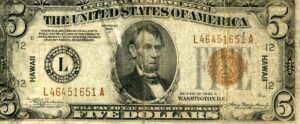
Pick up any Series 1950 Federal Reserve Note and flip it over. In the lower right corner, you will find a small number stamped into the green ink of the back design. That number identifies the specific intaglio plate used to print that side of the note. Now check the face plate number in the lower right corner of the obverse. In a perfectly matched production run, both numbers correspond to plates pulled from the same press cycle. But in a significant number of Series 1950 notes across all denominations, that correspondence breaks down entirely, and what you are holding is a mixed plate printing: a note whose face and back were produced from different production sequences before being married together in the final assembly process at the Bureau of Engraving and Printing.
What Are Mixed Plate Printings and Why Do They Occur?
The Bureau of Engraving and Printing printed Series 1950 Federal Reserve Notes using a two-pass intaglio process. Sheets of paper first received the back design from one set of plates, were then allowed to dry and cure, and subsequently passed through the press again to receive the face design from a separate plate. Because the BEP maintained large inventories of pre-printed back sheets and cycled plates in and out of production as they wore down or were retired, it was entirely routine for a back sheet printed from plate number 47 to eventually receive a face impression from plate number 312. The numbers simply did not need to match for a note to be legally valid or functionally complete.
From a production standpoint, this was unremarkable. From a collector standpoint, it creates a rich matrix of varieties because the range of plate numbers documented on Series 1950 notes spans from single-digit early plates through numbers exceeding 500 on certain denominations by the time the 1950E subseries was closing out in the early 1960s. A note showing a low back plate number combined with a high face plate number represents a measurable production anomaly, one that can often be cross-referenced against BEP production logs and Friedberg catalog data to narrow down approximate print windows.
When examining Series 1950 notes, always record both the face plate number AND the back plate number before assigning a variety designation. A note cataloged only by face plate number is missing half the data needed to identify a genuine mixed plate printing. Use a 5x loupe to read these numbers clearly, as worn notes can make the digits difficult to distinguish.
How to Identify Mismatched Plate Numbers: A Step-by-Step Process
Identifying a mixed plate printing on a Series 1950 note is straightforward once you know where to look and what ranges are considered normal for each denomination. Here is a systematic approach:
Step 1: Locate and Record Both Plate Numbers
On the face of the note, examine the lower right corner near the Treasury seal. You will see a small numeral, typically one to three digits, printed in black ink as part of the intaglio face impression. This is the face (or obverse) plate number. Flip the note and examine the lower right corner of the back design. The back plate number appears here in green ink, integrated into the back printing. Record both numbers precisely.
Step 2: Establish Expected Plate Ranges for the Subseries
Each subseries of Series 1950 notes corresponds to a different Treasury signature combination and a distinct window of BEP production. The original Series 1950 notes carry the Clerk Clark and Secretary Snyder signatures (Clark-Snyder), with face plates generally ranging from low numbers through approximately plate 86 on the $20 denomination. Series 1950A carries the Priest-Humphrey signatures, 1950B carries Priest-Anderson, 1950C carries Smith-Dillon, 1950D carries Granahan-Dillon, and 1950E carries Granahan-Fowler. Each transition brought new face plates into service while back plates from earlier production often remained in inventory and continued to be used.
Step 3: Flag Cross-Subseries Plate Combinations
The most collectible and documentable mixed plate printings are those where the back plate number falls within the known range of an earlier subseries while the face plate number is consistent with a later subseries, or vice versa. For example, a Series 1950B $20 Federal Reserve Note from the Chicago district (G) showing a back plate number in the range of 1 through 30 combined with a face plate number above 200 is a strong candidate for a genuine cross-production mixed plate. The back was almost certainly printed during original Series 1950 or 1950A production and sat in inventory until paired with a 1950B face printing.
The $20 denomination offers the most documented examples of mixed plate printings in the Series 1950 family, largely because the $20 had the highest print volumes of all the larger denominations during this era. If you are building a type set of mixed plate varieties, start with circulated $20 notes from multiple Federal Reserve districts before moving to the scarcer $50 and $100 denominations.
Denomination-by-Denomination Breakdown
$5 Federal Reserve Notes (Friedberg 1961-1966 range)
Series 1950 $5 notes show back plate numbers ranging from 1 through approximately 123 across all subseries. Mixed plate printings are most commonly found on 1950B and 1950C notes where early back plates in the 1-40 range were paired with late face plates in the 180-230 range. The Minneapolis (I) and Kansas City (J) districts tend to show this phenomenon more frequently than Boston (A) or New York (B) simply because smaller-district print runs meant sheets were processed over longer inventory holding periods. A Fine example of a 1950C $5 Minneapolis mixed plate note with a verifiable back plate under 20 and face plate over 200 can trade in the $85-$140 range, against a type value of roughly $20-$30.
$10 Federal Reserve Notes (Friedberg 2000-2013 range)
The $10 denomination saw particularly active plate cycling throughout the 1950s. Back plates for $10 notes in the Series 1950 family reached numbers exceeding 180 before production concluded. The most dramatic mixed plate combinations appear on 1950D notes, where BEP production records indicate that back sheet inventories from as early as 1951-1952 were occasionally still being consumed as late as 1958-1959. San Francisco (L) district 1950D $10 notes have been documented with back plates as low as 12 combined with face plates in the 290-310 range, a span representing nearly a decade of production separation.
$20 Federal Reserve Notes (Friedberg 2050-2063 range)
This is the workhorse denomination for mixed plate collectors. The $20 note was produced in the largest quantities during the Series 1950 era, and the BEP’s plate management practices for this denomination were particularly fluid. Back plate numbers on $20 notes ultimately extended above 400 across all subseries. The 1950A $20 from the New York (B) district is frequently encountered with back plates in the 15-35 range paired with face plates in the 140-175 range, a combination that places the back printing roughly two to three years before the face printing. These notes in Very Fine condition typically command a 20-40% premium over standard type specimens.
$50 and $100 Federal Reserve Notes
Mixed plate printings become considerably scarcer and more valuable at the $50 and $100 levels. Print volumes were lower, meaning inventory management was tighter and the window for cross-production sheet pairing was narrower. However, documented examples exist, particularly among 1950 and 1950A $100 notes from the Chicago and San Francisco districts. A confirmed 1950A $100 Chicago note with a back plate in single digits and a face plate above 50 represents a genuinely rare find and can attract significant collector premiums. NGC and PMG have both encapsulated and noted mixed plate varieties on higher denomination 1950 notes in their holder commentary, which adds measurable auction value.
Third-party grading services like PMG and NGC do not automatically flag or designate mixed plate varieties in their standard grading process unless submitted specifically for variety attribution. If you believe you have a significant cross-subseries mixed plate note, submit it with a cover letter requesting variety notation. This documentation dramatically increases the note’s secondary market value and collectibility.
District Variations and Their Impact on Rarity
The twelve Federal Reserve districts did not receive equal allocations of Series 1950 notes. New York (B) and Chicago (G) consistently received the largest print allocations, often accounting for 30-40% of total production in a given denomination and subseries. This means that while mixed plate notes from these districts are more frequently encountered in absolute terms, the notes from smaller-allocation districts such as Minneapolis (I), Kansas City (J), and Dallas (K) can show more extreme plate number differentials precisely because smaller batches of back sheets sat in inventory longer before being matched with face plates.
Dallas district Series 1950B $10 notes are a particularly interesting case. BEP delivery records from the early 1950s indicate that Dallas received periodic small supplemental deliveries rather than large continuous runs, which created situations where back sheets printed in one fiscal quarter were not consumed until deliveries were triggered by reserve bank requisitions sometimes 18 months or more later. The resulting plate number mismatches on these notes can span ranges that would be impossible to explain except through cross-period inventory pairing.
Authentication Considerations
It is worth addressing a question that sometimes arises among newer collectors: could a mixed plate printing be the result of two genuine notes being disassembled and fraudulently re-paired? In practice, this is essentially impossible to accomplish convincingly on an intaglio-printed Federal Reserve Note. The paper, inks, and printing impressions of genuine BEP notes are distinctive and consistent throughout, and any attempt to separate and reassemble components from two different notes would be detectable under even basic ultraviolet and fiber examination. Mixed plate printings are entirely a product of legitimate BEP production practices, not post-production manipulation. When a TPG holder notes a mixed plate variety, it is confirming a genuine production characteristic, not flagging a problem.
| Series / Subseries | Denomination and District | Approx. Print Run | Rarity |
|---|---|---|---|
| 1950 (Clark-Snyder) | $20, New York (B) | 32,400,000 | Common |
| 1950A (Priest-Humphrey) | $10, Chicago (G) | 18,720,000 | Common |
| 1950B (Priest-Anderson) | $20, Dallas (K) | 4,320,000 | Scarce |
| 1950C (Smith-Dillon) | $5, Minneapolis (I) | 2,880,000 | Scarce |
| 1950D (Granahan-Dillon) | $10, San Francisco (L) | 5,760,000 | Scarce |
| 1950A (Priest-Humphrey) | $50, Kansas City (J) | 1,440,000 | Rare |
| 1950B (Priest-Anderson) | $100, Chicago (G) | 2,160,000 | Rare |
| 1950A (Priest-Humphrey) | $100, San Francisco (L), back plate under 10 | Est. under 50 known | Key Date |
| 1950E (Granahan-Fowler) | $50, Minneapolis (I) | 720,000 | Key Date |
| 1950D (Granahan-Dillon) | $20, Richmond (E), face plate 300+ | Est. under 100 known | Key Date |
Building a Collection Around This Variety
A focused collection of Series 1950 mixed plate printings offers an achievable and intellectually engaging goal for intermediate collectors. A reasonable approach is to target one confirmed mixed plate note per denomination, beginning with circulated examples in the Fine to Very Fine range where affordability allows for broad coverage. Budget-conscious collectors can assemble a complete denomination run of mixed plate 1950 notes, from $5 through $20, for under $600 in circulated grades if they are patient and willing to examine notes carefully before purchasing.
Advanced collectors who want to push into Extremely Fine and About Uncirculated territory, or who are specifically targeting the $50 and $100 denominations, should expect to allocate significantly more per note and should consider working with established currency dealers who can provide documentation of the plate numbers before purchase. Major auction houses including Heritage Auctions and Stack’s Bowers regularly offer Series 1950 Federal Reserve Notes in their currency sessions, and lot descriptions from knowledgeable consignors will often include plate number information for notes where it adds value.
Keep a running log of every Series 1950 note you examine, recording the denomination, district, subseries letter, serial number block, face plate number, and back plate number. Even notes you do not purchase contribute to your reference database. Over time, this log becomes a personal research tool for identifying anomalous combinations and spotting genuine mixed plate rarities when they appear in dealer stock or at shows.
Reference Resources for Serious Researchers
The Friedberg catalog, specifically the 22nd edition of Paper Money of the United States, remains the foundational reference for Series 1950 Federal Reserve Notes and provides the Friedberg numbers used throughout this article. For plate-specific research, the BEP’s own production records, portions of which have been archived and studied by the Society of Paper Money Collectors (SPMC), offer the most granular data available. The SPMC journal Paper Money has published several detailed plate study articles on Series 1950 notes over the decades, and back issues are available through the society’s archives for members. Online, the PMG and NGC population reports can give collectors a rough sense of how frequently specific plate combinations have been submitted for grading, though these reports do not specifically break out mixed plate varieties in their standard search filters.
Conclusion
Mixed plate printings on Series 1950 Federal Reserve Notes represent one of the more analytically satisfying varieties available to currency collectors at accessible price points. Unlike star notes or major printing errors, which can command prices well beyond the reach of many collectors, mixed plate varieties are present throughout the Series 1950 family in quantities sufficient to allow systematic collection building. The knowledge required to find and authenticate them is learnable, the reference materials are available, and the reward of assembling a documented set of cross-production plate pairs spanning the $5 through $100 denomination range is genuinely satisfying. Flip your next Series 1950 note over, find that back plate number, and start comparing. You may already be holding something more interesting than you realized.