
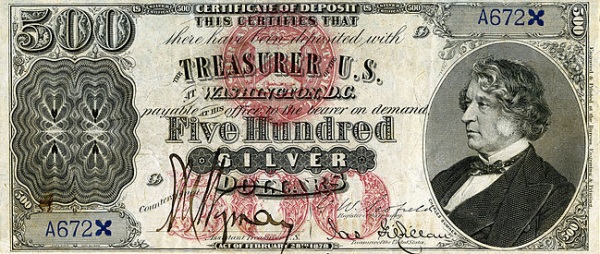
📷 Image source: banknote.ws (World Banknote Gallery). Images are selected by AI to represent the article topic and may not depict the exact note(s) described.
In the spring of 1899, tens of thousands of American soldiers were wading through rice paddies and jungle trails on Luzon, fighting a guerrilla war that most Americans back home barely understood. They were paid in US federal currency, they bought supplies with it, and they left it behind in a monetary landscape already fractured by Spanish colonial pesos, Mexican silver trade dollars, and locally issued scrip. The Philippine Insurrection, officially dated from February 4, 1899 to July 4, 1902, produced one of the most complex currency situations ever faced by American military forces abroad. For collectors today, the notes that circulated during this period represent a tangible link to a war that is rarely taught and even more rarely collected.
The Monetary Chaos American Soldiers Entered
To understand what currency American soldiers were carrying, you first have to understand what they were walking into. The Philippines in 1899 had no unified monetary standard. Spain had administered the islands using a peso system tied loosely to silver, but by the time Admiral Dewey’s fleet destroyed the Spanish squadron at Manila Bay on May 1, 1898, confidence in Spanish colonial currency had largely evaporated. The new American military government under General Wesley Merritt, and later General Elwell Otis, inherited a monetary vacuum.
Spanish-Philippine pesos, minted at the Manila Assay Office, continued to circulate alongside Mexican silver 8-reales pieces, which had been a staple of Pacific trade for decades. US silver coinage, particularly Morgan dollars, arrived with the troops and quickly became a preferred medium of exchange among both soldiers and Filipino civilians. But paper money was another matter entirely. Tropical humidity, insect damage, and the practical reality of guerrilla warfare made the large-format federal notes of the era extraordinarily vulnerable.
Which US Federal Notes Were Actually Present
The years 1899 through 1902 fall squarely in the Large Size note era, a period that ran from the Civil War through 1928. The notes measuring approximately 7.375 by 3.125 inches were already unwieldy by any standard, but they were the official currency of the United States, and soldiers were paid in them. Several series were actively in circulation or still being issued during this window.
Silver Certificates: The Workhorse of Military Pay
The Series 1899 Silver Certificates are perhaps the most historically significant notes tied to this conflict. The $1 denomination of the 1899 series, featuring the iconic Black Eagle design with portraits of Lincoln and Grant flanking a large American eagle, entered circulation beginning in late 1899. The Bureau of Engraving and Printing produced this note under numerous signature combinations, with the Lyons-Roberts pairing (Register of the Treasury James F. Lyons and Treasurer Ellis H. Roberts) being among the earliest and most widely distributed. The black seal and blue serial numbers of these notes made them visually distinct, and they were durable enough to survive moderate tropical conditions better than some contemporaries.
The $2 Silver Certificate of Series 1899, known to collectors as the “Mini Porthole” for its small oval portrait of George Washington, also circulated widely. The $5 Series 1899 Silver Certificate, featuring the so-called “Onepapa” or Indian Chief design with Running Antelope in traditional headdress, was another denomination present. These are cataloged in the Standard Catalog of United States Paper Money and in Friedberg’s Paper Money of the United States, with the $5 1899 Silver Certificate carrying Friedberg number Fr. 271 through Fr. 282 depending on signature combination.
When attributing Large Size Silver Certificates to the Philippine Insurrection period, focus on notes with Lyons-Roberts, Lyons-Treat, or Vernon-Treat signature combinations. These pairings bracket the years 1899 to 1905 and represent the notes most likely to have been in active military circulation during and immediately after the conflict. Check Friedberg numbers carefully, as signature combinations dramatically affect value.
Treasury Notes of 1890 and 1891: The Coin Notes
The Treasury Notes authorized by the Sherman Silver Purchase Act of 1890, known colloquially as Coin Notes because they promised payment in coin, were still circulating in significant quantities during the insurrection years, even though their issuance had ended. These notes, issued in denominations from $1 through $1,000, feature some of the most ornate engraving ever applied to American currency. The Series 1890 $1 note (Fr. 347-349) with its large ornate “1” on the reverse and the Series 1891 versions with their revised, less busy reverses were both present in Army pay envelopes.
By 1899, many of these notes were already five to ten years old and showed considerable wear. Finding a surviving example in Fine or better condition that shows signs of tropical climate exposure, such as moisture staining, insect damage to the margins, or repairs with local paper, is a legitimate numismatic specialty that very few collectors actively pursue.
The Educational Notes and Other Series 1896 Certificates
The celebrated Educational Series Silver Certificates of 1896 were being retired from circulation even as the Philippine war began, but substantial quantities remained in the money supply. The $1 featuring “History Instructing Youth” (Fr. 224-225), the $2 featuring “Science Presenting Steam and Electricity to Commerce and Manufacture” (Fr. 247-248), and the $5 featuring “America” by artist Edwin Blashfield (Fr. 268-269) were all technically present, though the $2 and $5 denominations were larger values that soldiers rarely carried in quantity.
Educational Series notes (Fr. 224-269) in circulated grades between Very Good and Fine can be acquired for $200 to $600 depending on denomination and specific Friedberg number, making them accessible entry points into this historical collecting theme. The $1 1896 note is by far the most available in circulated grades and represents the best value for thematic collectors focused on the Spanish-American War and Philippine period.
Legal Tender Notes and Gold Certificates: Officers and Their Pay
Commissioned officers received higher pay and sometimes dealt in United States Notes (Legal Tender Notes) of higher denominations. The Series 1880 and Series 1901 Legal Tender Notes were the principal large-denomination greenbacks circulating in this period. The Series 1901 $10 Legal Tender, known to collectors as the “Bison Note” or “Buffalo Note” for its dramatic engraving of an American bison by Frederick Burkey based on a live model named Black Diamond, entered production in 1901, right at the conflict’s tail end. This note, cataloged as Fr. 116-123a, is one of the most beloved Large Size type notes and can plausibly be placed in the Philippines in 1901 and 1902.
Gold Certificates, by contrast, were primarily used in bank-to-bank transactions and wholesale commerce. Their presence in field conditions would have been minimal, though they did circulate in Manila’s commercial district among merchants and importers dealing with American military contracts.
Insurgent Scrip: Aguinaldo’s Revolutionary Currency
While American forces were using federal notes, Emilio Aguinaldo’s Philippine Republic was issuing its own revolutionary currency. These notes, printed under desperate conditions and authorized by the Malolos Congress, represent a collecting specialty entirely separate from US federal notes but intimately connected to the same historical moment. Aguinaldo’s government issued paper centavos and pesos, typically printed on whatever paper stock could be found, between 1898 and 1901. These notes are extremely rare in any collectible condition and when they appear at auction, typically through Heritage Auctions or Stack’s Bowers, they command prices from $500 to over $10,000 depending on condition and specific issue.
The contrast between the engraved, officially produced US federal notes and the crude insurgent scrip tells the story of the war itself: a heavily resourced industrial power against a determined but materially disadvantaged independence movement.
Building a thematic collection around the Philippine Insurrection period does not require authentic Philippine provenance, which is essentially impossible to document for paper money. Instead, focus on date-appropriate US Large Size notes in the VG to Fine grade range, pair them with period photographs, maps, and soldier ephemera, and document the specific series and signature combinations that match the 1899 to 1902 window. This approach creates a compelling exhibit-quality collection without the premium prices of Uncirculated examples.
The Philippine Organic Act and the End of US Currency in the Islands
The Philippine Organic Act of July 1, 1902 formally established civilian colonial government and set the stage for a dedicated Philippine monetary system. In 1903, the Bureau of Insular Affairs, working with the US Mint, introduced the Philippine peso on a gold-exchange standard pegged at two Philippine pesos to one US dollar. These coins and, eventually, Philippine National Bank notes gradually replaced circulating US federal currency in everyday transactions. However, US notes continued to be used by American soldiers, civil servants, and merchants in Manila and other major cities well into the 1910s.
The transition created another numismatic curiosity: large quantities of worn, tropical-damaged US Large Size notes were repatriated to the mainland for redemption in the early 1900s, contributing to the destruction and cancellation of many notes that might otherwise have survived. This repatriation effect is one reason why surviving examples of 1899 to 1902 period notes in heavily circulated grades sometimes show damage patterns consistent with tropical storage: foxing, tide lines from moisture, and ink migration that differs from normal domestic wear patterns.
Grading Considerations for Philippine-Period Notes
Collectors who want to specialize in this area should understand that tropical climate damage is not the same as simple wear. A note that grades VG-8 or F-12 by PCGS or PMG standards due to folds, pinholes, and light soil may carry additional historical interest if it shows evidence of tropical exposure, but grading services do not distinguish geographic circulation history. The grade reflects the physical state of the note, not its story.
For practical collecting purposes, PMG and PCGS both encapsulate Large Size notes from this period readily. Notes in the Fine-12 to Very Fine-25 range represent the sweet spot for thematic collectors: worn enough to have been genuinely circulated in the period, but preserved enough to display well. The premium for Uncirculated examples of common Series 1899 Silver Certificates rarely justifies the cost for a thematic collection; the story is in the wear.
| Series / Friedberg No. | Denomination and Type | Approx. Known / Print Context | Rarity |
|---|---|---|---|
| 1899, Fr. 226 (Lyons-Roberts) | $1 Black Eagle Silver Certificate | Millions printed; common in circulated grades | Common |
| 1899, Fr. 258 (Lyons-Roberts) | $2 Mini Porthole Silver Certificate | Large print run; moderately available | Common |
| 1899, Fr. 279 (Vernon-Treat) | $5 Indian Chief Silver Certificate | Scarcer in Fine or better; many heavily worn | Scarce |
| 1896, Fr. 224 (Tillman-Morgan) | $1 Educational Series Silver Certificate | Widely redeemed; survivors mostly VG to VF | Scarce |
| 1896, Fr. 247 (Tillman-Morgan) | $2 Educational Series Silver Certificate | Far fewer survivors than $1; rare in Fine+ | Rare |
| 1901, Fr. 116 (Lyons-Roberts) | $10 Bison Legal Tender Note | Entered circulation 1901; first-year examples scarce | Scarce |
| 1890, Fr. 347 (Rosecrans-Huston) | $1 Treasury Coin Note | Heavily redeemed by 1902; tropical survivors extremely rare | Rare |
| 1891, Fr. 352 (Rosecrans-Nebeker) | $1 Treasury Coin Note, revised reverse | Similar redemption pattern; fewer than 1890 | Rare |
| Philippine Republic Peso Notes (Malolos Congress, 1898-1901) | Insurgent scrip, various centavo/peso values | Fewer than 200 confirmed survivors across all types | Key Date |
Building a Thematic Collection: Where to Start
For new collectors, the entry point to this theme is straightforward: acquire a circulated Series 1899 $1 Black Eagle Silver Certificate with a Lyons-Roberts signature combination (Fr. 226) in a PMG or PCGS holder graded Fine-12 to Very Fine-25. These notes trade regularly at $75 to $200 in that grade range, making them among the most affordable Large Size type notes available. Pair it with a researched writeup on the specific signature combination and its production dates, and you have the nucleus of a serious thematic collection.
Intermediate collectors might pursue a complete signature combination set of the Series 1899 $1 Silver Certificate, which requires tracking down seven or eight different Friedberg numbers. Advanced collectors can attempt to locate the Educational Series $2 and $5 in circulated grades, where examples in Fine condition can run $1,500 to $4,000 and $2,500 to $8,000 respectively at major auction houses.
Conclusion
The Philippine Insurrection of 1899 to 1902 is one of American history’s most understudied conflicts, and its numismatic dimension is even less explored. The US federal notes that circulated during those three brutal years of guerrilla warfare represent more than beautiful examples of Large Size currency design. They are artifacts of empire, instruments of a colonial monetary transition, and witnesses to a war fought in jungle heat with paper money never designed to survive it. For collectors willing to approach the subject with both numismatic precision and historical curiosity, this is genuinely fertile ground. The notes are available, the history is documented, and the competition among specialist collectors remains, for now, surprisingly modest.