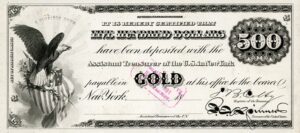
A Century and a Half of History in Your Hands
Pick up a Series 1880 $100 United States Note and you are holding something that predates the Federal Reserve System by more than three decades. These are Legal Tender Notes, sometimes called “United States Notes” or colloquially “Red Seals” by collectors, and the $100 denomination represents the pinnacle of the large-size legal tender series in terms of visual grandeur. Printed during an era when the Bureau of Engraving and Printing was still refining its craft, these notes carry an unmistakable 19th-century aesthetic that no modern reproduction can replicate.
Design Elements: Reading the Note Like an Expert
The obverse of the Series 1880 $100 Legal Tender Note features a portrait of Abraham Lincoln at the left, rendered in the intaglio engraving style that gives large-size notes their tactile depth. The word “UNITED STATES” arches boldly across the top, with “ONE HUNDRED DOLLARS” printed below in large, authoritative lettering. The obligation text reading “This note is a legal tender at its face value for all debts public and private except duties on imports and interest on the public debt” appears in fine print across the face, a statement of the note’s unique constitutional standing.
The reverse design is equally commanding. The large green back features an elaborate lathe-work geometric pattern surrounding the numeral “100” repeated in ornate fashion. The words “UNITED STATES OF AMERICA” and “ONE HUNDRED DOLLARS” dominate the back, with fine engine-turned border designs that were state-of-the-art anti-counterfeiting measures of the period. The physical dimensions, approximately 7.375 by 3.125 inches, dwarf any currency in circulation today and contribute to the commanding presence of these notes.
Treasury seals on the Series 1880 issue come in distinct varieties. Early printings carry a large brown seal, while later runs transitioned to a red seal in both large scalloped and smaller plain circular forms. Identifying which seal variety you have is the first step in proper attribution and valuation.
Always examine the Treasury seal under good raking light before purchasing a Series 1880 $100 note. Brown seals that have faded or been chemically altered to appear red are a known problem in this series. Genuine brown seals have a warm, chocolatey tone, while authentic red seals show a vivid, slightly orange-tinged crimson. When in doubt, have the note authenticated by PCGS Currency or PMG before committing to a significant purchase.
The Friedberg Catalog: Navigating the Varieties
Robert Friedberg’s “Paper Money of the United States” remains the standard reference for attributing these notes, and the Series 1880 $100 Legal Tender issues are cataloged as Fr. 167 through Fr. 172. Each Friedberg number corresponds to a specific combination of Treasury seal variety and the signatures of the Register of the Treasury and the Treasurer of the United States. Understanding these distinctions is not just academic trivia; it directly determines market value, sometimes by multiples of ten.
Fr. 167 carries the signatures of Scofield and Gilfillan with a large brown seal. This is generally considered the most available variety in circulated grades, though “available” is a relative term when discussing a note of which perhaps two dozen circulated examples are confirmed. Fr. 168 pairs Bruce and Gilfillan signatures with the large brown seal. Fr. 169 features Bruce and Wyman with the same brown seal configuration.
Fr. 170 introduces the Rosecrans and Jordan signatures, still with a large brown seal. Fr. 171 brings the transition: Rosecrans and Hyatt signatures with the large red seal, making this a transitional variety of some importance. Finally, Fr. 172 carries Rosecrans and Hyatt with a small red seal, representing the final configuration of this series. The Rosecrans-Hyatt pairing was in effect from approximately 1891 to 1893, giving us a reasonably firm production window for the later varieties.
Signature Combinations and Their Dating
Dating large-size notes precisely requires understanding Treasury appointment histories. Blanche K. Bruce served as Register of the Treasury from 1881 to 1885, then again from 1889 to 1893. Gilfillan served as Treasurer from 1877 to 1883. Wyman held the Treasurer position from 1883 to 1885. This means Fr. 168 (Bruce-Gilfillan) was printed between 1881 and 1883, while Fr. 169 (Bruce-Wyman) dates to the 1883 to 1885 window. Rosecrans served as Register from 1881 to 1887, overlapping with multiple Treasurers.
These windows matter because they help collectors and researchers estimate the relative print quantities for each signature combination, even when formal Bureau of Engraving and Printing records from this era are incomplete or inconsistent. Generally, shorter service overlaps translate to smaller print runs and greater rarity for the corresponding signature combination.
When researching a Series 1880 $100 Legal Tender Note, cross-reference the signature combination against Treasury appointment dates using the Friedberg catalog appendix or the reference guide by Hessler and Limpert. Misattributed signature combinations are not uncommon on older auction lot descriptions, and verifying the exact pairing yourself could reveal a rarer variety than the seller realized.
The Surviving Population: What the Census Data Tells Us
PCGS Currency and PMG maintain population reports that, while incomplete since many notes remain in private collections unsubmitted, provide a meaningful window into survival rates. Across all six Friedberg varieties of the Series 1880 $100 Legal Tender Note, the combined graded population sits somewhere between 130 and 175 examples as of recent census data, with perhaps another 20 to 40 examples known in private hands that have never been submitted for grading.
The grade distribution is heavily skewed toward the lower end of the scale. Notes grading VG (Very Good, approximately PMG/PCGS 10) through Fine (PMG/PCGS 15) account for the majority of surviving examples. This is consistent with the note’s denomination: a $100 bill in 1880 represented roughly two months of wages for an average laborer, so these notes circulated extensively before eventually being redeemed, mutilated, or destroyed. Finding an example in Extremely Fine (EF-40 and above) is a genuine event in the marketplace.
Uncirculated examples are extraordinarily rare. Fewer than ten examples across all varieties have been certified in grades of AU-55 or above by the major grading services. A pristine Gem example would be virtually without precedent and would command a price that defies easy estimation. The finest known Fr. 167 graded by PMG sits at 45 Choice Extremely Fine, a note that realized over $28,000 at a major auction in 2019. Fr. 172 in AU-58 has achieved prices exceeding $55,000 when condition-census examples came to market.
Condition Grading Nuances Specific to This Series
Grading large-size legal tender notes of this era requires attention to factors beyond the standard wear grades. Paper originality is paramount: Series 1880 notes should exhibit the crisp, slightly fibrous texture of original BEP stock, not the limp, washed feel of a note that has been pressed or cleaned. Color brightness on both the obverse engraving and the green reverse is another critical factor. The elaborate lathe-work on the reverse is particularly susceptible to fading from handling and environmental exposure.
Margins matter significantly on these notes. Large-size notes were cut by hand, and sheets were not always cut with perfect consistency. A Series 1880 $100 with four broad, even margins commands a meaningful premium over an otherwise identical note with close or uneven margins. This margin premium is especially pronounced in the EPQ (Exceptional Paper Quality) and PPQ (Premium Paper Quality) designations assigned by the major grading services.
Corner integrity deserves specific attention on high-denomination notes from this era. The corners of large-size notes were frequently the first areas to show wear, fold cracking, or rounding from handling. A note with four sharp, original corners and no evidence of corner repair is a genuine condition rarity in this series, even at grades as low as VF-30.
Before submitting a Series 1880 $100 Legal Tender Note for grading, examine it carefully under a UV (ultraviolet) light. Washed notes will often show a different fluorescence pattern than original notes, and repaired pinholes or tears sometimes become visible under UV that are invisible under normal lighting. Both PCGS Currency and PMG will note any repairs or alterations on their holders, which dramatically affects resale value.
Market Trends and What Collectors Are Paying
The Series 1880 $100 Legal Tender Note occupies a specialized but passionate corner of the large-size note market. Major auction houses including Heritage Auctions, Stack’s Bowers, and Lyn Knight Currency Auctions have offered examples regularly over the past two decades, providing a reasonable data set for price analysis.
In Fine to Very Fine grades (F-12 to VF-30), common varieties like Fr. 167 typically realize between $6,500 and $14,000 depending on eye appeal, centering, and originality. The same grade range for rarer varieties like Fr. 171 or Fr. 172 can push to $18,000 or higher when genuine collector competition materializes. Extremely Fine examples in the EF-40 to EF-45 range have historically realized $20,000 to $35,000 for the more available varieties.
The broader legal tender large-size note market has shown consistent appreciation over the 2010s and 2020s, driven by a growing collector base, increasing awareness through online auction platforms, and the fundamental scarcity of high-grade material. Unlike some areas of numismatics that saw price corrections after speculative peaks, high-quality large-size legal tender notes have held their values well, supported by genuine rarity rather than manufactured scarcity.
| Friedberg No. | Signatures | Seal Type | Est. Known | Rarity |
|---|---|---|---|---|
| Fr. 167 | Scofield / Gilfillan | Large Brown | 40-55 examples | Scarce |
| Fr. 168 | Bruce / Gilfillan | Large Brown | 25-35 examples | Scarce |
| Fr. 169 | Bruce / Wyman | Large Brown | 20-30 examples | Rare |
| Fr. 170 | Rosecrans / Jordan | Large Brown | 15-25 examples | Rare |
| Fr. 171 | Rosecrans / Hyatt | Large Red (Lg.) | 10-18 examples | Key Date |
| Fr. 172 | Rosecrans / Hyatt | Small Red | 12-20 examples | Key Date |
Building a Collection Strategy Around This Note
For collectors approaching the Series 1880 $100 Legal Tender Note for the first time, the strategic question is almost always whether to pursue a single high-grade example of a common variety or a complete type set of all six Friedberg numbers in consistent mid-grades. Budget reality usually drives this decision: assembling all six varieties in VG to Fine grades might cost $60,000 to $90,000 total, while a single EF-grade Fr. 167 might consume a similar budget on its own.
For those with the patience and resources, the complete type set is a genuinely prestigious achievement. Very few collectors have assembled all six signature varieties of this denomination, and a properly documented, consistently graded set would represent a remarkable collection centerpiece. If you are pursuing this goal, begin with the more available varieties while prices remain relatively accessible, then work toward the key-date Fr. 171 and Fr. 172 issues as opportunities arise.
New collectors to large-size notes would do well to start by handling as many examples as possible at major currency shows, including the annual Memphis International Paper Money Show and the Chicago Paper Money Expo. Developing an eye for original paper quality and genuine wear patterns before making significant purchases is time well spent in a field where condition subtleties translate directly into thousands of dollars.
If you are assembling a type set of Series 1880 $100 Legal Tender Notes, document your collection meticulously. Photograph each note under multiple lighting conditions, record the serial number, and note any auction provenance or prior collection history. Provenance adds measurable value to rare large-size notes and a well-documented collection history makes any eventual sale significantly smoother and more profitable.
Conclusion: Monuments of American Currency History
The Series 1880 $100 United States Note is not merely a collectible. It is a physical artifact of American economic history from an era when the country was still working out the fundamental nature of its money supply, fighting between hard money advocates and greenback supporters, and building the financial infrastructure that would eventually lead to the Federal Reserve Act of 1913. Each surviving example of Fr. 167 through Fr. 172 is a document of that turbulent and fascinating period.
With a combined surviving population that likely does not exceed 200 examples across all varieties, these notes are rarer in absolute terms than many classic numismatic coins that command far higher prices. As awareness of large-size legal tender notes continues to grow among the collecting community, and as condition-census examples become increasingly difficult to locate, the Series 1880 $100 Legal Tender Note stands as both a compelling historical document and a sound long-term addition to any advanced currency collection. The challenge, as always, is simply finding one worth owning.