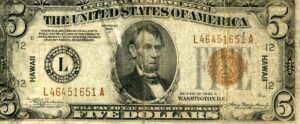
Imagine opening a cash drawer in Terre Haute, Indiana, in 1902 and pulling out a $10 bill that reads “The First National Bank of Springfield, Illinois” on its face. The note cleared, the cashier didn’t flinch, and the error note quietly entered circulation, surviving against all odds to torment and delight currency collectors more than a century later. Overprinting errors on National Bank Notes represent one of the most compelling fault lines in American numismatic history: the place where industrial-era bureaucracy collided with human fallibility, producing notes that were simultaneously valid legal tender and spectacular documentary mistakes.
How National Bank Notes Were Made: The Pipeline That Created Errors
To understand how overprinting errors happened, you have to understand the production sequence at the Bureau of Engraving and Printing. National Bank Notes were not printed all at once like modern Federal Reserve Notes. Instead, they were produced in a two-stage process that stretched over days or even weeks, and sometimes much longer when backlogs developed.
In the first stage, sheets of currency paper received the primary intaglio printing: the intricate vignettes, border work, green backs (on large-size notes), and the generic “National Currency” obligation text. These sheets were stored in large flat files, often sorted loosely by denomination. They did not yet identify any specific bank. In the second stage, a separate overprinting operation applied the black typeset elements unique to each issuing bank: the bank’s full legal name, its home city and state, its charter number, and the signatures of its president and cashier. On large-size notes prior to 1902, the Treasury serial numbers and Treasury seal were also applied at this stage.
The error window opened between those two stages. A pressman loading sheets for the overprint run could pull from the wrong stack. A file clerk could misfile a completed stack of first-stage sheets into the wrong denomination bin. Worse, during particularly busy periods such as the explosive growth of National Banking following the National Bank Acts of 1863 and 1864, and again during the economic expansion of 1900 to 1910, the BEP was processing charter applications and note orders for hundreds of banks simultaneously. The opportunity for mix-ups was structural, not merely accidental.
When examining a suspected overprint error, always check whether the denomination of the printed back matches the overprinted face. A $5 First Charter back with a $10 overprint is a confirmed sheet-mix error. Mismatched denomination errors are among the rarest and most valuable of all National Bank Note mistakes.
Categories of Overprinting Errors: Not All Mistakes Are Equal
Collectors and researchers generally group National Bank Note overprinting errors into several distinct categories, each with its own rarity profile and collecting appeal.
Wrong Bank Name, Correct State
This is the most frequently encountered category, though “frequently” is relative when the total known population is in the dozens. These notes received the overprint package intended for a different bank that happened to operate in the same state. A famous example involves notes intended for one Illinois bank whose sheets were overprinted with the name and charter number of a different Illinois institution. Because the state line matched, these notes sometimes passed through bank examination before being flagged, allowing more of them to enter and survive in circulation.
Wrong Bank Name, Wrong State
Far more dramatic and correspondingly rarer are notes where the overprint names a bank in a completely different state from the one that received the shipment. These would have been caught almost immediately by the receiving bank’s officers, who would have returned them to the Treasury for correction. The notes that survived did so because a handful slipped through, were set aside as curiosities, or were caught but not destroyed before a sympathetic bank officer pocketed one. Notes in this category routinely command premiums of 300 to 500 percent over an equivalent note from either of the involved banks.
Wrong Charter Number, Correct Bank Name
Charter number errors are more subtle and were frequently missed entirely during the era of circulation. The charter number appeared in multiple locations on large-size notes: in the upper left and upper right corners of the face, within the obligation clause, and sometimes as part of the serial number prefix on certain series. If even one of those placements carried the wrong number, the note qualifies as a charter error. These are particularly treacherous for modern collectors because they require careful comparison of all charter number positions rather than a single obvious mismatch.
Partial Overprint Errors and Double Overprints
A smaller subset involves notes that received a partial overprint from one bank and a complete overprint from another, the result of a sheet that went through the press twice or was incompletely cleared between runs. Double overprint errors, where two complete bank overprints are legible, are among the showpieces of the error note hobby. The 1902 Plain Back series produced at least three confirmed double-overprint nationals, two of which have been graded by PCGS Currency.
Charter number errors on 1929 Type 1 small-size nationals can be confirmed by cross-referencing the visible charter number against Don Kelly’s “National Bank Notes: A Guide with Prices” (5th edition). Kelly’s charter listings include the correct serial number ranges for every issuing bank, giving you an independent check on whether the charter printed on a note matches the institution that should have received it.
Large-Size vs. Small-Size: Where the Errors Cluster
National Bank Notes were issued in two broad size formats. Large-size notes ran from the Original Series of 1863 through the 1902 Plain Back series, with the last large-size nationals delivered to banks in the mid-1920s. Small-size nationals were issued only in the Series of 1929, in Type 1 (with the bank’s charter number in brown ink in two positions) and Type 2 (charter number added in a third position on the face) formats, through the formal end of the National Banking System in 1935.
Overprinting errors appear in both size categories but cluster differently. Large-size error notes are overwhelmingly found in the 1902 Date Back and 1902 Plain Back series, which had enormous print runs during the 1908 to 1922 period. The sheer volume of notes being processed created maximum statistical opportunity for sorting and loading errors. The Original Series and Series of 1875 First Charter notes are so individually rare that confirmed overprint errors from those series are essentially theoretical at this point, though at least one suspected example exists in a midwestern private collection.
Small-size 1929 overprint errors are rarer in absolute number but are somewhat more accessible to collectors because the notes themselves are more recently produced, better preserved on average, and more thoroughly documented in the surviving BEP production records that researchers like John Hickman and Dean Oakes used when compiling their landmark census work in the 1980s.
Famous Confirmed Examples
The most celebrated large-size overprint error in the hobby is a Series 1902 Plain Back $10 note bearing the overprint of a Kansas bank that was instead delivered to a Missouri institution. This note, cataloged in specialized references and illustrated in Eric Newman’s research files at Washington University, sold at a major Stack’s Bowers auction in 2019 for $74,000 in VF-25 grade. The previous auction record for the same note, set in 2006, was $41,000, an illustration of how dramatically the market for confirmed error nationals has appreciated.
Among small-size errors, a 1929 Type 1 $20 note from a Texas charter that received the complete overprint package of an Oklahoma bank in PCGS Fine-15 is considered a benchmark example. It appeared in a Heritage Currency Auctions sale in January 2021 and realized $38,400 against a pre-sale estimate of $22,000 to $28,000.
Charter number errors on 1929 Type 2 notes are documented in at least fourteen confirmed examples across eight states, making them the most populated category of small-size overprint error. Even in lower circulated grades, these typically open at $4,500 to $6,500 at major auctions when accompanied by a PCGS or PMG error designation on the holder.
Never buy a claimed National Bank Note overprint error without a PCGS Currency or PMG holder that explicitly describes the error on the certification label. Both services use specific language for confirmed wrong-bank and wrong-charter designations. A raw note described as an error by a dealer, no matter how reputable, has not been subjected to the multi-examiner review that third-party grading provides, and the stakes with these notes are simply too high to skip that step.
Authentication Challenges: The Fake Error Problem
The high values commanded by confirmed overprint errors have inevitably attracted counterfeit errors: genuine National Bank Notes that have been altered to appear as though they received the wrong overprint. The most common manipulation involves chemically lightening or physically abrading an original overprint and applying a new one via modern printing technology. Under magnification, genuine BEP letterpress overprints show characteristic ink impression depth, slight paper compression around the letterforms, and ink chemistry consistent with early twentieth-century iron gall and carbon black formulations. Modern laser or inkjet reproductions lack impression depth entirely and often show uneven ink distribution under a loupe.
A second category of fake involves genuinely mismatched components: a face from one note married to a back from another denomination or series. While this produces an obvious visual mismatch, it is not a production error and has no numismatic premium. Fiber UV examination and careful measurement of paper thickness across the note are the first lines of defense against married notes.
The Professional Currency Dealers Association (PCDA) maintains a registry of known altered nationals that have been submitted to grading services and returned as genuine alterations. Consulting that registry before purchasing any high-value error note is strongly recommended.
| Series / Size | Error Category | Confirmed Examples Known | Rarity |
|---|---|---|---|
| 1902 Plain Back (Large) | Wrong bank name, same state | Approx. 18 to 25 | Rare |
| 1902 Plain Back (Large) | Wrong bank name, different state | Fewer than 8 confirmed | Key Date |
| 1902 Date Back (Large) | Wrong charter number | Approx. 10 to 14 | Rare |
| 1902 Plain Back (Large) | Double overprint (two banks) | 3 confirmed, 2 graded | Key Date |
| 1882 Brown Back (Large) | Wrong bank name, same state | 2 confirmed | Key Date |
| 1929 Type 1 (Small) | Wrong bank name, different state | Approx. 6 confirmed | Key Date |
| 1929 Type 1 (Small) | Wrong charter number | Approx. 9 confirmed | Rare |
| 1929 Type 2 (Small) | Wrong charter number | Approx. 14 confirmed | Rare |
| 1929 Type 2 (Small) | Wrong bank name, same state | Approx. 5 confirmed | Key Date |
| Original / 1875 Series (Large) | Any overprint error | 1 suspected, unconfirmed | Key Date |
Building a Collection Around Overprint Errors
Most collectors who specialize in National Bank Note errors approach the category one of two ways. The first approach is state-focused: assembling a collection of error notes where one of the two involved banks is located in a particular state. This gives the collection a geographic coherence and makes the stories behind each note more personal. A collector based in Ohio, for instance, might seek out every confirmed error involving an Ohio charter, whether the Ohio bank was the intended recipient or the one whose name was mistakenly applied.
The second approach is type-focused: acquiring one confirmed example of each error category regardless of state or denomination. A complete type set of National Bank Note overprint errors, covering wrong-bank same-state, wrong-bank different-state, wrong-charter, partial overprint, and double overprint, would be a genuinely museum-quality achievement. As of this writing, no single collector is known to hold confirmed examples of all five categories, which gives a determined specialist a meaningful goal.
Budget-conscious collectors should note that charter number errors on 1929 Type 2 small-size notes represent the most accessible entry point. These notes appear at auction with enough regularity that patient collectors can acquire a PCGS or PMG certified example for $5,000 to $8,000 in circulated grades, a fraction of the cost of large-size error nationals. Starting here and working toward larger and earlier errors is a sensible strategy that allows you to develop authentication expertise before committing five-figure sums.
Join the Society of Paper Money Collectors (SPMC) and subscribe to their journal “Paper Money,” which has published several landmark studies on National Bank Note production errors since the 1970s. Back issues are available digitally through the SPMC website, and the research articles by Hickman, Oakes, and Andrew Shiva on BEP production records are essential reading before you spend serious money in this category.
What the Market Looks Like Today
The market for overprint error nationals has strengthened consistently since the early 2000s, driven partly by the general rise of error note collecting and partly by the finite, well-documented nature of the census. Unlike modern Federal Reserve error notes, where a newly discovered hoard can add hundreds of examples to the population in a single event, the National Bank Note production pipeline closed in 1935. Every example that exists is already somewhere in the world; the only question is whether it has been found and documented yet.
Major auction houses, including Heritage, Stack’s Bowers, and Lyn Knight Currency Auctions, offer confirmed error nationals several times per year. Realized prices over the past five years show a clear upward trend, with large-size wrong-state errors appreciating at roughly 8 to 12 percent annually in VF to EF grades. Raw, ungraded examples continue to sell at significant discounts to certified examples, reflecting the authentication premium that the hobby has assigned to third-party grading for this material.
For dealers specializing in this area, names like Tom Denly of Boston and Lyn Knight of Overland Park have historically handled more confirmed error nationals than any other firms, and their archives and auction records serve as de facto price guides for the category in the absence of a dedicated published price reference.
Conclusion: The Beautiful Mess of a Production Error
There is something deeply humanizing about a National Bank Note overprint error. Behind every misapplied bank name is a pressman working under pressure in a hot pressroom, a file clerk managing thousands of sheets, a system operating at industrial scale with human hands at every critical point. The note that resulted was wrong by every regulatory standard of its time, yet it passed through tellers, merchants, farmers, and factory workers before somehow surviving to reach us. That journey, documented by the note itself, is what makes these errors more than mere printing mistakes. They are accidental history, stamped in letterpress ink on cotton and linen paper, waiting for a collector with enough knowledge to recognize what they are holding.