Walk into any serious error currency show today and you will hear the same refrain from seasoned dealers: Series 1963 Federal Reserve Notes represent a watershed moment in shift-error collecting. The Bureau of Engraving and Printing was in the midst of a major production expansion that year, ramping up output across all twelve Federal Reserve districts to meet surging cash demand driven by postwar economic growth. That expansion brought new press crews, adjusted tolerances, and, inevitably, a category of dramatic faulty alignment errors that slipped past inspectors in surprisingly significant numbers. For collectors willing to do their homework, these notes offer a rare combination of visual impact, historical significance, and genuine scarcity.
Understanding the Three-Print Process and Where Alignment Fails
To appreciate a shifted face error, you first need to understand how Federal Reserve Notes were produced in 1963. The BEP used a three-pass intaglio and letterpress process. The back design was printed first, followed by the face (the portrait and fine-line engraved design), and then the overprint: the Federal Reserve district seal, Treasury seal, serial numbers, and district letter. A faulty alignment error specifically refers to a misregistration during the face printing pass, meaning the engraved portrait, border, and denomination numerals are shifted relative to the back printing that was already on the sheet.
Shifts can occur in four directions: upward, downward, left, or right. Dramatic diagonal shifts combining both axes are the most visually arresting and the most sought after by collectors. On a $1 note, even a shift of 4 to 6 millimeters is clearly visible to the naked eye. Shifts exceeding 10 mm are considered major errors in most cataloging systems, and anything above 15 mm begins to push into the territory of dramatic double-margin errors where the face design partially invades blank sheet border areas.
When measuring shift magnitude on a Series 1963 note, use the border of the portrait vignette as your reference point against the note’s printed edge. A consistent shift greater than 5 mm on a $1 note merits closer examination under a loupe for press registration marks. Document your measurements in both axes before consigning or submitting for grading.
The 1963 Production Context: Why This Series Is Error-Prone
The Series 1963 notes were the first Federal Reserve Notes to drop the obligation clause “Will pay to the bearer on demand” from the face design, a significant textual change that required new master dies across all denominations. The BEP also transitioned during this period from wet-process to dry-process intaglio printing for some runs, a change that affected paper tension and, by extension, sheet registration during multi-pass printing. Dry-process printing reduced paper shrinkage but introduced different dimensional variables, and press operators in 1963 were still calibrating tolerances. The result was a statistically higher incidence of alignment errors than in Series 1957 or earlier issues.
Additionally, the 1963 series marked the introduction of the new “small” Federal Reserve district numeral placement system on $1 notes, consolidating production across the twelve districts. Boston (A), New York (B), Philadelphia (C), Cleveland (D), Richmond (E), Atlanta (F), Chicago (G), St. Louis (H), Minneapolis (I), Kansas City (J), Dallas (K), and San Francisco (L) all received new production allocations, and the sheer volume of concurrent district printing increased the statistical likelihood that misalignment sheets would escape quality control at any given district’s production run.
Documenting Shifts by District: What the Record Shows
Not all twelve districts show equal representation in the error population. The distribution of known Series 1963 shifted face errors skews noticeably toward high-volume districts. New York (B) and Chicago (G) had the largest print runs and therefore contribute the most examples to the known population, but that larger base also means their errors are comparatively less scarce than equivalent errors from low-volume districts like Minneapolis (I) or Dallas (K).
For the Series 1963 $1 note, total production across all districts ran approximately 1.9 billion notes. New York alone accounted for roughly 460 million notes in the 1963 series proper (Granahan-Dillon signatures), while Minneapolis printed closer to 42 million across the same issue. When an error rate of perhaps 0.001 to 0.003 percent of a print run is assumed based on BEP quality control records from the period, the math produces dramatically different surviving populations between districts.
Series 1963-A notes (Granahan-Fowler) are often overlooked by collectors focusing exclusively on the 1963 Granahan-Dillon issues. The 1963-A $1 notes for districts like Minneapolis and Dallas were produced in substantially smaller runs, meaning district-specific shift errors from 1963-A can be considerably scarcer than their 1963 counterparts. Always check the signature combination when cataloging an error note.
Specific Error Varieties and Catalog References
The Oakes-Schwartz “Standard Guide to Small-Size U.S. Paper Money” remains the foundational reference for error collectors working in this series. Shifted face errors are categorized under the broader “misalignment” heading, and the guide distinguishes between minor shifts (under 5 mm), moderate shifts (5 to 10 mm), and major shifts (over 10 mm). For Series 1963 $1 Federal Reserve Notes, Friedberg numbers 1900-A through 1900-L cover the twelve districts, while 1963-A issues carry Friedberg numbers 1901-A through 1901-L.
The most frequently documented shift variety in dealer inventories and auction archives is the downward face shift on Series 1963 $1 New York (B) notes, where the portrait of Washington descends toward the lower border and the upper margin shows an anomalously wide white space. These have appeared at auction with realized prices ranging from approximately $85 for minor shifts in Fine-12 condition to over $650 for major shifts exceeding 12 mm in Choice Uncirculated-64 EPQ.
Left-shift varieties on the $5 denomination are considerably scarcer across all districts. The $5 note carries Lincoln’s portrait and a more intricate border design, making even moderate shifts of 6 to 8 mm dramatically visible as Lincoln’s likeness migrates toward the left edge. Richmond (E) district $5 notes with leftward face shifts have appeared in only a handful of PCGS Currency and PMG graded populations, with one notable example grading PMG 63 EPQ selling for $1,450 in a Heritage Auctions sale. The precise serial number range for that note fell within block E-A, consistent with early 1963 production.
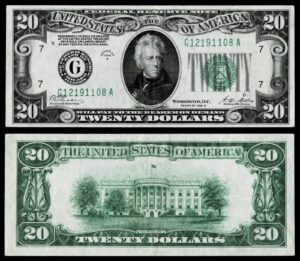
The $20 denomination shows a different error profile. Twenty-dollar face shifts are less common in the known error population than $1 or $5 examples, likely because higher-denomination sheets received more rigorous inspection before release. When they do appear, they command strong premiums. A Series 1963 $20 Chicago (G) note with an upward face shift of approximately 9 mm graded PMG 55 EPQ realized $2,200 at auction, demonstrating that even circulated high-denomination shift errors attract serious bidder competition.
Before submitting a suspected shift error for third-party grading, examine both the face and back carefully under raking light. True faulty alignment errors will show consistent directional displacement across the entire face design, including both the portrait vignette and the denomination numerals. If only one design element appears off-center while others align normally, you may be looking at a cutting error rather than a face misalignment, and the distinction matters significantly for catalog identification and value.
The Overprint Complication: Two-Error Notes
A small but exceptionally exciting subset of Series 1963 shift errors involves notes where both the face printing and the overprint are shifted, sometimes in different directions from one another. These two-error notes occur when a sheet that already carried a misaligned face passed back through the press for the overprint stage without being culled. The result is a note where Washington’s portrait tilts one direction while the Federal Reserve seal and serial numbers tilt another, creating a visually chaotic but numismatically extraordinary piece.
Two confirmed examples of this type from Series 1963 have been authenticated by PMG, both $1 New York (B) notes. One carries a face shift of approximately 8 mm downward combined with an overprint shift of approximately 5 mm to the right, placing the green Federal Reserve seal partially over the portrait area. That note graded PMG 64 EPQ and sold privately for a reported $3,800 in 2019. Two-error notes of this type are not cataloged separately in most standard references, making them one of the more underappreciated opportunities in the Series 1963 error market.
Grading Shift Errors: Special Considerations
Third-party grading services apply their standard grading scales to shift errors but make no formal adjustments to the numerical grade based on shift magnitude alone. That said, PMG and PCGS Currency both note the nature and approximate magnitude of the misalignment in the certification holder’s description field, which directly affects market value independent of the numerical grade. A PMG 30 Very Fine note with a 14 mm diagonal shift will typically outperform a PMG 35 Choice Very Fine note with a 4 mm minor shift at auction, even though the grade itself is lower.
Collectors should also be aware that some faulty alignment errors will be graded with a net grade notation if the note shows other issues. A major shift error that also has a small corner fold, for example, might grade PMG 30 NET rather than a straight 30, and that net designation can have a chilling effect on bidding even when the error itself is dramatic. EPQ (Exceptional Paper Quality) designations carry particular weight on error notes because original, uncirculated paper quality confirms the note was preserved as found and not manipulated after the fact.
| Series / Denomination | District | Approx. Base Print Run | Rarity |
|---|---|---|---|
| 1963 $1 | New York (B) | 460,000,000+ | Common |
| 1963 $1 | Chicago (G) | 380,000,000+ | Common |
| 1963 $1 | San Francisco (L) | 310,000,000+ | Common |
| 1963 $1 | Richmond (E) | 145,000,000 | Scarce |
| 1963 $1 | Minneapolis (I) | 42,000,000 | Rare |
| 1963-A $1 | Dallas (K) | 38,400,000 | Rare |
| 1963 $5 | Richmond (E) | Not separately published | Rare |
| 1963 $10 | Any district | Lower than $1 by factor of 8-10x | Rare |
| 1963 $20 | Chicago (G) | Not separately published | Rare |
| 1963 $1 Two-Error | New York (B) | Fewer than 5 confirmed | Key Date |
Building a District Set: A Collector Strategy
One of the most compelling ways to approach Series 1963 shift errors is to build a district set: one shifted face example from each of the twelve Federal Reserve districts on the $1 denomination. This approach has several advantages. The $1 denomination gives you the largest pool of available examples to choose from, error magnitudes are easier to verify visually, and the price points are accessible enough that even early-career collectors can participate. A complete twelve-district set of $1 Series 1963 shifted face errors, assembled in grades ranging from Fine to Very Fine with major shifts, would represent a genuinely rare and exhibition-worthy collection.
Start with the high-volume districts, New York, Chicago, and San Francisco, where examples appear regularly in dealer stock and at major auction houses like Heritage, Stack’s Bowers, and Lyn Knight Currency Auctions. Use those acquisitions to calibrate your eye for shift magnitude and to establish relationships with dealers who specialize in error currency. Then pursue the low-volume districts, particularly Minneapolis, Dallas, and Kansas City, where patience and a willingness to wait for the right example are essential virtues.
The Paper Money Guaranty (PMG) population report is freely searchable online and is invaluable for researching Series 1963 error notes. Search under the note type and look for the holder description fields that mention “misalignment” or “shift.” PMG’s error notation system will indicate both the type and direction of shift when documented by the grader. Cross-reference with PCGS Currency’s population data for a more complete picture of known survivors.
Authentication Concerns: Detecting Fraudulent Alterations
As with all premium error notes, the Series 1963 shifted face market attracts a small number of fraudulent pieces. The most common manipulation involves trimming one or more margins of a normal note to simulate the appearance of a shifted design. A carefully trimmed $1 note can be made to look as though the face design migrated toward one edge, but close examination under magnification will reveal uneven fiber cuts at the trimmed edge, an absence of the natural paper deckle, and dimensional measurements that fall short of standard note specifications.
A genuine Series 1963 $1 Federal Reserve Note measures 6.14 inches by 2.61 inches (156 mm by 66.3 mm). Any note submitted as a shift error that measures substantially less in either dimension should be treated with extreme suspicion. Third-party grading remains the gold standard for authentication, and no serious collector should pay a premium for a raw, unholdered shift error note above the $200 level without independent expert verification.
Conclusion: A Productive Niche With Real Depth
Series 1963 Federal Reserve Notes with shifted face printings occupy a productive niche in American error currency collecting. They are numerous enough that dedicated collectors can actually assemble meaningful sets, yet scarce enough by district and denomination that the hunt remains genuinely challenging. The historical backdrop of BEP expansion, dry-process printing transitions, and massive concurrent district production creates a plausible and documented explanation for why these errors exist. That context makes the notes more than curiosities. They become artifacts of a specific transitional moment in American currency manufacturing history, and that combination of numismatic rarity and historical narrative is exactly what drives long-term collector enthusiasm and market resilience.