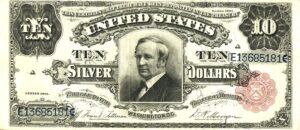
Ask most currency collectors to name a $20 Treasury Note and you will likely get a blank stare or a vague reference to the more commonly discussed Legal Tender issues. Yet the Series 1891 $20 Treasury Note, bearing the portrait of Chief Justice John Marshall, represents one of the most visually striking and historically loaded pieces in the entire Coin Note series. Issued during a turbulent monetary era when the federal government was navigating the demands of silver coinage legislation, these notes blend elegant Bureau of Engraving and Printing artistry with genuine scarcity. Whether you are a beginning collector drawn to 19th-century currency or a seasoned numismatist filling out a type set, this note deserves far more attention than it typically receives.
What Is a Treasury Note, and Why Does the $20 Matter?
Treasury Notes, often called Coin Notes, were authorized by the Sherman Silver Purchase Act of July 14, 1890. Congress passed this legislation as a compromise with silver-producing states, requiring the U.S. Treasury to purchase 4.5 million ounces of silver per month and to issue Treasury Notes in payment for that silver. Critically, holders could redeem these notes in either gold or silver coin at the Treasury’s discretion, making them a unique hybrid in the American monetary system. The series was short-lived: the panic of 1893 prompted President Grover Cleveland to call a special session of Congress, which repealed the Sherman Act in November 1893, effectively ending the Coin Note program after just two series, 1890 and 1891.
The $20 denomination was printed in both series but the 1891 issue replaced the ornate, visually complex back design of the 1890 notes with a cleaner, more open reverse. The 1890 $20 Treasury Note features an elaborate “tombstone” counter design on the back that collectors prize for its beauty, but the 1891 version is arguably more elegant in its restraint. Both share the Marshall portrait on the face, but only the 1891 issue carries the red small-scalloped Treasury seal that would become a hallmark of later 19th-century federal currency design refinement.
John Marshall: A Portrait Choice with Constitutional Weight
The selection of John Marshall for the $20 Treasury Note was not arbitrary. As the fourth Chief Justice of the United States, serving from 1801 until his death in 1835, Marshall shaped the constitutional architecture of the federal government more profoundly than almost any other single figure. His landmark decisions in Marbury v. Madison (1803), which established judicial review, and McCulloch v. Maryland (1819), which affirmed broad federal power including the constitutionality of the Bank of the United States, made him a logical symbol for a note issued by the federal Treasury. There is a certain irony in placing Marshall, who upheld the federal bank’s constitutionality, on a note born out of silver politics, but the Bureau of Engraving and Printing was focused on dignity and historical gravitas when selecting portrait subjects.
The portrait engraving on the 1891 $20 was executed with the fine line detail that defines BEP work of the period. Marshall is depicted in three-quarter view, wearing judicial robes, with the engraving capturing both authority and intellectual depth. The lathe work surrounding the portrait vignette is intricate without overwhelming, and the overall face design is considered among the more composed of the entire Treasury Note series.
When examining a Series 1891 $20 Treasury Note, check the portrait engraving under magnification. Genuine notes show crisp, fine line work in Marshall’s facial features and robe detail. Washed-out or muddy portrait lines in otherwise high-grade notes can indicate cleaning or chemical treatment, which PCGS and PMG graders will note as “details” grades.
Design Details: Face and Back
The face of the Series 1891 $20 Treasury Note is printed primarily in black ink with a red Treasury seal positioned to the right of center. The seal on the 1891 issues is the small red scalloped variety, distinguishing it immediately from the large red spiked seal seen on some earlier issues and from the brown or blue seals of other note types of the era. The serial numbers are printed in red as well, creating a clean two-color composition against the black engraving.
The back of the 1891 $20 is printed in green, a departure from the more complex ornamental designs of the 1890 series. The large numeral “20” dominates the center of the reverse, flanked by decorative scrollwork, with the obligation text “This note is a legal tender at its face value in payment of all debts public and private except when otherwise expressly stipulated in the contract” printed clearly. The simplified back was part of a broader BEP effort to improve the counterfeit-detection clarity of federal currency, making genuine notes easier for the public to authenticate by visual inspection.
Signature Combinations and Friedberg Numbers
The Series 1891 $20 Treasury Note was issued under two signature combinations, each cataloged separately in the Friedberg reference guide, which is the standard catalog used by collectors and dealers for U.S. paper money.
Fr. 375 carries the signatures of Treasurer James Fount Tillman and Register of the Treasury Edmund Burke. Tillman served as Treasurer from 1893 to 1897, and Burke served as Register from 1893 to 1897 as well. Fr. 375 is the more commonly encountered of the two varieties, though “common” is a relative term given the overall low survival rates for this series.
Fr. 376 carries the signatures of Treasurer Daniel N. Morgan and Register of the Treasury Judson W. Lyons. Morgan served as Treasurer from 1893 to 1897 and Lyons served as Register from 1898 to 1906, making Fr. 376 a later printing. Fr. 376 is considered scarcer than Fr. 375 in circulated grades, though the population differential is not dramatic in the highest grades.
Always verify the signature combination before purchasing a Series 1891 $20 Treasury Note. Tillman-Burke (Fr. 375) and Morgan-Lyons (Fr. 376) notes are priced differently in major auction results. A misidentified note, especially one sold as the scarcer variety, is a costly mistake that even experienced collectors have made when relying on unclear photographs in online listings.
Population Reports and Surviving Examples
Survival rates for Series 1891 $20 Treasury Notes are genuinely low across all grade levels. These notes circulated actively during the 1890s and early 1900s, and many were redeemed and destroyed as part of normal Treasury currency retirement. The combined PCGS and PMG certified population for Fr. 375 and Fr. 376 in all grades hovers in the low hundreds, with notes grading Very Fine 20 to Extremely Fine 40 representing the largest portion of surviving examples.
Uncirculated examples are notable rarities. PMG-graded examples at 63 Choice Uncirculated or above are infrequently offered at public auction, typically appearing only a handful of times per decade in major sales conducted by Heritage Auctions, Stack’s Bowers, or Lyn Knight Currency Auctions. When they do surface, they command prices well above guide values, driven by competitive bidding from advanced type collectors and specialized Treasury Note collectors.
In circulated grades, a Very Good 10 example of Fr. 375 might sell in the $800 to $1,200 range at auction depending on eye appeal and the absence of problems such as tears, tape repairs, or heavy staining. Fine 15 examples regularly bring $1,500 to $2,500. Jumping to Very Fine grades, prices climb to $3,500 and above for attractive, problem-free notes. At the Extremely Fine level, Fr. 375 examples have brought $6,000 to $9,000 in recent auction cycles.
For this series, eye appeal matters enormously in determining realized price. A PMG Very Fine 25 note with original paper surfaces and bright color will often outperform a mechanically graded Very Fine 30 with dull, washed color or a repaired corner. Always request high-resolution scans from dealers and study the note’s overall visual presentation, not just the numeric grade.
Collecting Context: Treasury Notes as a Type Set Challenge
Many collectors approach Treasury Notes as part of a broader 19th-century type set, attempting to acquire one representative example of each major note type and denomination issued by the federal government. Within this framework, the $20 denomination Treasury Note is one of the more challenging pieces to acquire in presentable circulated condition at a reasonable price point. The $1 and $2 Treasury Notes of 1890 and 1891 are far more plentiful and affordable, and the $5 and $10 denominations, while scarce, appear at auction with enough regularity that patient collectors can find them. The $20, $50, $100, and $1,000 denominations represent genuine challenges, with the $20 being the entry point into the true scarcity tier of this series.
For collectors building a comprehensive Treasury Note collection by denomination, acquiring both the 1890 and 1891 $20 issues is the natural goal. The 1890 $20 (Fr. 373 and Fr. 374) features the distinctive ornate back and is often considered the more visually dramatic piece. Owning both side by side tells the complete story of how BEP design philosophy evolved within just one year of the series’ existence.
| Friedberg Number | Signatures | Estimated Surviving Examples | Rarity |
|---|---|---|---|
| Fr. 375 | Tillman-Burke | 150-200 known | Scarce |
| Fr. 376 | Morgan-Lyons | 80-120 known | Rare |
| Fr. 373 (1890 $20) | Rosecrans-Huston | 100-150 known | Scarce |
| Fr. 374 (1890 $20) | Rosecrans-Nebeker | 60-90 known | Rare |
| Fr. 375 in VF30 or above | Tillman-Burke | Approx. 40-60 known | Rare |
| Fr. 376 in EF40 or above | Morgan-Lyons | Fewer than 20 known | Key Date |
| Fr. 375 in CU63 or above | Tillman-Burke | 5-8 known | Key Date |
| Fr. 376 in CU63 or above | Morgan-Lyons | 2-3 known | Key Date |
Authentication Considerations
Given their age and value, Series 1891 $20 Treasury Notes do attract the attention of counterfeiters and paper alterers. The most common form of fraud seen with 19th-century large-size currency is not outright counterfeiting but rather the cleaning, pressing, and artificial aging of notes to improve apparent grade. A circulated Fine example that has been cleaned and pressed can appear to be a Very Fine or Extremely Fine note to the untrained eye, yet the loss of natural surface fibers and original embossed print feel will reveal the treatment under proper examination.
Third-party grading and authentication by PMG (Paper Money Guaranty) or PCGS Currency is strongly recommended for any Series 1891 $20 Treasury Note. Both services maintain expert examination teams specifically trained in large-size U.S. currency, and their holders provide immediate market credibility when reselling. The cost of grading submission is minor relative to the purchase price of these notes at any grade level.
Ungraded Series 1891 $20 Treasury Notes offered at estate sales, antique shows, or general online auctions should be treated with caution. Before purchasing a raw example above the $500 mark, have it examined by a PCGS or PMG-authorized dealer, or plan to immediately submit it for encapsulation. The grading fee is an investment, not an added cost, when dealing with notes of this age and value.
Where to Find These Notes Today
The most reliable sources for Series 1891 $20 Treasury Notes are the major currency auction houses: Heritage Auctions holds multiple large-format currency auctions annually and maintains an extensive archive of past realizations that is invaluable for pricing research. Stack’s Bowers Galleries and Lyn Knight Currency Auctions also handle significant examples of this type regularly. For collectors who prefer direct purchase, dealers affiliated with the Professional Currency Dealers Association (PCDA) or the International Bank Note Society (IBNS) are solid resources.
Price guides such as the Standard Guide to Small-Size U.S. Paper Money and the Schwartz-Shull large-size price guide provide baseline values, but auction records are the true market indicator for notes of this scarcity. Cross-referencing recent Heritage and Stack’s realized prices with current dealer retail offerings will give any collector a clear picture of fair market value before making a purchase commitment.
Conclusion: A Note That Rewards Serious Attention
The Series 1891 $20 Treasury Note is not a note for casual collectors building inexpensive type sets, but it is absolutely a note for collectors who want to own a piece of American monetary history at the intersection of silver politics, constitutional legacy, and masterful 19th-century engraving. John Marshall’s portrait carries genuine symbolic weight, the red seal and red serial numbers create a visually striking composition, and the rarity of surviving examples, particularly in the higher grades, ensures that acquisition remains a meaningful achievement. For those willing to invest the time in market research and patient searching through reputable auction channels, the rewards are a note that anchors any large-size collection with authority and distinction.