📷 Image source: Wikimedia Commons. Images are selected by AI to represent the article topic and may not depict the exact note(s) described.
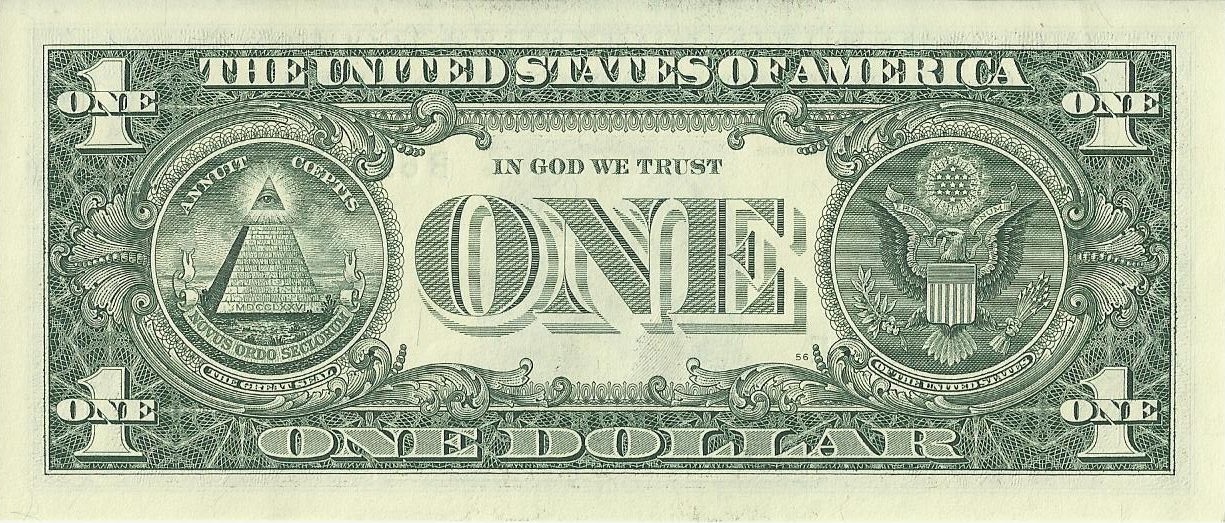
Pull a dollar bill from your wallet and flip it over. There, above the word ONE, sits the phrase “In God We Trust” — so familiar now that most Americans never give it a second glance. But that motto did not always appear on Federal Reserve Notes. It took an act of Congress, a presidential signature, and a full redesign of the currency’s reverse printing plates to put those words there. The Series 1963 Federal Reserve Notes were the first to carry this inscription, and they represent one of the most historically charged issues in twentieth-century American paper money. For collectors, they offer a rich landscape of varieties, scarce star notes, and signature combinations that reward careful study.
The Road to the Motto: Legislative and Historical Context
The phrase “In God We Trust” had appeared on certain U.S. coins as far back as 1864, introduced during the Civil War at the urging of Treasury Secretary Salmon P. Chase and religious citizens who wanted a divine acknowledgment on the nation’s coinage. But paper currency was a different matter. It was not until July 30, 1956, that President Dwight D. Eisenhower signed Public Law 84-851 into law, making “In God We Trust” the official national motto of the United States. A companion measure, signed the same day, required the motto to appear on all U.S. currency, coins and paper alike.
Implementation on paper money moved gradually. The motto first appeared on the reverse of Series 1957 Silver Certificates in the $1 denomination, where it was incorporated during a redesign of the reverse printing plates. Federal Reserve Notes, however, lagged behind. It was not until the Series 1963 issue that all Federal Reserve Notes across all denominations carried the inscription. This made 1963 the true watershed year for the motto’s universal presence on American paper currency.
The timing also overlapped with a broader cultural moment. The early 1960s saw Congress and the executive branch both emphasizing religious identity as a counter to Soviet atheism during the Cold War. Putting “In God We Trust” on every Federal Reserve Note circulating in millions of American wallets was, in part, a statement of national values that extended well beyond numismatic policy.
Design and Physical Characteristics
The Series 1963 Federal Reserve Notes retained the familiar portraits and vignettes that had defined Federal Reserve Notes since the 1928 redesign. The $1 featured George Washington, the $5 Abraham Lincoln, the $10 Alexander Hamilton, the $20 Andrew Jackson, the $50 Ulysses S. Grant, and the $100 Benjamin Franklin. What changed was exclusively on the reverse: “In God We Trust” was added above the large central denomination word on each bill’s back design.
Collectors should note that the green Federal Reserve seal and green Treasury seal appear on the face of these notes, consistent with all Federal Reserve Notes of the era. The district letter and number identifying the issuing Federal Reserve Bank appear in the four corners of the face, and the black Federal Reserve seal to the left of the portrait carries the district letter as well. These design conventions remained unchanged from immediately prior series.
When examining Series 1963 notes, use a loupe to confirm the motto’s presence on the reverse. Occasionally, pre-1963 series notes are mislabeled by novice sellers. On genuine Series 1963 Federal Reserve Notes, “In God We Trust” appears in small serif type above the large denomination word on the back, and its engraving depth is consistent with surrounding design elements.
Signature Combinations: Granahan-Dillon and Granahan-Fowler
Two signature combinations appear across the 1963 series issues, and distinguishing them is fundamental to building a complete type set.
The Series 1963 notes carry the signatures of Treasurer of the United States Kathryn O’Hay Granahan and Secretary of the Treasury C. Douglas Dillon. Granahan served as Treasurer from April 1962 to November 1966, while Dillon served as Secretary from January 1961 to April 1965. Their pairing on the 1963 series is historically notable: Granahan was only the second woman to serve as Treasurer, and her signature appears on an extraordinarily large volume of notes from the early-to-mid 1960s.
The Series 1963-A notes bear the signatures of Granahan and the new Secretary of the Treasury Henry H. Fowler, who replaced Dillon in April 1965. The suffix letter “A” was added to the series designation whenever a new signature combination was adopted without a fundamental redesign of the notes. Collectors sometimes overlook the 1963-A designation when building sets, but completing both signature types across all twelve districts and all denominations is a serious undertaking.
The $1 Federal Reserve Note of 1963: The Collector’s Gateway
The $1 Series 1963 Federal Reserve Note is by far the most accessible entry point for collectors. Produced in enormous quantities across all twelve Federal Reserve districts (Boston, New York, Philadelphia, Cleveland, Richmond, Atlanta, Chicago, St. Louis, Minneapolis, Kansas City, Dallas, and San Francisco), circulated examples are plentiful and inexpensive. A circulated $1 1963 or 1963-A can often be found for a dollar or two above face value.
The real collecting challenge lies in uncirculated examples with strong paper quality and centering, star notes (replacement notes), and district completions. A full set of $1 Series 1963 notes would require all 12 districts in both Series 1963 and 1963-A, plus star notes from each district in both series, totaling well over 48 individual notes. Some district star note combinations are genuinely scarce, particularly from lower-volume printing districts like Minneapolis and San Francisco in the 1963 series.
Star notes from the Series 1963 $1 Federal Reserve Notes are identified by a star symbol replacing the first letter of the serial number. When searching for these, focus on the Minneapolis (I) and San Francisco (L) districts, which had the smallest star note print runs in the 1963 series. Even in circulated grades, these can command meaningful premiums over common-district examples.
Higher Denominations: Underappreciated Rarities
While the $1 notes dominate collector attention, the Series 1963 higher denominations present their own compelling stories. The $2 denomination was not issued as a Federal Reserve Note in this series (the $2 FRN did not debut until Series 1976), so the six denominations ran from $1 through $100.
The $100 Series 1963 and 1963-A Federal Reserve Notes are particularly underappreciated by collectors. Because higher-denomination notes were used heavily in commerce and wore out quickly, finding genuinely crisp uncirculated examples is harder than one might expect given their later print dates. The $50 and $100 notes were also more likely to be saved briefly as curiosities when first issued, but true gem uncirculated survivors are not common.
The $5 and $10 denominations occupy a middle ground. They circulated heavily but were printed in sufficient quantities that Very Fine to Extremely Fine examples are affordable for most collectors. The $20 Series 1963 notes were produced in large quantities as well, though certain district and signature combination pairings are considerably scarcer than others.
Grading Considerations
For Series 1963 Federal Reserve Notes, the standard Sheldon-derived paper money scale applies. The PMG and PCGS Currency grading services are the recognized authorities, and their holders provide market confidence, particularly for notes above the Very Fine range. For the common $1 notes, only MS-65 EPQ (Exceptional Paper Quality) or better examples justify third-party grading costs. For star notes, scarce district combinations, or higher denominations in uncirculated condition, grading is strongly recommended before significant purchases.
Key grading points for this series include ink strike quality (look for sharp, complete motto lettering on the reverse), centering of margins on all four sides, paper freshness free of folds or counting wrinkles, and the absence of rust or soiling near the red fiber threads embedded in the paper. A note with an off-center reverse is common and generally not penalized heavily in grades below Uncirculated, but gem-grade examples demand four-sided centering within approximately 1mm tolerance.
Many Series 1963 $1 Federal Reserve Notes were saved as souvenirs when first issued due to the motto change. However, most were stored loosely in drawers or books, resulting in notes that grade AU-55 or AU-58 due to light handling folds at the corners. True gem uncirculated (MS-65 or better) examples from the original issue are rarer than their print numbers suggest, so do not overpay for raw notes claimed to be “uncirculated” without careful examination.
Notable Varieties and Errors
Beyond the expected district and signature varieties, Series 1963 Federal Reserve Notes produced a number of documented printing errors that attract specialist collectors. Printed folds, double impressions, missing overprints, and dramatic miscuts all appear in the population reports of major grading services. The BEP’s production methods of the early 1960s, while technically advanced for the time, were not immune to mechanical anomalies, and the large print runs of the 1963 series mean that errors surface regularly in the marketplace.
One variety worth knowing: certain $1 Series 1963-A notes from the New York district (B) exhibit a sub-variety related to plate position markings. While not dramatically price-affecting, advanced collectors documenting plate usage find these details fascinating. The standard reference for plate varieties in this era remains the Friedberg catalog, now in its twentieth edition, which assigns Friedberg numbers to distinguish denominations, series, and districts.
| Series / Denomination | District or Variety | Approx. Print Run | Rarity |
|---|---|---|---|
| 1963 $1 | New York (B) Regular | Over 1 billion | Common |
| 1963 $1 Star | Atlanta (F*) | Approx. 3,840,000 | Scarce |
| 1963 $1 Star | Minneapolis (I*) | Approx. 640,000 | Rare |
| 1963 $1 Star | San Francisco (L*) | Approx. 1,920,000 | Scarce |
| 1963-A $1 Star | Minneapolis (I*) | Approx. 640,000 | Rare |
| 1963 $5 | All Districts, Regular | Varies by district | Common |
| 1963 $50 | Any District, Gem Unc. | Moderate quantities | Scarce |
| 1963 $100 | Any District, Gem Unc. | Moderate quantities | Scarce |
| 1963-A $100 | Boston (A), Star Note | Under 500,000 est. | Key Date |
| 1963 Any Denom. | Dramatic Printing Error | Very few documented | Rare |
Building a Series 1963 Collection: Strategies and Starting Points
For collectors approaching the Series 1963 issue for the first time, a tiered strategy works well. Start with a type set: one circulated example each of the $1 through $100 in either the 1963 or 1963-A series. This gives you a tangible connection to the motto’s debut on Federal Reserve Notes without requiring a major financial commitment. A nice Very Fine set can be assembled for well under $200 in today’s market.
From there, consider expanding into star notes for the $1 denomination, focusing first on the common New York and Chicago districts to understand what genuine star notes look like, then hunting for the scarcer Minneapolis and San Francisco examples. Online auction platforms, major paper money shows such as the Memphis International Paper Money Show (held annually each June), and specialist dealers all provide sourcing opportunities.
Advanced collectors building a complete district set across both series and both signature combinations will find the project occupying months or years of searching. This is genuinely competitive territory at the upper end, where gem Minneapolis or Boston star notes from the 1963 series appear infrequently and attract multiple bidders when they do surface.
Conclusion: A Motto, a Moment, and a Magnificent Collecting Challenge
The Series 1963 Federal Reserve Notes hold a secure place in American numismatic history. They are the notes that completed the national motto’s migration onto all circulating U.S. paper currency, a journey that began with Civil War-era coinage and culminated on the backs of bills that passed through hundreds of millions of American hands in the mid-1960s. Whether you are drawn to the historical narrative, the challenge of completing district sets, the hunt for elusive star notes, or simply the pleasure of owning a crisp, original example of the first Federal Reserve Note to carry “In God We Trust,” this series rewards every level of engagement. The motto has been there ever since, taken for granted by most and treasured by the few who know the story behind it.