📷 Image source: U.S. Currency Education Program (uscurrency.gov). Images are selected by AI to represent the article topic and may not depict the exact note(s) described.
In the summer of 1929, the United States embarked on one of the most dramatic overhauls in the history of American paper money: the shift from large-size to small-size currency. What most collectors know well is that this transition produced the familiar National Bank Notes and Federal Reserve Notes in their new compact format. What is less commonly appreciated is that a parallel series of emergency-issue notes, the Federal Reserve Bank Notes of Series 1929, was simultaneously authorized and printed for all twelve Federal Reserve districts. Among these, the $50 and $100 denominations stand apart as the highest-value brown seal notes ever produced in the small-size era, combining institutional authority with a sense of urgency that makes them endlessly fascinating to study and collect.
What Are Federal Reserve Bank Notes?
Federal Reserve Bank Notes (FRBNs) are frequently confused with Federal Reserve Notes, but they are legally and structurally distinct. While Federal Reserve Notes are obligations of the United States government, Federal Reserve Bank Notes are direct obligations of the individual Federal Reserve Bank that issued them. This distinction is printed right on the face of the note: “The Federal Reserve Bank of [City] will pay to the bearer on demand” a stated sum in lawful money. The brown Treasury seal and brown serial numbers visually distinguish them from the green-seal Federal Reserve Notes that collectors are most accustomed to handling.
The Series 1929 FRBNs were authorized under the Federal Reserve Act and were intended as a transitional measure. The Bureau of Engraving and Printing needed time to fully retool production for the new small-size Federal Reserve Notes, and the FRBN series essentially bridged the gap, allowing Federal Reserve Banks to meet currency demand during the changeover. They were backed by the same collateral requirements as National Bank Notes of the same era, giving them a hybrid character that is unique in American monetary history.
The Emergency Context: Why the $50 and $100 Were Critical
When Congress authorized the small-size currency transition with the Currency Redesign Act of 1929, the banking system was entering a period of profound instability. The stock market crash of October 1929 arrived just as the new notes were beginning to circulate, dramatically increasing the urgency with which high-denomination notes were needed. Banks required large quantities of $50 and $100 notes to meet withdrawal demands, conduct interbank settlements, and maintain public confidence in the currency. The FRBN series, already in production, answered that call.
Each of the twelve Federal Reserve Banks issued $50 and $100 denominations under their own district name and charter, signed by two bank officers: the Governor (later titled President) of the issuing Federal Reserve Bank and the Cashier of that same bank. This is a key identification point. Unlike Federal Reserve Notes, which carry the signatures of the Treasurer of the United States and the Secretary of the Treasury, FRBNs carry district-level officer signatures. These signatures vary by district and add a layer of variety that dedicated collectors pursue aggressively.
Always check the officer signatures on Series 1929 FRBNs. The Governor and Cashier combinations vary by district and by the period of issue. Some signature pairings for the $50 and $100 are considerably scarcer than others, and this variety is often underpriced in dealer inventory because buyers focus only on the district rather than the specific signing officers.
Design and Physical Characteristics
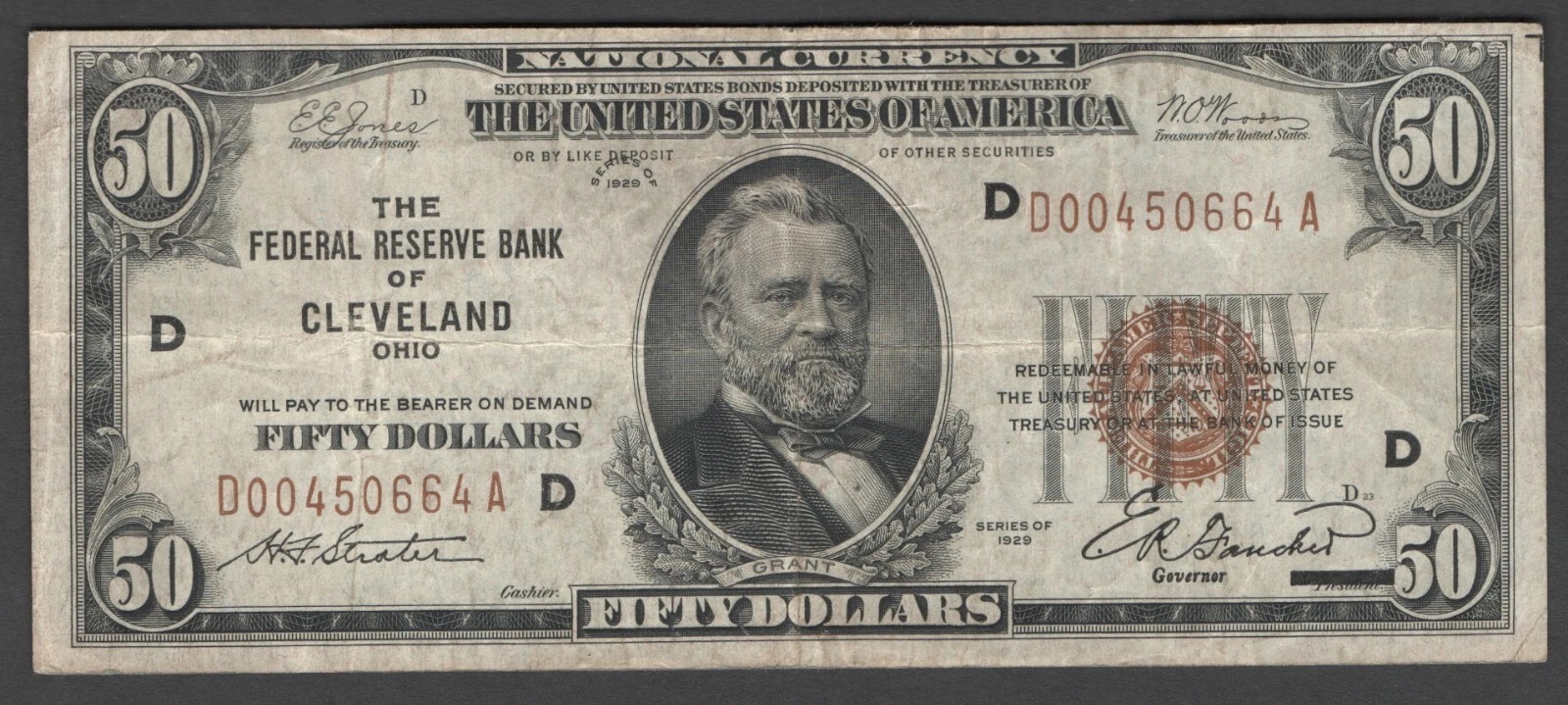
The $50 Series 1929 FRBN features a portrait of Ulysses S. Grant on the obverse, consistent with the $50 denomination across all note types of the era. The reverse depicts the United States Capitol building. The $100 features Benjamin Franklin on the obverse, with Independence Hall on the reverse. Both designs were carried over from the large-size format and adapted for the 6.14 by 2.61 inch small-size standard that remains in use today.
The brown Treasury seal appears to the right of the portrait on both denominations, and serial numbers are printed in brown ink, which immediately distinguishes these notes from contemporary green-seal Federal Reserve Notes. The issuing district is identified by a large letter and numeral, printed in black, on the face of the note. The plate letters and check letters follow the same format used on National Bank Notes of the period, a practical consequence of the shared printing infrastructure.
Paper quality and print sharpness vary considerably across surviving examples because these notes circulated during the Great Depression, a period when currency was used hard before being returned to banks. Uncirculated specimens of the $50 and $100 are genuinely uncommon, and gem-grade examples command strong premiums at auction.
When evaluating Series 1929 FRBN $50 and $100 notes for grade, pay particular attention to the corners and the area around the portrait, where wear concentrates first. A note that appears bright and crisp in photographs may reveal corner folds or a central crease under direct light. Always request high-resolution scans of both faces before purchasing.
The Twelve Districts: Which Are Scarce at These Denominations?
All twelve Federal Reserve Banks issued both the $50 and the $100 in the Series 1929 FRBN format, but print quantities varied dramatically by district. The Boston (A), Minneapolis (I), and Dallas (K) districts consistently produced the smallest print runs at these denominations, reflecting the smaller economic footprints of those banking regions in 1929. The New York (B) and Chicago (G) districts printed the largest quantities, and survivorship is correspondingly higher for those districts today.
However, high print numbers do not always translate to high survival rates. Many notes from the Atlanta (F) and St. Louis (H) districts circulated intensely through rural communities during the Depression and suffered proportionally higher attrition rates. Regional collection patterns also play a role: collectors in certain parts of the country have long focused on their home districts, creating demand that depletes the available pool of high-grade examples faster than for other districts.
The San Francisco (L) district $100 is particularly noted among advanced collectors for its combination of a modest print run and documented collector demand from the West Coast, where FRBN collecting has a deep tradition. Meanwhile, the Kansas City (J) $50 in Very Fine or better has proven surprisingly difficult to locate in recent auction cycles, suggesting that circulated notes from that district were rarely saved by contemporary collectors.
Building a complete district set of $50 or $100 Series 1929 FRBNs in a consistent grade is a long-term project that rewards patience. Consider setting a minimum grade threshold, such as Fine-15, before beginning, as mixing circulated and uncirculated examples in the same album creates a visually inconsistent presentation. A circulated set in uniform VF is often more satisfying and ultimately more valuable than a set with wide grade variance.
Grading Nuances for High-Denomination Brown Seals
Grading Series 1929 FRBNs follows the same standards applied to all small-size currency, but there are a few denomination-specific considerations worth noting. Because $50 and $100 notes circulated in commercial and banking contexts rather than everyday retail transactions, they sometimes show different wear patterns than lower denominations. A $50 note might display sharp corners and minimal surface wear but carry a light fold through the center, suggesting it was stored folded in a cash drawer rather than passed hand to hand. PCGS Currency and PMG both account for these patterns, but collectors who grade their own notes should be aware that apparent freshness on the edges can be misleading.
Paper quality is another grading factor specific to these notes. FRBNs were printed on the same cotton-linen stock used for National Bank Notes, and some lots of that paper have developed a slightly yellowish cast over decades of storage. This toning is distinct from artificial cleaning, and experienced graders can usually distinguish between the two. Notes with original skin and honest toning often grade higher than they appear to novice eyes, while artificially brightened notes tend to fail technical grading with a details designation.
Auction Records and Current Market Values
The auction market for Series 1929 FRBN $50 and $100 notes has been active throughout the 2010s and into the 2020s, with Heritage Auctions and Stack’s Bowers recording the most significant results. A PMG 65 EPQ example of the Minneapolis $100 sold for over $14,000 in a 2019 Heritage sale, reflecting both the scarcity of that district at gem grade and the strong demand for brown seal high-denomination notes. At the other end of the spectrum, a circulated Very Good $50 from New York might sell in the $150 to $300 range, making entry-level collecting accessible even at these denominations.
The most important price determinant is the combination of district, grade, and signature pairing. A Boston $50 in Fine with a desirable officer signature combination will consistently outperform a nominally higher-grade New York example because the collector base for scarce districts is deep and well-funded. Consulting the Standard Catalog of United States Paper Money alongside recent realized prices on Heritage, Stack’s Bowers, and GreatCollections gives the most accurate picture of current market conditions.
| District / City | Denomination | Est. Print Run | Rarity |
|---|---|---|---|
| Boston (A) | $100 | Approx. 14,400 | Rare |
| New York (B) | $100 | Approx. 180,000 | Common |
| Philadelphia (C) | $50 | Approx. 28,800 | Scarce |
| Minneapolis (I) | $100 | Approx. 12,000 | Key Date |
| Kansas City (J) | $50 | Approx. 19,200 | Rare |
| Dallas (K) | $100 | Approx. 10,800 | Key Date |
| San Francisco (L) | $100 | Approx. 24,000 | Scarce |
| Chicago (G) | $50 | Approx. 96,000 | Common |
| Atlanta (F) | $50 | Approx. 21,600 | Scarce |
| Richmond (E) | $100 | Approx. 16,800 | Rare |
Storage, Certification, and Building Your Collection
For notes at the $50 and $100 denomination level, third-party grading by PMG or PCGS Currency is strongly recommended before purchase. The combination of meaningful monetary value and historical significance makes authentication important, and certified holders also provide long-term archival protection superior to most aftermarket currency sleeves. Notes above a raw Fine grade are almost always better purchased certified, since the grading premium more than pays for itself in transaction confidence and future resale value.
Storage of raw notes should use Mylar-D or equivalent inert polyester holders, never PVC-based plastics, which will eventually migrate plasticizer onto the note surface and cause irreversible damage. Temperature and humidity stability matters more for high-denomination notes that show toning sensitivity, so a climate-controlled environment away from light exposure is the sensible long-term storage approach.
Conclusion: A Worthy Pursuit for Serious Collectors
The Series 1929 Federal Reserve Bank Notes in $50 and $100 denominations occupy a distinctive corner of American numismatic history. They emerged from an institutional emergency, circulated through the worst economic crisis the country had seen, and survived in numbers far smaller than their initial print runs might suggest. Collecting them by district, by signature combination, or in matched denomination pairs across all twelve banks offers a structured pursuit that can take years to complete at any meaningful grade level. For collectors who want a series that combines genuine historical depth, visual distinction, and measurable rarity into a focused specialty, the high-denomination brown seals of 1929 remain one of the most rewarding areas in all of small-size United States paper money.