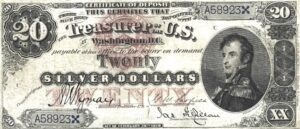
Pick up an 1882 National Bank Note Brown Back in decent condition and turn it over. What greets you is not the restrained geometry of modern Federal Reserve notes but something far more ambitious: a Great Seal eagle rendered with almost baroque confidence, its breast covered by a bold shield of alternating red and white stripes, its talons clutching arrows and an olive branch, its wings spread as if the bird itself had just alighted on the note from some Gilded Age government ceiling mural. This reverse design was deliberate, layered with meaning, and it tells us a great deal about how the United States chose to present itself during one of the most economically turbulent and nationally self-conscious periods in its history.
Context: The National Banking System and the Brown Back Era
To appreciate the symbolism on the reverse, one must first understand what these notes represented in the American financial landscape. National Bank Notes were issued by federally chartered private banks under the National Bank Acts of 1863 and 1864. Each issuing bank printed notes bearing its own name, charter number, and the names of its president and cashier, but the federal government controlled the design and guaranteed a measure of uniformity across the system.
The 1882 series succeeded the so-called Original and Series of 1875 National Bank Notes, which had featured a green reverse design. When the Treasury and the Bureau of Engraving and Printing redesigned the reverse for the 1882 series, they chose brown ink, giving collectors the nickname Brown Back that has stuck ever since. This was not merely an aesthetic change. The brown ink was more resistant to certain counterfeiting techniques of the era, and the bolder, more heraldically complex eagle design was itself a security feature, its intricate line work being extremely difficult to reproduce by hand or by the photographic counterfeiting methods then emerging.
The Great Seal Eagle: A Primer on the Imagery
The central figure on the Brown Back reverse is drawn from the Great Seal of the United States, formally adopted by Congress on June 20, 1782. The eagle depicted on these notes, however, is not a simple crib from the seal. The engravers at the Bureau of Engraving and Printing, working under the artistic direction that characterized late nineteenth-century government printing, rendered the bird with considerably more dynamism than the flat heraldic representations common in official contexts.
The shield on the eagle’s breast is perhaps the most symbolically dense element of the entire design. It is a design known in heraldry as a pale-wise shield: the chief, or top horizontal band, is blue (rendered in the engraving as a field of tight horizontal lines), representing Congress, the legislative body that binds the union together. Below the chief, thirteen vertical stripes of alternating white and red represent the original thirteen colonies and states. The shield is borne on the eagle’s breast without any other support, a deliberate heraldic choice that, according to the original 1782 seal committee’s own notes, signified that the United States ought to rely on its own virtue.
When examining an 1882 Brown Back under magnification, count the stripes on the eagle’s shield. A well-struck, high-grade note will show clear separation between all thirteen stripes. Weakness or merging of the stripes in the shield area is a common sign of a heavily circulated or lightly struck note and will significantly affect grading by PCGS Currency or PMG.
Arrows, Olive Branch, and the Language of Power
The eagle’s talons carry two classical attributes: a bundle of thirteen arrows in the left talon and an olive branch in the right. The assignment of the olive branch to the right, or dexter, talon (the eagle’s own right, which appears on the left from the viewer’s perspective) is significant. In heraldic convention, the dexter side is the place of honor, indicating that the United States preferred peace but held war always in readiness. The thirteen arrows again invoke the original states, and their bundled form echoes the Roman fasces, a symbol of collective strength that was thoroughly familiar to classically educated founders and to the Gilded Age politicians and bankers who circulated these notes.
Above the eagle’s head, the engraving includes a constellation of thirteen stars arranged in a cloud or glory, formally called the Crest of the Great Seal. This element was particularly challenging for the engravers to render at banknote scale, and close examination of Brown Backs across different denominations reveals subtle variations in how the stars were laid out. On the $5 denomination, the cloud is somewhat more compressed due to the smaller note format, while the $50 and $100 notes give the engravers enough real estate to produce a more expansive glory with finer detailing.
E Pluribus Unum: The Motto as Design Element
The scroll held in the eagle’s beak bears the motto E Pluribus Unum, Latin for “Out of Many, One.” On the Brown Back reverse, this motto does double duty: it is both a patriotic declaration and a visible component of the anti-counterfeiting design. The fine serif lettering of the motto, deeply engraved into the printing plate, produces an inked impression with sharp edges and subtle ink stand-up that is virtually impossible to replicate by lithographic or photographic means. Experienced collectors quickly learn to check the crispness of the motto scroll as an indicator of both printing quality and note condition.
The choice to make E Pluribus Unum so visually prominent on National Bank Notes carried an additional political resonance. National Bank Notes were issued by hundreds of individual banks in cities and towns across a country still psychologically reconstructing its sense of unified nationhood after the Civil War. Placing a motto proclaiming unity on notes that were simultaneously expressions of local banking identity was a quiet but persistent argument for federal cohesion.
Charter number and bank name placement on the obverse can help you quickly narrow down a Brown Back’s geographic origin, but the reverse design is constant across all issuing banks. If you collect by state or region, pair your Brown Backs with a reference like the Standard Catalog of National Bank Notes by Hickman and Oakes, which cross-references charter numbers with issuing cities and provides circulation data invaluable for rarity assessment.
Brown Ink as Aesthetic and Security Choice
The distinctive brown ink of the reverse was formulated by the Bureau of Engraving and Printing specifically for this series. Unlike the green of Legal Tender notes or the blue of the reverse on some contemporary issues, the brown was produced from a pigment base that photographed extremely poorly on the orthochromatic film available to counterfeiters in the 1880s and 1890s. The brown tone also created a striking visual contrast with the predominantly black obverse printing and with the red or blue Treasury seal, making alterations to denominations or bank names easier to detect by simple visual comparison.
From a purely aesthetic standpoint, the warm brown of the reverse against the intricate black line engraving of the eagle produces what many collectors and currency art enthusiasts consider the most visually cohesive reverse design in the entire National Bank Note series. The later Date Back and Value Back varieties of 1882 notes, while interesting in their own right, are generally considered less successful as graphic compositions precisely because they sacrificed the unified eagle design in favor of more text-heavy layouts.
Denomination-Specific Differences in the Eagle Design
While the heraldic symbolism is constant across denominations, the execution varies in ways that reward close study. The $5 Brown Back, measuring the same as all National Bank Notes of the period (approximately 7.375 by 3.125 inches in the large-note format), nevertheless required the engravers to scale the eagle to fit within a compositional frame that also included the large denomination numeral and the bank information panel. On the $5, the eagle’s wings are slightly more compressed and the glory of stars above is abbreviated.
The $10 and $20 denominations represent what most numismatists consider the sweet spot for the design: the eagle is rendered at a scale where all the heraldic details are legible without crowding. The $50 and $100 Brown Backs are considerably scarcer and command substantial premiums, but their larger compositional field does not actually produce a larger eagle image; rather, the surrounding border and filigree work is expanded to fill the space, which creates an interesting design tension between the central figure and its ornamental frame.
High-denomination Brown Backs ($50 and $100) are legitimately rare and frequently appear with significant circulation wear, as they were heavily used in commercial transactions between banks and large businesses. A $50 Brown Back in Fine-12 from a documented small-town bank can be a more historically significant and challenging acquisition than a $5 example in Very Fine-30 from a major city charter.
The Gilded Age Aesthetic and Currency Design
It is no coincidence that the most heraldically elaborate National Bank Note reverse coincides with the Gilded Age, roughly 1870 to 1900. This was a period when American public art, architecture, and official design leaned heavily into neoclassical and baroque vocabulary as expressions of national ambition. The Library of Congress, the Pennsylvania State Capitol, and hundreds of county courthouses built in these decades share with the Brown Back reverse a taste for allegorical figures, heraldic devices, and classical motifs deployed at maximal visual intensity.
The Bureau of Engraving and Printing’s master engravers, men trained in the tradition of European intaglio engraving and acutely aware of their craft’s history, understood that the eagle on a banknote was a statement of sovereignty. Every National Bank Note Brown Back that passed through a merchant’s hands or sat in a farmer’s cash box was a small, portable assertion of American national identity, one rendered in the most technically demanding printmaking technique of the era.
| Denomination | Charter / Variety | Est. Known Examples | Rarity |
|---|---|---|---|
| $5 | Original Charter, Major City Bank | 500+ | Common |
| $5 | Extended Charter, Small-Town Bank | 50 to 150 | Scarce |
| $10 | Original Charter, Major City Bank | 300+ | Common |
| $10 | Extended Charter, Rural Bank (1 known bank) | Fewer than 20 | Rare |
| $20 | Original Charter, Regional Bank | 100 to 300 | Scarce |
| $20 | Single-Issue Small Charter | Fewer than 10 | Key Date |
| $50 | Any Charter, Any State | Under 200 total | Rare |
| $100 | Any Charter, Any State | Under 100 total | Key Date |
| $5 | Territorial Bank Issue (pre-statehood) | Fewer than 30 | Key Date |
| $10 | Hawaii or Alaska Territory Charter | Fewer than 15 | Key Date |
What to Look for When Collecting Brown Backs
For collectors approaching the 1882 Brown Back series, the heraldic reverse is both the primary attraction and the primary grading challenge. The eagle’s fine-line engraving shows wear first in the breast shield area, where the alternating stripe lines tend to merge together as the note circulates. The feathers of the wing primaries are the next area of deterioration, followed by the glory of stars above the eagle’s head. A note that retains sharp, separated stripes in the shield and individually distinct primary feathers is genuinely in Very Fine or better condition.
Bank-by-bank rarity is the second axis of serious Brown Back collecting. Because each issuing bank received a separate printing, and because smaller banks often had lower capital requirements and thus smaller note allocations, the population of surviving Brown Backs varies enormously by charter number. The Hickman and Oakes reference and its later supplements provide census data by charter, but the PCGS Currency and PMG population reports are now the most current tools for assessing how many examples of a given bank’s notes have been professionally graded.
Geography adds another collecting dimension. Territorial Brown Backs, meaning notes issued by national banks chartered in territories that had not yet achieved statehood, are among the most coveted items in all of large-size currency collecting. An 1882 Brown Back from a bank in Indian Territory, Oklahoma Territory, or Arizona Territory represents a specific moment in American political geography and survives in genuinely tiny numbers. The eagle and shield on such a note take on additional resonance: federal heraldry, literally, from a place that was not yet fully part of the nation those symbols proclaimed.
Always verify the charter number on a Brown Back against the bank name printed on the obverse. Fraudulent notes created by marrying the obverse of a common-bank Brown Back with the reverse of a rarer note do appear in the market. A professional grading service encapsulation is the best protection, but self-education in the expected signature combinations and charter number ranges for specific banks adds an important layer of personal verification.
Conclusion: A Small Republic in Your Hand
The eagle and shield on the reverse of the 1882 National Bank Note Brown Back are far more than decoration. They are a compressed argument about what the United States was and aspired to be during a period of enormous economic expansion, political consolidation after the Civil War, and growing international ambition. The heraldic vocabulary chosen by the Bureau of Engraving and Printing’s designers, drawing on centuries of European tradition but reconfigured for an explicitly republican and constitutional context, produced a reverse design that remains one of the most satisfying in American currency history.
For collectors, every Brown Back is an intersection of local banking history and national symbolism, a specific bank in a specific town, issued during specific years, carrying on its reverse a heraldic statement that was the same whether the note came from a Boston financial institution with millions in capital or from a single-branch bank on the Kansas frontier. That combination of the particular and the universal is what makes the 1882 Brown Back series, and the magnificent eagle at its center, endlessly worth studying.