📷 Image source: banknote.ws (World Banknote Gallery). Images are selected by AI to represent the article topic and may not depict the exact note(s) described.
Walk through any major currency show and spend enough time at the better dealers’ tables, and you will inevitably encounter the Series 1899 $2 Silver Certificate. It is a note that stops people mid-stride. The large-size format, the deep black engraving on crisp white paper, and that haunting central vignette of a classical female figure set against a globe and an American eagle command attention in a way that few nineteenth-century notes can match. But the 1899 $2 is far more than a pretty face. Beneath its elegant surface lies a collecting universe of signature combinations, Treasury seal varieties, and population subtleties that reward the patient, educated collector handsomely.
A Note Born at the Turn of a Century
The Series 1899 $2 Silver Certificate entered circulation during one of the most prolific eras of American banknote artistry. The Bureau of Engraving and Printing was at its peak of ornamental engraving craft, and the new $2 note reflected that. It replaced the earlier Series 1886 and 1891 $2 Silver Certificates, which had featured portraits of General Winfield Scott Hancock and William Windom respectively. The 1899 design broke from the portrait tradition entirely, choosing instead an allegorical composition that would remain in production for over two decades, with notes printed well into the 1910s under the 1899 series designation.
Production spanned the administrations of multiple Secretaries of the Treasury and Registers of the Treasury, which is precisely why so many signature combinations exist. Each time a new official took office, the printing plates were updated to reflect the new authorized signatures, creating a distinct variety that collectors now track meticulously.
The Vignette: Not Purely “South American” but Thoroughly Allegorical
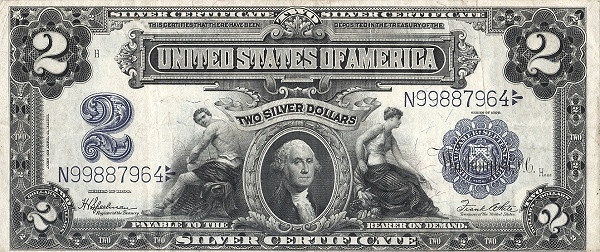
The central vignette on the face of the 1899 $2 Silver Certificate has acquired the popular nickname “the South American note” among collectors, a name that traces back to the female figure depicted in the center. She is sometimes identified as an allegorical representation of either America or Commerce, rendered in the classical Greco-Roman style so fashionable in the Gilded Age. Flanking her are additional allegorical elements: a large bald eagle with spread wings dominates the upper portion, while a globe and agricultural symbols reinforce themes of American prosperity and international reach.
The Bureau of Engraving and Printing never officially titled the vignette “South American,” and the origin of the nickname is somewhat disputed. Some numismatic historians suggest the female figure’s pose and attire resembled contemporary depictions of South America used in allegorical art of the period. Others attribute the name simply to collector tradition passed down through the early twentieth century. Whatever its origin, the nickname stuck, and today virtually every dealer and catalog uses it as a shorthand identifier.
When examining a Series 1899 $2 Silver Certificate, use a loupe to inspect the engraving quality in the eagle’s feathers and the fine cross-hatching in the background. Genuine BEP engraving shows crisp, razor-sharp lines even under magnification. Mushy or blurred line work is a red flag for a reproduction or an altered note.
The Nine Signature Combinations: A Collector’s Roadmap
The heart of 1899 $2 collecting lies in its signature combinations. The face of each Silver Certificate was signed by two officials: the Register of the Treasury (whose signature appears on the left) and the Secretary of the Treasury (whose signature appears on the right). The Friedberg catalog assigns individual numbers to each combination, running from Fr. 247 through Fr. 258, though not every number represents a different signature pairing. Some Friedberg numbers within the series distinguish mule notes (those with mismatched plate styles from transitional printings) or other plate varieties.
The Lyons-Roberts Combination (Fr. 247)
The first and arguably most common signature pairing is that of Register Judson W. Lyons and Secretary Leslie M. Shaw, but the earliest combination actually pairs Lyons with Secretary Lyman J. Gage (Fr. 247). Lyons served as Register from 1898 to 1905, overlapping with multiple Secretaries. The Lyons-Roberts combination (Fr. 248), with Secretary William B. Roberts, is often confused by newer collectors because Roberts served only briefly. Notes with Lyons-Roberts signatures are genuinely scarcer than the more frequently encountered Lyons-Treat pairing.
The Napier and Vernon Era Combinations
Register James C. Napier served from 1911 to 1913 and his signature appears alongside Secretaries Franklin MacVeagh (Fr. 255) and William G. McAdoo (Fr. 256). The Napier-McAdoo combination marks the transition into the Wilson administration era and is moderately scarce in high grade. Vernon-Treat (Fr. 251) and Vernon-McClung (Fr. 252) pairings from Register William T. Vernon’s tenure (1905 to 1911) represent the middle production run of the series and are among the more available combinations today in circulated grades, though Uncirculated examples of any 1899 $2 command serious premiums.
The Parker-Burke Combination (Fr. 258)
The final and rarest signature combination is Parker-Burke, cataloged as Fr. 258. Register Houston B. Teehee and Secretary William G. McAdoo produced notes late in the series run, but the Parker-Burke pairing, representing Register James C. Napier’s successor William S. Parker alongside Secretary William Gibbs McAdoo, had a very limited print run before the series was retired. In collector circles, a Parker-Burke example in Very Fine or better condition is considered a genuine key date piece, and certified examples in Extremely Fine grades regularly trade at multiples of catalog value.
Building a complete set of all nine signature combinations for the 1899 $2 Silver Certificate is an achievable long-term goal for intermediate collectors, but budget for the Parker-Burke (Fr. 258) and Lyons-Roberts (Fr. 248) examples early. These two combinations appreciate faster than the common pairings, and waiting until last often means paying substantially more.
The Blue Treasury Seal and Serial Number Characteristics
All Series 1899 $2 Silver Certificates carry a small blue Treasury seal on the left side of the face, flanked by blue serial numbers. This blue seal is the standard identifier for Silver Certificates of this era and distinguishes them immediately from the red seals of Legal Tender Notes and the gold seals of Gold Certificates. The serial numbers on 1899 $2 notes run in standard format with a letter prefix and a suffix letter, both in blue ink.
Star replacement notes, denoted by a star symbol replacing the suffix letter, exist for the Series 1899 $2 and are understandably rare. The Bureau of Engraving and Printing used star notes to replace defective notes in a sheet before it left the BEP, meaning production numbers were always small relative to regular-issue notes. A certified star note in any signature combination for this series is a legitimately important rarity.
Grading Nuances Specific to the 1899 $2
Large-size Silver Certificates present particular grading challenges. The 1899 $2, printed on high-quality linen-cotton fiber paper, was designed to circulate, and most surviving examples did exactly that. Folds, edge wear, and ink transfer from other notes are common. When grading, pay close attention to the following:
Paper quality is paramount. The 1899 $2’s white ground makes paper staining, foxing, and cleaning immediately apparent to experienced graders. A note with original surfaces, even with honest circulation wear, is far preferable to an artificially pressed or cleaned example that grades higher superficially. The major grading services (PCGS Currency and PMG) will note cleaning or pressing as qualifiers, which significantly impacts market value.
Centering matters enormously on this design. The ornate border work and fine engraved frame around the vignette mean that even slight misalignment during printing creates a visually imbalanced note. Well-centered examples command substantial premiums over their catalog counterparts. Margins of at least three millimeters on all sides are considered ideal for a high-grade large-size note.
Do not confuse natural aging or honest circulation on a 1899 $2 with damage. A note with light folds and original paper surfaces is worth considerably more than an artificially brightened or pressed example. Always ask dealers whether a raw note has been processed before purchasing, and when possible, buy certified examples from reputable third-party grading services until you develop an eye for original versus processed paper.
The Back Design: Understated Elegance
While the face of the 1899 $2 receives most of the collector attention, the back design deserves its own appreciation. Printed entirely in green ink, the reverse features a central denomination panel reading “TWO DOLLARS” surrounded by intricate geometric lathe work and fine engraved scrollwork. The words “SILVER CERTIFICATE” and the redemption clause are clearly inscribed. The back design remained essentially constant across all signature combinations, making it less useful as a variety identifier but no less beautiful as an example of the BEP’s craft at its pinnacle.
| Friedberg No. | Signature Combination | Relative Availability | Rarity |
|---|---|---|---|
| Fr. 247 | Lyons / Gage | Scarce in all grades | Scarce |
| Fr. 248 | Lyons / Shaw | Moderately available in VG-VF | Common |
| Fr. 249 | Lyons / Cortelyou | Scarce, short tenure printing | Scarce |
| Fr. 250 | Lyons / MacVeagh | Scarce in XF or better | Scarce |
| Fr. 251 | Vernon / Treat | Common in circulated grades | Common |
| Fr. 252 | Vernon / McClung | Common, large print run | Common |
| Fr. 253 | Napier / McClung | Moderately available | Common |
| Fr. 255 | Napier / MacVeagh | Scarce, limited printing window | Scarce |
| Fr. 256 | Napier / McAdoo | Moderately scarce in high grade | Scarce |
| Fr. 258 | Parker / Burke | Rare in any grade; key date | Key Date |
Market Values and Collecting Strategy
As of recent major auction results, a common-signature 1899 $2 in Very Good condition (VG 10) typically trades in the $75 to $120 range, while the same note in Very Fine (VF 30) brings $200 to $350 depending on centering and eye appeal. Certified Uncirculated examples of common combinations (Vernon-Treat or Vernon-McClung) in PMG 63 or better can bring $800 to $1,500 or more. Scarce signature combinations in equivalent grades command two to three times those figures, and the Parker-Burke in any grade above Fine is a four-figure note without question.
Star notes, when they appear at auction, often establish new price benchmarks. A certified star note in the Vernon-McClung combination graded PMG 40 Extremely Fine sold for well over $3,000 at a major Heritage auction in recent years, illustrating just how thin the population of star replacement notes truly is.
Population reports from PMG and PCGS Currency are essential research tools before purchasing any scarce 1899 $2 signature combination. A note priced as “rare” by a dealer should have a verifiably low certified population. If dozens of examples exist in the combined population reports for a given combination, the note is not truly rare regardless of the asking price narrative.
Conclusion: A Series Worth a Lifetime of Study
The Series 1899 $2 Silver Certificate occupies a special place in American numismatic history. It is simultaneously accessible enough for beginning large-size collectors to acquire affordable examples and deep enough in its varieties, population subtleties, and condition rarities to engage advanced collectors for years. The South American vignette, whatever its true allegorical meaning, remains one of the most compelling images ever placed on American paper money. Nine signature combinations, each representing a real moment in Treasury Department history, give the series a biographical dimension that transforms it from a mere collectible into a tangible record of the people who administered the nation’s finances across two decades.
Whether you are chasing a complete signature set, hunting a certified star note, or simply acquiring your first large-size Silver Certificate, the 1899 $2 rewards research, patience, and a genuine appreciation for the extraordinary craft of the Bureau of Engraving and Printing at the height of its powers.