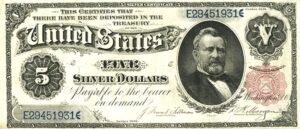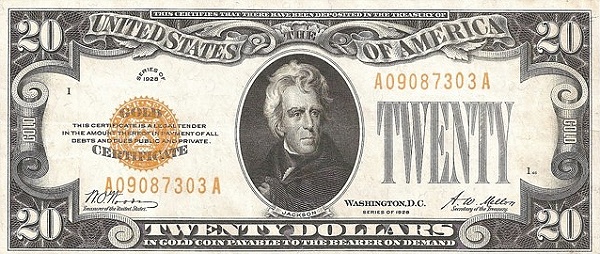
📷 Image source: banknote.ws (World Banknote Gallery). Images are selected by AI to represent the article topic and may not depict the exact note(s) described.
There is something almost forbidden about holding a 1928 Gold Certificate. For most of the twentieth century, it was literally illegal for American citizens to own them. Franklin Roosevelt’s Executive Order 6102, signed on April 5, 1933, demanded the surrender of gold coins, gold bullion, and gold certificates to the Federal Reserve. The Treasury followed with its own directives requiring banks to return the notes. What survived in private hands did so through oversight, defiance, or simple luck. Today, these golden-bordered relics of the classical gold standard era are among the most visually striking and historically charged notes in American numismatics.
A Brief History of Gold Certificates in America
Gold Certificates were first authorized by Congress in 1863, though they circulated in limited fashion for decades, primarily among banks and large commercial transactions. The series that most collectors know and pursue are the small-size notes introduced alongside the broader currency reform of 1928, when the Treasury standardized all paper money to the compact 6.14 x 2.61 inch format still in use today. The 1928 Gold Certificates were issued in denominations of $10, $20, $50, $100, $500, $1,000, $5,000, and $10,000, though the higher denominations were used almost exclusively for interbank transfers and are essentially museum pieces today.
All 1928 Gold Certificates share the distinctive golden-yellow Treasury seal printed on the face, the bold “GOLD CERTIFICATE” designation across the top, and the promise printed on the obverse: “This certifies that there have been deposited in the Treasury of the United States of America [X] dollars in gold coin payable to the bearer on demand.” The signature combination on all 1928 series notes is Walter O. Woods as Register of the Treasury and Andrew W. Mellon as Secretary of the Treasury. Mellon, the Pittsburgh banking and industrial titan who served under three presidents, is one of the most recognizable names in early small-size currency.
The $10 Gold Certificate, Series 1928
The $10 Gold Certificate features Alexander Hamilton on the obverse, consistent with the small-size Federal Reserve Note issued simultaneously. The serial numbers run with a yellow ink, a detail that immediately distinguishes these notes from their Federal Reserve counterparts. The print run for the 1928 $10 Gold Certificate was approximately 130,812,000 notes, making it the most plentiful of the collectible denominations by a wide margin. Despite this large printing, circulated examples in Fine to Very Fine condition remain modestly priced, generally ranging from $125 to $300 depending on grade. Uncirculated examples, graded 63 or above by PCGS or PMG, routinely bring $600 to over $2,000. The note’s wide availability makes it the natural entry point for collectors new to the series.
When buying any 1928 Gold Certificate, insist on a note in a PMG or PCGS Currency holder. Because these notes were subject to mandatory surrender in 1933, many survivors were spent and re-spent before being saved, and cleaned or pressed notes are more common in this series than in contemporaneous Federal Reserve Notes. Third-party grading dramatically reduces your risk of buying a problem note.
The $20 Gold Certificate, Series 1928
The $20 features Andrew Jackson on the obverse, and with a print run of roughly 66,204,000 notes, it is the second most available denomination in the series. Its golden seal and yellow serial numbers pop brilliantly against the green back design depicting the White House. In circulated grades from Very Good through Very Fine, a collector can typically acquire an example for $200 to $500. The $20 is often considered the “sweet spot” of the series for collectors who want a visually impressive note without reaching for the comparative rarity of the $50 or $100. Gem Uncirculated 65 EPQ examples are genuinely scarce and can bring $3,000 to $5,000 or more at major auction.
The $50 Gold Certificate, Series 1928
Ulysses S. Grant appears on the $50, mirroring the contemporary Federal Reserve design. The print run here drops sharply to approximately 5,520,000 notes, a figure that reflects both the higher face value and the general pattern of larger denominations seeing less active circulation. This is where the series starts to feel genuinely scarce in higher grades. A Fine example might be had for $400 to $700, but Very Fine and Extremely Fine specimens quickly climb into the $1,000 to $2,500 range. In Uncirculated condition, the $50 1928 Gold Certificate is a legitimate rarity, with population reports from the major grading services showing relatively thin numbers above PMG 64.
Pay close attention to paper quality and originality when evaluating $50 and $100 Gold Certificates. Because these notes had real purchasing power when most Americans earned under $2,000 per year, many survivors show evidence of careful folding and long storage in wallets or envelopes. Folds that are not pressed or ironed, and paper that retains its original crispness in unfolded areas, are hallmarks of an honest, uncleaned example.
The $100 Gold Certificate, Series 1928
Benjamin Franklin anchors the $100 Gold Certificate, a note with a print run of approximately 3,240,000. At this level, the combination of lower survival rates and strong collector demand creates a genuinely competitive market. Circulated examples in Very Good to Fine condition typically start around $600 to $900. The jump to Very Fine and above is substantial: expect to pay $1,500 to $3,500 for a presentable VF, and well into five figures for a PMG 65 EPQ or better. The $100 is the highest denomination that most advanced collectors actively pursue as a “obtainable” goal, though it requires patience and a meaningful budget to find a truly original, high-grade example.
The $500 Gold Certificate, Series 1928
This is where the series transitions from “challenging” to “rare.” The $500 Gold Certificate features William McKinley on the obverse, a portrait used across multiple large-denomination types of the era. The print run was a mere 420,000 notes, and survival in any grade is limited. Most known examples are in circulated condition, reflecting the note’s primary use in significant commercial transactions during its brief period of active circulation from 1928 to 1933. When a $500 Gold Certificate appears at auction in Fine to Very Fine condition, it typically realizes $8,000 to $20,000 or more depending on eye appeal and provenance. In Uncirculated condition, the $500 1928 Gold Certificate is a major rarity; PMG and PCGS combined census figures in grades of 63 and above number in the single digits to low double digits.
For the $500 and higher denominations, provenance matters enormously. Notes with documented histories, such as those from named collections sold at Heritage Auctions or Stack’s Bowers, often carry a premium but also provide important assurance of authenticity and legitimacy. High-value Gold Certificates have historically attracted skilled counterfeiters, so buying raw examples from unknown sources carries real risk.
Grading Considerations Unique to Gold Certificates
Grading 1928 Gold Certificates requires attention to a few characteristics not always present in Federal Reserve Notes. First, the yellow serial numbers can show ink flaking or fading more readily than the green or red ink used on other types, so note the sharpness and completeness of the serials. Second, the golden Treasury seal is printed with a slightly different ink formulation than standard seals of the era, and genuine wear presents differently than artificial manipulation. Third, the paper itself was a specific Treasury-contract stock, and the “feel” of an original versus a cleaned or restored note is something experienced handlers develop over time.
The major grading services use the standard Sheldon-derived 70-point scale with the addition of the EPQ (Exceptional Paper Quality) and PPQ (Premium Paper Quality) designations for notes with original paper surfaces. For Gold Certificates, EPQ designation in grades of 63 and above is a significant value driver. A PMG 64 EPQ will typically outperform a PMG 65 without a quality designation at auction.
Legal Status and the Road to Collectibility
It bears repeating that Gold Certificates were illegal to hold in private hands from 1933 until December 1964, when the Treasury Department formally lifted the restriction. The legalization was partly symbolic, as by 1964 the notes had no gold redemption value, but it opened the door for open-market collecting and auction sales. Notes that appear in collections with pre-1964 provenance are particularly interesting historically, as they survived through some form of technical non-compliance with the surrender orders. The majority of surviving specimens, however, likely drifted back into private hands through estate dispersals, bank vault discoveries, and similar channels after 1964.
| Denomination | Portrait | Approx. Print Run | Rarity |
|---|---|---|---|
| $10 (Series 1928) | Alexander Hamilton | 130,812,000 | Common |
| $20 (Series 1928) | Andrew Jackson | 66,204,000 | Common |
| $50 (Series 1928) | Ulysses S. Grant | 5,520,000 | Scarce |
| $100 (Series 1928) | Benjamin Franklin | 3,240,000 | Scarce |
| $500 (Series 1928) | William McKinley | 420,000 | Rare |
| $1,000 (Series 1928) | Grover Cleveland | 288,000 | Rare |
| $5,000 (Series 1928) | James Madison | 24,000 | Key Date |
| $10,000 (Series 1928) | Salmon P. Chase | 48,000 | Key Date |
Building a Set: Strategies for the Modern Collector
A complete circulated set of the five collectible denominations ($10 through $500) is a realistic long-term goal for a dedicated collector. The $10 and $20 can be acquired with relative ease through major dealers, currency shows, and auction platforms like Heritage Auctions and Stack’s Bowers. The $50 and $100 require more patience and a willingness to compete at auction. The $500 is best approached through established dealers with specialist inventory or major auction houses where provenance is documented.
Budget-conscious collectors sometimes opt for a “type set” approach, acquiring a single high-grade $10 or $20 as a representative of the entire 1928 Gold Certificate series. This is a perfectly valid strategy that captures the aesthetic and historical significance of the type at a fraction of the cost of a complete set.
Subscribe to the auction archives at Heritage Auctions (ha.com) and Stack’s Bowers to track realized prices for 1928 Gold Certificates over time. Watching a year or two of auction results before making your first significant purchase will calibrate your sense of market value far better than any price guide, since the Gold Certificate market is thinner and more volatile than common small-size Federal Reserve Notes.
Conclusion: A Series Worth the Hunt
The 1928 Gold Certificates occupy a singular place in American monetary history. They represent the end of a genuine commodity-backed currency system, the last paper money that any American could walk into a Treasury office and exchange for physical gold. Their golden seals, yellow serials, and bold design language set them apart visually from every other type of small-size U.S. currency. Whether you are building a date set, a denomination type set, or simply adding a single example to a broader collection of American paper money, the 1928 Gold Certificate series rewards the effort. The research, the patience, and the investment are all justified by the singular thrill of holding a note that once carried the full faith and gold of the United States Treasury.