Before the United States existed as a nation, counterfeiters were already at work undermining colonial paper money. The story of fake American currency is not a footnote to monetary history, it is woven into the fabric of every design choice, every color shift, every microprinted legend on the notes we collect today. From crude woodcut imitations of Massachusetts Bay Colony bills in the 1690s to the sophisticated inkjet reproductions that drove a complete currency redesign beginning in the 1990s, counterfeiting has forced the Treasury and the Bureau of Engraving and Printing (BEP) into a perpetual technological sprint. For collectors, understanding this history transforms a banknote from a flat piece of paper into a living document of that sprint.
The Colonial Roots: Woodcuts, Wampum, and the First American Fakes
Paper money in America began as a wartime expedient. Massachusetts Bay Colony issued the continent’s first government paper notes in December 1690 to pay soldiers returning from a failed expedition against Quebec. Within months, counterfeit versions began circulating. Colonial printers worked with hand-cut woodblocks, and any skilled craftsman with a press could attempt a copy. The resulting fakes were often crude, but so was the original printing, making detection genuinely difficult for an illiterate public.
Benjamin Franklin understood the problem intimately. His Philadelphia printing firm produced paper money for Pennsylvania, New Jersey, and Delaware beginning in the 1730s. Franklin’s countermeasure was elegant: he pressed actual leaves into the paper molds, creating nature-print backgrounds of extraordinary complexity. The leaf-vein patterns in 1739 Pennsylvania twelve-pence notes, for example, were essentially impossible to duplicate with period technology. Franklin also deliberately misspelled words such as “Philadelfia” on some issues, a trap for counterfeiters who would “correct” the error and thereby expose themselves. These early notes are among the most historically significant pieces in American numismatics, with authenticated fine-grade examples regularly selling for $1,500 to $8,000 depending on denomination and colony.
When examining colonial and Continental Currency notes, study the nature-print backgrounds under magnification. Genuine Franklin-printed Pennsylvania notes show asymmetrical vein structures that differ from note to note. Uniform or repeated patterns in the background are a strong indicator of a period counterfeit or later reproduction. The Newman Numismatic Portal maintains high-resolution scans of authenticated examples for comparison.
Continental Currency and the British Counterfeiting Campaign
The Revolutionary War introduced state-sponsored counterfeiting as a weapon of economic warfare. The British government, operating through Tory loyalists and agents in New York City, produced high-quality imitations of Continental Currency notes beginning around 1776. Advertisements placed openly in loyalist newspapers, including the New-York Gazette, offered “genuine” Continental bills for sale at a fraction of face value. The campaign was devastatingly effective. Continental Currency, already suffering from massive overprinting by the Continental Congress (over $241 million in face value issued between 1775 and 1779), became nearly worthless. The phrase “not worth a Continental” entered the American lexicon partly because of this deliberate debasement.
Collectors today can sometimes identify British-produced counterfeits of Continental Currency by examining the paper and ink quality. Authentic Continental notes used paper produced by Nathan Sellers of Pennsylvania, which contained mica flakes visible under raking light. British counterfeits, produced on English paper stock, typically lack this characteristic. Certified Continental Currency notes catalogued in Eric P. Newman’s foundational work The Early Paper Money of America provide the definitive reference for this identification work.
The Wild West of Wildcat Banking: 1836 to 1863
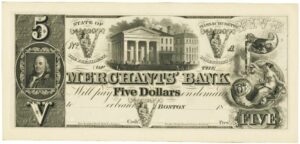
The period between the dissolution of the Second Bank of the United States in 1836 and the National Banking Act of 1863 is sometimes called the “Free Banking Era,” but counterfeiters called it paradise. Over 1,600 state-chartered banks issued their own notes during this period, producing more than 30,000 distinct note varieties. A counterfeit detector publication called Bicknell’s Counterfeit Detector, first published in Philadelphia in 1826 and updated frequently, listed thousands of known counterfeits and altered notes. By 1860, competing publications including Thompson’s Bank Note Reporter and Hodges’ New Bank Note Safeguard were essential tools for merchants and bankers.
The most common fraud of this era was not outright counterfeiting but alteration: raising the denomination of low-value notes from one-dollar institutions to tens or twenties by carefully bleaching and overprinting numerals and vignettes. A genuine one-dollar note from an obscure Michigan bank might be altered to appear as a twenty-dollar note from a well-known Boston institution. For collectors, altered notes from this period are themselves a collecting category. They should be described accurately as “altered” in any catalog listing, with their actual bank of origin noted. Values for altered Obsolete notes in Fine condition typically run $50 to $200, compared to $15 to $75 for common unaltered examples of the same issuer.
When acquiring Obsolete banknotes from the Free Banking Era, examine denomination numerals under ultraviolet light. Legitimate alterations made at the time often show residue from bleaching chemicals that fluoresce differently from the surrounding paper. PCGS Currency and PMG both note detected alterations in their certification labels, making third-party grading particularly valuable for this series.
The Civil War Crisis and the Birth of the Secret Service
By 1862, Secretary of the Treasury Salmon P. Chase estimated that one-third of all currency in circulation was counterfeit. The introduction of Demand Notes in August 1861 and Legal Tender Notes (United States Notes) beginning February 25, 1862 created a new unified national currency, but also a single high-value target. Within weeks of each new issue, counterfeit versions appeared. The Series of 1862 one-dollar Legal Tender Note, for example, had at least twelve documented counterfeit varieties in circulation by mid-1863.
President Abraham Lincoln signed legislation creating the United States Secret Service on April 14, 1865, the same day he was shot at Ford’s Theatre. The agency formally began operations on July 5, 1865, under Chief William P. Wood. In its first year, the Secret Service arrested over 200 counterfeiters and seized printing equipment across multiple states. The agency estimates that at its creation, between one-third and one-half of all currency in circulation was fake.
For collectors of Large-Size Type notes from the 1860s through 1890s, period counterfeit notes are themselves collectible artifacts. Known counterfeits are documented in Friedberg’s Paper Money of the United States, the standard collector reference. A documented period counterfeit of a Friedberg-listed note, in clearly identifiable condition as a fake (sometimes called a “contemporary counterfeit”), might sell for $75 to $400 depending on the note type and quality of the forgery, considerably less than a genuine example but historically fascinating in its own right.
The Engraving Craft Era: Skilled Forgers of the Late 19th Century
The period from roughly 1870 to 1920 produced America’s most artistically accomplished counterfeiters. Men like Emanuel Ninger, known as “Jim the Penman,” produced hand-drawn imitations of Large-Size notes so convincing that they passed casual inspection for years. Ninger worked exclusively in pen and watercolor, creating notes one at a time, and was arrested in 1896 after a wet note smeared ink on a bartender’s hand. His “notes” are now collected as curiosities, with authenticated Ninger pieces selling at auction for $8,000 to $20,000 because of their extraordinary craftsmanship and notoriety.
More systematic operations used photographic processes. The “Brockway Gang,” led by William Brockway, used early photographic etching to produce plates capable of printing hundreds of convincing counterfeits. Brockway was arrested multiple times between 1865 and 1896, demonstrating both his persistence and the limitations of early law enforcement. The BEP responded by steadily increasing the complexity of intaglio engraving in genuine notes, adding finer lathe-work geometric patterns called “guilloches” that photographic reproduction could not cleanly capture.
The Superdollar: State-Sponsored Counterfeiting in the Modern Era
The most technically sophisticated counterfeit notes in American history are the so-called “Superdollars” or “Supernotes,” high-quality forgeries of the $100 Federal Reserve Note first detected in 1989 in the Philippines. These notes, designated by the Secret Service as note family C-14342, were printed on paper with the correct cotton-linen composition and used intaglio printing indistinguishable from genuine BEP production to the naked eye. U.S. intelligence agencies and multiple independent researchers attributed production to North Korea, though Pyongyang has consistently denied involvement.
Superdollars targeted pre-1996 Series $100 notes, which lacked the polyester security thread and color-shifting ink introduced in the Series 1996 redesign. The threat directly accelerated the most comprehensive redesign of American currency since the shift to Small-Size notes in 1929. The Series 1996 $100 note (Fr. 2175) introduced: a color-shifting ink numeral in the lower right corner shifting from green to black, a polyester security thread inscribed “USA 100” readable under UV light, enlarged off-center portrait, microprinting reading “THE UNITED STATES OF AMERICA” on the portrait lapel, and fine-line printing behind the portrait and Independence Hall.
For collectors of modern Federal Reserve Notes, the Series 1996 $100 represents a pivotal transitional issue. Transition-year star notes, particularly from the San Francisco (L) and New York (B) districts with low print runs in the first 1996 print sequence, carry meaningful premiums in gem uncirculated grades. Always verify the series date on the face of the note, not just the design type, when purchasing high-denomination modern notes for type sets.
The Digital Threat: Inkjet Printers and the Series 2004 Color Revolution
By the late 1990s, a new and democratized counterfeiting threat had emerged from an unexpected source: consumer color inkjet printers. Epson, Canon, and Hewlett-Packard printers of the period could produce surprisingly passable imitations of pre-1996 notes at a quality level accessible to anyone with a $200 printer and a scanner. The Secret Service reported that by 1995, offset and digital printing methods had surpassed traditional photography as the most common counterfeiting technique. In 2000, digitally produced counterfeits accounted for 44 percent of passed fakes; by 2004 that figure exceeded 60 percent.
The Treasury and BEP responded with the most visually dramatic redesign in modern American currency history: the Series 2004 “colorized” notes. The $20 (Fr. 2091), redesigned first and introduced October 9, 2003, added background colors in peach and blue, an updated watermark portrait, additional microprinting, and a color-shifting numeral shifting from copper to green. The $50 Series 2004 (Fr. 2128) followed in September 2004 with blue and red background tones. The $100 Series 2009A (Fr. 2185), introduced October 8, 2013, added the most complex security architecture yet: a 3-D Security Ribbon woven into the paper (not printed on it) containing shifting images of bells and numerals, a bell-in-inkwell color-shifting image, and additional microprinting.
Printer manufacturers quietly incorporated the EURion constellation, a pattern of small rings first introduced on the Euro, into their software beginning around 2002. Photocopiers and imaging software that detect the constellation refuse to reproduce currency images. Collectors who have tried to scan notes for reference images have encountered this feature firsthand.
What Counterfeiting History Means for Collectors
Every security feature on a modern note is an answer to a specific historical threat. The security thread answers the Superdollar. Color-shifting ink answers digital scanning. Microprinting answers photographic reproduction. Nature printing answered the colonial woodcut. Understanding this cause-and-effect relationship gives collectors a deeper framework for examining any note in their collection, whether it is a 1739 Pennsylvania colonial issue or a 2017 Federal Reserve Note.
For collectors of contemporary counterfeits as historical artifacts, proper disclosure is both an ethical and legal obligation. Notes that are clearly identified as counterfeits, that are obviously fake to any reasonable observer, and that are collected purely as historical curiosities occupy a gray legal area that varies by jurisdiction. Always consult current Secret Service guidelines before buying, selling, or displaying identified counterfeit notes. PMG and PCGS Currency will not certify counterfeits under any circumstances, which means the authentication burden for historical fakes falls on the collector and specialist dealers.
| Series / Date | Denomination or Variety | Notes in Circulation / Significance | Rarity |
|---|---|---|---|
| 1690 Massachusetts Bay | Colonial Paper, Various Denoms | First American paper money; counterfeits appeared within months | Key Date |
| 1775-1779 Continental | Continental Currency, $1-$80 | British-forged examples exist; mica-paper test separates genuine | Rare |
| 1862 Legal Tender | $1 United States Note (Fr. 16) | 12+ documented period counterfeit varieties; peak Civil War forgery | Scarce |
| 1880s-1896 | Emanuel Ninger Hand-Drawn Notes | Unique hand-painted fakes; authenticated examples $8,000-$20,000 | Key Date |
| Series 1928-1934 | $100 Small-Size FRN (pre-thread) | Primary Superdollar target series; pre-security-thread design | Common |
| Series 1996 | $100 FRN (Fr. 2175), first issue | First color-shift ink and thread; low-run star notes command premium | Scarce |
| Series 2004 | $20 FRN (Fr. 2091), first colorized | First modern colorized note; gem star notes from low-run districts scarce | Common |
| Series 2009A | $100 FRN (Fr. 2185), 3-D Ribbon | Most advanced anti-counterfeiting design in U.S. history to date | Common |
Practical Authentication for Collectors
Even experienced collectors handling genuine notes should maintain basic authentication habits. For pre-1996 Large-Size and Small-Size notes, the primary tools are: a 5x to 10x loupe for examining intaglio printing texture (genuine BEP intaglio printing has a tactile ridged quality from ink standing above the paper surface), a UV lamp for fluorescence testing (genuine post-1990 security threads glow under UV; most counterfeits either do not glow or glow the wrong color), and reference scans from authenticated sources such as the PCGS CoinFacts currency section or the BEP’s own historical archives.
For notes predating 1900, the standard references are Friedberg’s Paper Money of the United States (21st edition, 2020) for Small and Large-Size Federal issues, and Eric Newman’s The Early Paper Money of America for colonial and Continental material. Both books document known counterfeits of their respective series. No serious collector of high-value notes should operate without them.
The single most reliable physical test for modern Federal Reserve Notes is the feel of intaglio printing. Genuine BEP notes are printed in three passes: intaglio for the portrait and major design elements, letterpress for serial numbers and Treasury seals through Series 1990, and offset for backgrounds. Run your fingertip firmly across the portrait: you should feel distinct ridges. A note that feels completely flat through the portrait area deserves immediate further examination regardless of its other apparent security features.
Conclusion: The Forger as Inadvertent Design Consultant
There is a dark irony in the history of American currency counterfeiting. Every successful forger, from the anonymous colonial woodcut printers of the 1690s to the industrial-scale Superdollar operation of the 1990s, forced improvements that made genuine American notes more secure, more visually complex, and ultimately more interesting to collect. The Series 2009A $100 note, with its 3-D ribbon, color-shifting bell, and multiple layers of microprinting, is as much a product of criminal ingenuity as of BEP artistry. For collectors, that layered history is part of what makes American paper money so endlessly compelling. Every note in your collection is both a financial instrument and a chapter in a three-century story of fraud, detection, and technological one-upmanship. Learning to read those chapters makes you a better collector and a sharper authenticator.