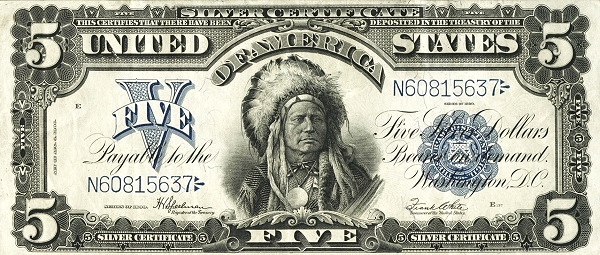
📷 Image source: banknote.ws (World Banknote Gallery). Images are selected by AI to represent the article topic and may not depict the exact note(s) described.
A Portrait Worth Chasing
Walk into any major currency auction and you will find the Series 1899 $1 Silver Certificate commanding the room. The design is arrestingly beautiful: a majestic bald eagle perched above the Lincoln and Grant vignettes, framed by an ornate lathe-work border that was already old-fashioned by the time the note entered circulation. Collectors have called it the “Black Eagle” for well over a century, and the nickname has stuck because nothing else in American paper money looks quite like it. But within this already celebrated issue, one subset stands apart in terms of rarity, collector demand, and sheer historical intrigue: the star note replacements. Understanding why these notes are so scarce requires a short trip into the mechanics of how the Bureau of Engraving and Printing handled damaged sheets in the large-size era, and what the survival data actually tells us today.
The Black Eagle: A Brief Design History
The Series 1899 $1 Silver Certificate entered production in late 1899 and remained in use until 1923, making it one of the longest-running large-size note designs in American history. The principal design element is a large black-printed eagle at center, with portraits of Abraham Lincoln at lower left and Ulysses S. Grant at lower right. The reverse carries an elaborate green geometric lathe pattern with “UNITED STATES OF AMERICA” and “ONE DOLLAR” prominently displayed. The blue Treasury seal and blue serial numbers identify it immediately as a Silver Certificate, redeemable in silver coin on demand.
Because the series ran for over two decades, it passed through eight distinct signature combinations, each representing a change in either the Register of the Treasury or the Treasurer of the United States. These combinations are catalogued in the Standard Catalog of United States Paper Money (Friedberg) as Fr. 226 through Fr. 233 for regular-issue notes. Each of those eight varieties also produced star note replacements, designated Fr. 226* through Fr. 233*, and it is in this star territory that rarity becomes dramatic.
Star Notes in the Large-Size Era: How They Were Made
The star note system for large-size currency was implemented by the Bureau of Engraving and Printing around 1899 to 1910, depending on the denomination and type. Before the star system existed, a defective note found during the printing or inspection process simply caused a gap in an otherwise sequential serial number run. That gap had to be accounted for, which created accounting headaches. The BEP solution was elegant: print a replacement note with an identical serial number to the one being discarded, but append a five-pointed star at the end of the serial number to distinguish it as a replacement. This way, the serial sequence remained complete in the government’s ledgers without duplicate numbers entering circulation.
For the Series 1899 $1 Silver Certificate specifically, replacement production was inherently limited for two reasons. First, print runs for individual signature varieties were not astronomical by modern standards. Second, replacement printing was triggered only by defects, so the star note print quantity represented a small fraction of an already moderate total. The BEP did not print stars in advance or maintain large inventories; they were printed in small batches as needed, often in runs of 1,000 to 5,000 notes at a time.
When examining a Black Eagle star note, check the serial number prefix carefully. On genuine large-size stars from this era, the star symbol appears at the end of the serial number, not the beginning as on modern Federal Reserve Notes. A star at the beginning is a red flag for a misidentified or altered note.
The Eight Signature Varieties and Their Stars
Understanding star rarity within the 1899 series requires knowing each signature combination and what survives. Here is a breakdown of all eight Friedberg varieties:
Fr. 226 (Lyons-Roberts, 1899): This is the first signature pairing for the series. Regular issues are moderately collectible, but the star note Fr. 226* is one of the rarest in the entire run. Fewer than a dozen examples are confirmed across major grading services, with most appearing in circulated grades of Very Good to Fine. A single example in Extremely Fine or better would be a landmark find.
Fr. 227 (Lyons-Treat, 1905): Ellis H. Roberts was replaced as Treasurer by Charles H. Treat in 1905, creating this pairing. Both regular and star issues from this combination are scarce, with Fr. 227* appearing in auction records perhaps eight to twelve times in the last three decades.
Fr. 228 (Vernon-Treat, 1906): William T. Vernon replaced Lyons as Register in 1906. The Fr. 228* is marginally more available than the previous two star varieties, but “more available” is relative when total known survivors number in the low teens.
Fr. 229 (Vernon-McClung, 1909): Leslie M. Shaw’s departure and the appointment of Franklin MacVeagh as Treasury Secretary reshuffled signatures again. The Fr. 229* is considered slightly more accessible, with perhaps fifteen to twenty graded examples known.
Fr. 230 (Napier-McClung, 1910): James C. Napier took over as Register, and this signature change creates one of the more interesting collecting puzzles. Print runs for the regular issue were substantial, but star production records suggest very limited replacement printing. The Fr. 230* is rare.
Fr. 231 (Napier-Thompson, 1913): This is among the scarcest signature combinations even in regular issues. The corresponding star, Fr. 231*, is genuinely rare and seldom appears at auction. Population reports from PCGS Currency and PMG combined show fewer than eight examples tracked.
Fr. 232 (Parker-Burke, 1915): This combination benefits from slightly higher regular-issue survival, and the Fr. 232* has a somewhat larger known population than the earliest varieties. Still, uncirculated examples are virtually unknown.
Fr. 233 (Teehee-Burke, 1917): The final signature combination is also the most frequently encountered of the star varieties, partly because the notes were printed closer to the end of large-size production and saw somewhat less time in hard circulation before being preserved. The Fr. 233* remains rare by any standard, but it is the entry point for collectors building a type set of Black Eagle stars.
If budget is a constraint, consider starting with the Fr. 233* (Teehee-Burke signature) star note. It is the most attainable of the eight varieties and still carries significant numismatic prestige. Once you hold one, the series will likely pull you toward the earlier, scarcer signatures.
Why So Few Survived
Several compounding factors explain the extreme scarcity of these replacement notes. First, silver certificates of this era circulated heavily. The $1 denomination was a workhorse note, passing through countless hands in everyday commerce from grocery stores to saloons to railroad ticket windows. Paper currency in active circulation loses its numismatic quality rapidly, and most notes were worn to tatters before anyone thought to save them.
Second, the star note concept was not publicly known or advertised by the Treasury. Ordinary citizens had no reason to pluck a note with a star out of circulation. It looked like any other dollar bill to the untrained eye. The note-collecting community of the early twentieth century was small, and systematic series-building with an eye toward star varieties was practiced by only a handful of specialists.
Third, replacement printing was genuinely small-scale. Unlike the modern Federal Reserve Note system, where star note print runs can reach into the hundreds of thousands for a single Federal Reserve Bank district, large-size star production was measured in thousands, not tens of thousands. Some individual batches may have numbered as few as 500 to 1,000 notes.
Finally, the transition to small-size currency in 1929 led to mass redemption and destruction of large-size notes. The Federal Reserve and commercial banks called in vast quantities of large-size paper for destruction as the new small-size notes flooded commerce. Whatever Black Eagle stars had not already been destroyed through circulation were now at risk of being turned in and shredded.
Grading Considerations for the Black Eagle Star
Grading large-size Silver Certificates presents its own set of challenges compared to small-size notes. The paper composition of large-size notes is different, often showing a crisper initial surface but aging differently over time. For Black Eagle stars specifically, collectors and graders look for the following:
Paper quality and color: Original paper should show a bright white or light cream tone. Notes that have been washed, pressed, or chemically treated will often show unnatural brightness or a plasticky surface feel. Many Black Eagle stars that have been in collector hands for decades have been subjected to improper storage, leading to toning or foxing.
Folds and creases: A single center fold drops an otherwise Uncirculated note to About Uncirculated territory. Multiple folds suggest genuine circulation. Given the workhorse status of these $1 certificates, even a note grading Fine-15 represents a meaningful survival.
Margins: Large-size notes were cut from printed sheets with less precision than modern currency. Generous, even margins are a positive grading factor. Notes with close margins on one or more sides are not automatically considered damaged, but wider margins contribute to higher grades and broader collector appeal.
Always purchase Black Eagle star notes in holders from PCGS Currency or PMG. Given the value of these notes even in circulated grades, the authentication and grading protection is worth far more than the submission fee. Altered or repaired examples are known in the market, and the star designation makes counterfeiting incentives higher than for common regular-issue notes.
What They Sell For: Market Values
Auction records provide the clearest window into current market valuations for Black Eagle star notes. Because these notes appear at auction infrequently, individual sale prices can vary significantly based on grade, eye appeal, and the competitive dynamics of a given auction room.
In circulated grades such as Very Good (VG-8) to Fine (F-12), examples of the more available star varieties such as Fr. 233* have sold in the range of $3,000 to $6,000 at major currency auctions including Heritage Auctions and Stack’s Bowers. In Extremely Fine grades, prices escalate sharply, with Fr. 233* examples reaching $10,000 to $18,000 at recent sales.
For the key-date varieties such as Fr. 226* and Fr. 231*, even heavily circulated examples in Good to Very Good condition have brought $8,000 to $15,000 when their rarity was properly documented and the note authenticated. An Fr. 226* in Fine or better condition would almost certainly exceed $25,000 in today’s market, and an uncirculated example, if one were confirmed to exist, would be a six-figure conversation.
| Friedberg Number | Signature Combination | Est. Star Print Run | Rarity |
|---|---|---|---|
| Fr. 226* | Lyons-Roberts | Est. 1,000 to 3,000 | Key Date |
| Fr. 227* | Lyons-Treat | Est. 1,000 to 3,000 | Key Date |
| Fr. 228* | Vernon-Treat | Est. 2,000 to 5,000 | Rare |
| Fr. 229* | Vernon-McClung | Est. 2,000 to 5,000 | Rare |
| Fr. 230* | Napier-McClung | Est. 2,000 to 5,000 | Rare |
| Fr. 231* | Napier-Thompson | Est. 500 to 2,000 | Key Date |
| Fr. 232* | Parker-Burke | Est. 3,000 to 6,000 | Scarce |
| Fr. 233* | Teehee-Burke | Est. 5,000 to 10,000 | Scarce |
Building a Black Eagle Star Collection
A complete set of all eight Black Eagle star varieties would be among the most prestigious accomplishments in large-size currency collecting. It is a goal that only a handful of collectors in history have achieved or come close to achieving. For most collectors, the realistic approach is to pursue the set incrementally, beginning with the most available variety and working toward the key dates over years or even decades.
Patience and network matter enormously in this pursuit. Many Black Eagle stars that come to market do so through estate sales, private treaty transactions, and dealer networks rather than public auctions. Maintaining relationships with specialist currency dealers, monitoring auction archives, and participating in organizations such as the Society of Paper Money Collectors (SPMC) and the Professional Currency Dealers Association (PCDA) will increase your awareness of when specimens become available.
It is also worth consulting the most current PCGS Currency and PMG population reports before bidding. Because the total known population of some varieties is so small, a single new discovery can meaningfully shift both the understanding of rarity and the price expectations for a given variety.
Subscribe to Heritage Auctions, Stack’s Bowers, and Lyn Knight currency auction archives and set up alerts for “1899 Silver Certificate star” searches. Heritage’s online archives in particular go back decades and allow you to track price trends, compare condition census examples, and identify which signature varieties have not appeared publicly in recent years. That absence from the market often signals extreme rarity rather than collector disinterest.
A Final Word on Condition Census and Discovery Notes
The condition census for most Black Eagle star varieties remains informally maintained by specialist collectors and dealers rather than through any official registry. This means that a note found in an old collection or an estate could legitimately represent the finest known example of its signature variety. In the world of Morgan dollars or rare coins, that kind of discovery story is rare. In large-size star notes, it remains a real possibility.
The Series 1899 $1 Silver Certificate Black Eagle is celebrated for its beauty, its longevity, and its place in American monetary history. Its star note replacements add a layer of numismatic depth that rewards serious research and patient collecting. They are not notes that can be acquired casually or cheaply, but for collectors who commit to understanding them, few pursuits in American paper money are more satisfying.