📷 Image source: banknote.ws (World Banknote Gallery). Images are selected by AI to represent the article topic and may not depict the exact note(s) described.
A One-Dollar Bill That Belongs in a Museum
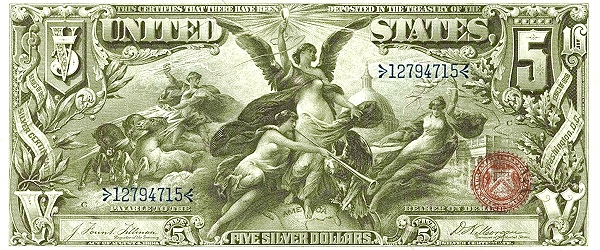
In the spring of 1896, the Bureau of Engraving and Printing released a series of Silver Certificates that stunned the American public and immediately drew comparisons to Renaissance engravings and neoclassical sculpture. The Series 1896 Educational Notes, as they came to be known, were the product of a deliberate government initiative to elevate the aesthetic standard of United States paper money to match the finest currency produced by European nations. Of the three denominations issued in that series, the one-dollar note carries what is arguably the most visually complex reverse design ever applied to American currency: a sweeping allegorical harvest scene drawn directly from classical Roman artistic and literary traditions.
The Artistic Commission and Edwin Blashfield
The Educational Series originated from a Bureau of Engraving and Printing competition held in the early 1890s, won by the muralist Edwin Howland Blashfield, one of the foremost American painters working in the Beaux-Arts tradition. Blashfield is perhaps best known today for his dome mural “The Apotheosis of Pennsylvania” in the Pennsylvania State Capitol and his contributions to the Library of Congress, but his designs for the 1896 notes represent his only major foray into currency art. The Treasury Department gave Blashfield and his collaborators extraordinary creative latitude, and the resulting designs broke radically from the portrait-based conventions that had defined American banknotes since the Civil War era.
For the one-dollar obverse, Blashfield depicted “History Instructing Youth,” a female allegory of History unveiling a scroll before a young man symbolizing America, with Washington’s monument and the Capitol visible through an arched window. But it is the reverse that concerns us here, because its visual language reaches back not to 19th-century academicism alone but to the agricultural allegories of ancient Rome.
Decoding the Reverse: What the Harvest Scene Actually Shows
The reverse of the 1896 $1 Silver Certificate is dominated by two large portrait vignettes: Martha Washington on the left and Ulysses S. Grant on the right. These medallion portraits are framed within an elaborate decorative field, but the true conceptual center of the design is the central allegorical vignette that occupies the upper register of the note. This scene depicts a reclining female figure, identifiable as Ceres, the Roman goddess of grain, agriculture, and the harvest, accompanied by a cornucopia overflowing with wheat sheaves, fruits, and vegetables. A secondary female figure, representing the abundance of the American earth, mirrors her posture in a composition borrowed directly from Roman triumphal iconography.
Charles Schlecht, the primary engraver assigned to the reverse, rendered the scene in intaglio with a fineness of line that was unprecedented in American currency production at the time. The crosshatching used to model the drapery folds on the Ceres figure, for example, required over 200 individual engraving passes and was directly influenced by the stipple-engraving tradition used to reproduce Roman fresco cycles in 18th-century European print collections.
When examining the reverse under magnification, focus on the cornucopia in the central vignette. On genuine examples, the individual wheat stalks are distinctly engraved and do not blur into one another even at 10x magnification. Blurred or uniform shading in this area can indicate a reprint, a counterfeit, or significant plate wear on circulated examples graded below VF-20.
Classical Roman Sources: Ceres, Tellus, and the Ara Pacis Tradition
The iconographic program of the 1896 $1 reverse did not emerge from a vacuum. Blashfield was deeply familiar with Roman visual culture, and two specific classical sources shaped his harvest allegory in measurable ways.
The first is the figure of Tellus, the Roman earth goddess, as she appears on the Ara Pacis Augustae, the Altar of Augustan Peace dedicated in 9 BCE in Rome. The Ara Pacis’s eastern panel depicts Tellus (sometimes identified as Italia or Pax) as a serene, seated mother surrounded by abundant vegetation, with two infants at her breast and flanking figures representing Air and Water. The compositional logic of that relief, a central abundance figure framed by elemental allegories within a naturalistic landscape, is replicated with striking fidelity in the Blashfield design. The reclining posture of his Ceres figure, the diagonal thrust of the cornucopia, and the placement of secondary attendant figures all echo the Ara Pacis arrangement.
The second source is Virgil’s Georgics, the four-book didactic poem on Roman agriculture completed around 29 BCE, which had been a touchstone of American classically educated culture since the colonial era. The Georgics describe the gifts of Ceres to humanity in terms that 19th-century allegorical painters regularly translated into visual imagery: the golden grain, the turning seasons, the moral virtue of agricultural labor. Blashfield explicitly cited the Georgics in his notes on the Educational Series designs, connecting the harvest allegory on the one-dollar reverse to Virgil’s Book I, which invokes Ceres as the patron of the tilled earth. This literary connection was not incidental; it was meant to signal that American prosperity, symbolized by the Silver Certificate itself, was rooted in the same classical virtues that had sustained Roman civilization.
The Three Signature Varieties and Their Collecting Hierarchy
The Series 1896 $1 Silver Certificate was issued with three distinct signature combinations, each corresponding to a change in Treasury personnel, and these varieties carry significantly different values in today’s market. Understanding them is essential for any collector pursuing this series.
The first variety, Friedberg 224, bears the signatures of Register of the Treasury James F. Tillman and Treasurer of the United States Daniel N. Morgan. This combination was used during the initial release of the series and carries a slight premium in high grades because early printings tend to exhibit crisper plate strikes. In Very Fine 25, Fr. 224 typically realizes between $275 and $375 at major auction houses. In Extremely Fine 40, the range rises to $500-$700.
The second variety, Friedberg 225, pairs Tillman with Treasurer Enoch H. Nebeker, replacing Morgan. This is the most commonly encountered of the three varieties and serves as the entry-level piece for new collectors. VF examples can still be found for $225-$325, and even circulated Fine-12 examples remain visually appealing given the depth of the intaglio engraving.
The third and scarcest variety, Friedberg 226, carries signatures of Register William S. Rosecrans and Treasurer Nebeker. Wait, to be precise: Fr. 226 pairs Register of the Treasury William S. Rosecrans with Treasurer Nebeker. This combination had a shorter production window, and certified examples in Gem Uncirculated 65 have realized over $3,500 at Heritage Auctions and Stack’s Bowers sales between 2018 and 2023.
All three signature varieties of the 1896 $1 Silver Certificate share the same reverse design, making the reverse condition equally important regardless of which Fr. number you are pursuing. Because the Ceres vignette is the visual centerpiece, any folds, stains, or ink transfers that cross the central allegorical scene will dramatically reduce both eye appeal and market value, often more so than equivalent damage in the border areas.
Why the Note Was Withdrawn: Public Controversy and Practical Complaints
The Educational Series was retired after only a few years of circulation, replaced by the Series 1899 Silver Certificates beginning in 1899. The reasons were both practical and political. On the practical side, merchants and bank tellers complained that the busy reverse design made it difficult to distinguish the denomination at a glance, a significant operational concern during an era of rapid commercial transaction. The notes were also expensive to produce; the intricate intaglio work on the reverse required more press time and more frequent plate maintenance than simpler designs.
Politically, the semi-nude allegorical figures on the obverse designs of the two- and five-dollar Educational Notes drew protests from moralist organizations, though the one-dollar reverse was largely spared this specific criticism since the Ceres figure’s drapery is relatively modest by Blashfield’s own standards. Nevertheless, the controversy over the series as a whole accelerated its withdrawal, and the decision to replace it with the more conventional “Black Eagle” and “Silver Dollar” reverse designs of 1899 was made by Treasury Secretary Lyman J. Gage.
Grading Considerations Specific to the 1896 $1 Reverse
The extraordinary detail of the Schlecht engraving creates grading dynamics that differ from most 19th-century notes. Because the intaglio is so deep, the note retains visible design crispness even at lower circulated grades, which can make accurate grading difficult for collectors accustomed to simpler designs. The Professional Currency Dealers Association (PCDA) and the major third-party grading services (PCGS Currency and PMG) have noted in their grading standards that the 1896 Educational Notes require particular attention to paper quality and original surface, not just design crispness, when assigning numerical grades.
Specifically, collectors should examine the following areas on the reverse when assessing grade: first, the fine lines of the cornucopia, where wear first becomes visible; second, the hair detail on the reclining Ceres figure; third, the lettering in the decorative borders surrounding the Martha Washington and Grant portraits. A note that appears VF by fold count alone may grade only Fine or Very Good once surface abrasions in those high-relief areas are factored in.
Submit your 1896 $1 Educational Note to PMG or PCGS Currency before purchasing at auction if you are considering a raw (ungraded) example above the $400 price point. The authentication is equally important as the grade: high-quality color photocopies of this note have been passed as originals at smaller shows, particularly in the VF-20 to EF-40 range where buyers are less likely to apply rigorous scrutiny.
The Reverse in the Context of American Currency Art
No American note before or since has attempted the kind of sustained classical allegory visible on the 1896 $1 reverse. The decision to place Ceres, Tellus, and the entire harvest iconographic tradition on a circulating one-dollar bill was an extraordinary act of cultural ambition, one that reflected the late 19th century’s confidence that a democratic republic could legitimately inherit the aesthetic traditions of classical antiquity. Blashfield’s design argued, in visual terms, that American agricultural prosperity was the spiritual heir to Roman virtus, that the wheat fields of Kansas and Iowa were continuous with the grain-bearing provinces of the Roman Empire.
Whether or not that argument succeeds as ideology, it produced a piece of engraving that remains unmatched in American currency history. For collectors, that combination of artistic achievement, historical significance, and genuine scarcity in high grades makes the 1896 $1 Educational Silver Certificate one of the most rewarding notes to pursue in all of large-size paper money.
| Friedberg Number | Signature Combination | Est. Surviving Examples (All Grades) | Rarity |
|---|---|---|---|
| Fr. 224 | Tillman / Morgan | Approx. 3,500-5,000 | Scarce |
| Fr. 225 | Tillman / Nebeker | Approx. 6,000-9,000 | Common |
| Fr. 226 | Rosecrans / Nebeker | Approx. 1,200-2,000 | Rare |
| Fr. 224 (PMG 65 EPQ or higher) | Tillman / Morgan, Gem CU | Fewer than 40 certified | Key Date |
| Fr. 225 (PMG 65 EPQ or higher) | Tillman / Nebeker, Gem CU | Approx. 60-80 certified | Scarce |
| Fr. 226 (PMG 65 EPQ or higher) | Rosecrans / Nebeker, Gem CU | Fewer than 20 certified | Key Date |
| Any Fr. (Error: Inverted Back) | All signatures | Fewer than 5 documented | Key Date |
Conclusion: Pursuing the Harvest Scene
For new collectors, an entry point into the 1896 $1 Educational Silver Certificate need not be intimidating. A problem-free VG-10 or Fine-12 example of Fr. 225, the most available variety, can still be acquired for under $200 at many currency shows and online auctions, and even in that circulated state the Ceres harvest allegory reads with remarkable clarity. The depth of Schlecht’s engraving ensures that the classical imagery survives decades of handling in a way that later, more lightly printed notes cannot match.
For advanced collectors, the challenge is Fr. 226 in Extremely Fine or better, or any variety in PMG/PCGS Gem Uncirculated with the coveted EPQ (Exceptional Paper Quality) or PPQ (Premium Paper Quality) designation. These are genuinely rare notes that appear at major auction only a handful of times each year, and their prices have risen steadily over the past two decades as the collector base for large-size Silver Certificates has grown and deepened.
Either way, what you are acquiring when you add the 1896 $1 Educational to your collection is not simply a banknote. It is a precise argument, engraved in steel and printed in intaglio ink, that the American republic understood itself as the legitimate heir to the agricultural virtues, the artistic ambitions, and the civilizational confidence of ancient Rome. That argument, pressed into a single dollar bill in 1896, is worth considering every time you hold one.