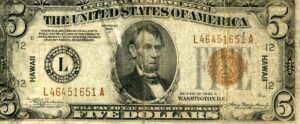
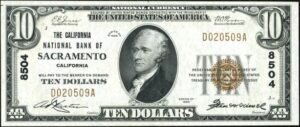
Pick up any circulated Series 1963 Federal Reserve Note and you are holding a product of an era when the Bureau of Engraving and Printing was undergoing significant operational changes. The BEP was transitioning production methods, juggling enormous print runs to meet postwar demand, and doing so with mechanical printing equipment that, while sophisticated for its time, was not immune to human error. It was precisely within this environment that one of the most intriguing error types in modern American currency was born: the mismatched district letter and seal.
These notes carry a Federal Reserve Bank district letter printed in the center of the note as part of the serial number prefix, and a separate Federal Reserve Bank seal printed on the left side. In a correctly produced note, both identifiers match the same issuing district. When a sheet of paper printed with one district’s seal was mistakenly fed into a press configured for a different district’s serial numbers, the result was a note with internally contradictory identifiers. The rarity, the mechanical story behind the error, and the surprisingly finite number of confirmed examples make these among the most sought-after error notes of the entire Federal Reserve Note series.
The Anatomy of a Federal Reserve Note: Why the District Identifiers Exist
To fully appreciate this error, you need to understand the layered printing process that produces a Federal Reserve Note. The BEP prints currency in multiple passes. The back of the note is printed first, followed by the face, and then a separate overprinting pass applies the Treasury seal, the Federal Reserve Bank seal and district designation, the serial numbers, and the Federal Reserve district letter embedded in those serial numbers.
On a Series 1963 note, the Federal Reserve Bank seal appears as a bold black circular seal on the left side of the face, enclosing the name of the issuing Federal Reserve Bank and its city. Surrounding this seal are sawtooth points. The district is also encoded in the serial number itself: the prefix letter identifies the issuing Federal Reserve Bank, running A through L for the twelve districts (A for Boston, B for New York, C for Philadelphia, D for Cleveland, E for Richmond, F for Atlanta, G for Chicago, H for St. Louis, I for Minneapolis, J for Kansas City, K for Dallas, and L for San Francisco).
Both identifiers are applied during the overprinting stage, but they are not necessarily applied in the same single press pass from the same plate. Therein lies the vulnerability that produces the mismatch error.
When examining any Series 1963 Federal Reserve Note for this error, always compare the district letter at the start of the serial number against the Federal Reserve Bank named on the left-side seal. They must match. If your note begins with a “G” serial prefix but the seal reads “Federal Reserve Bank of Dallas,” you have found a potential K-district seal with G-district serial numbering error worth immediate professional authentication.
The Mechanics: How Exactly Does a Mismatch Happen?
The mismatched district error is a sheet-feed error combined with a press-setup error, and understanding the distinction matters for appreciating how many notes could be affected in any single incident.
During the overprinting stage in the early 1960s, large sheets of already-printed currency were stacked in press feeders. Each district’s notes were intended to be kept in separate batches, matched to presses set up with the correct serial number dies and Federal Reserve Bank seal plates for that district. However, if a stack of sheets bearing one district’s pre-printed Federal Reserve seal was inadvertently combined with, or substituted for, a stack intended for a different district’s serial number press run, the resulting sheets would carry the seal of one bank but the serial number prefix of another.
This is not the same as a single-note freak accident. A mismatched stack could theoretically result in an entire press run of 100,000 notes or more before the error was caught by inspectors. In practice, BEP quality control was reasonably attentive and most such errors were caught quickly, meaning the number of mismatched notes that escaped into circulation was small. But “small” in BEP terms still means hundreds or even a few thousand individual notes could reach Federal Reserve vaults and ultimately the public.
The Series 1963 and 1963-A issues are particularly associated with this error for a practical reason: these were the first Federal Reserve Notes printed without the obligation clause on the reverse (that clause was dropped with the 1963 series), and the BEP was reorganizing press assignments and sheet-handling procedures during this transition period. Administrative changes to workflow increase the probability of human error in sheet routing.
Do not confuse a mismatched district letter and seal error with the related but distinct “wrong district” error where a note is entirely printed for the wrong district from the start. In the mismatch, one element is correct for District A while another element is correct for District B, creating an internal contradiction. This is verifiable by checking the district letter in the serial prefix against the seal text and the district number printed in each corner of the note face.
Documented Examples and Known Combinations
Research published in the Numismatic News, Paper Money magazine (the official journal of the Society of Paper Money Collectors), and auction archives has identified several confirmed mismatch combinations in the Series 1963 family. The most frequently cited documented examples involve $1 notes, simply because the $1 denomination had by far the largest print run of the series and therefore had the highest statistical probability of producing escapees.
Among the best-documented cases is a Series 1963-A $1 note bearing a Chicago (G) district serial number prefix but a Richmond (E) Federal Reserve Bank seal, examples of which have been authenticated by PCGS Currency and PMG. Another confirmed combination involves a Series 1963 $5 note with a New York (B) serial prefix paired with a Boston (A) seal. The $10 and $20 denominations are known but significantly rarer in confirmed examples, with some numismatists believing fewer than a dozen authenticated specimens exist for those face values in any mismatch combination.
The Friedberg catalog (“Paper Money of the United States” by Arthur and Ira Friedberg) does not assign individual catalog numbers to error notes as a rule, treating errors as varieties rather than distinct issues. Collectors and dealers instead rely on PMG and PCGS population reports for tracking known examples, and the SPMC’s specialized error note literature for historical documentation.
Why Series 1963 Specifically? The Production Context
The Series 1963 Federal Reserve Notes were authorized under Public Law 88-36, signed June 4, 1963, which also eliminated silver certificates as an obligation of the United States. The new Federal Reserve Notes of this series were printed beginning in late 1963 and continued into 1964 and 1965 for the base 1963 series, with the 1963-A series (reflecting the new Secretary of the Treasury Henry Fowler replacing C. Douglas Dillon) printed from 1965 onward. The combined production runs for both series across all twelve districts and multiple denominations were staggering in volume.
The $1 Series 1963 alone had a combined print run across all twelve Federal Reserve Banks exceeding 1.6 billion notes. At that scale, even an error rate of one in a million represents thousands of potential error notes entering circulation. The sheer volume of production, combined with the procedural transitions at the BEP during this period, created the conditions under which mismatch errors could occur, briefly go undetected, and reach Federal Reserve vaults before inspectors could pull the affected sheets.
If you believe you have found a Series 1963 mismatched district note, submit it to either PMG (Paper Money Guaranty) or PCGS Currency for authentication before assuming it is genuine. Some mismatched notes are the product of post-printing tampering, where someone has physically removed and transplanted seals between notes. Genuine printing errors will show consistent ink behavior, no disturbed paper fibers, and alignment consistent with a single overprint pass.
Grading Considerations for Mismatch Errors
Error notes are graded on the same standard 70-point Sheldon scale used for all paper money, with PMG and PCGS Currency as the two primary third-party grading services for US currency. For mismatch errors specifically, condition matters enormously to value, but the error itself is the primary value driver. A Fine-12 example of a confirmed $5 mismatch note can command more than a Choice Uncirculated-64 example of a non-error note from the same series.
Collectors should note that mismatch errors in grades below Very Fine-20 are still highly collectible given the rarity of the error, but the premium over a VF or better example is not as dramatic as it is with some other error types. Centering and eye appeal matter alongside technical grade for these notes, as mismatched notes are often displayed as showpieces and aesthetic quality enhances presentation.
Authentication Red Flags
The collectibility of these errors has unfortunately made them targets for sophisticated alterations. Key red flags to watch for include: inconsistency in ink depth between the seal and the surrounding overprint elements; hairline tears or disturbances around the seal perimeter that suggest removal and re-application; and misalignment of the seal relative to the note’s other overprint elements that exceeds what genuine press variation would produce. A genuine mismatch will have both the correct seal and the correct serial block for their respective districts, meaning the serial numbers themselves will fall within authenticated ranges for the district indicated by the prefix letter.
| Series / Date | Denomination and Mismatch Type | Est. Known Examples | Rarity |
|---|---|---|---|
| 1963-A | $1, G-serial / E-seal (Chicago prefix, Richmond seal) | 20-40 confirmed | Scarce |
| 1963 | $1, B-serial / A-seal (New York prefix, Boston seal) | 15-30 confirmed | Scarce |
| 1963-A | $1, various district mismatches (other combinations) | 10-20 per combination | Rare |
| 1963 | $5, B-serial / A-seal (New York prefix, Boston seal) | 6-12 confirmed | Rare |
| 1963-A | $5, mismatched combinations (any) | Under 10 total known | Key Date |
| 1963 | $10, any mismatch combination | Fewer than 8 confirmed | Key Date |
| 1963-A | $10, any mismatch combination | Fewer than 5 confirmed | Key Date |
| 1963 | $20, any mismatch combination | 3-5 confirmed | Key Date |
What These Notes Are Worth: A Realistic Market Overview
Values for authenticated Series 1963 and 1963-A mismatched district notes vary considerably based on denomination, the specific district combination, grade, and market timing. For $1 notes in the most common mismatch combinations, auction results from Heritage Auctions, Stack’s Bowers, and Lyn Knight Currency Auctions over the past decade have shown retail values in the $500 to $2,500 range for circulated examples in VF to EF grades, with uncirculated specimens reaching $4,000 to $7,500. Higher denomination mismatches in the $10 and $20 range have sold for $8,000 to over $15,000 in Choice Uncirculated condition when authenticated by a major third-party grader.
The market for error notes generally has strengthened since 2015, with particularly strong growth in the 2020 to 2024 period as new collectors entered the hobby. Well-documented mismatch errors with clear attribution and major-service holders command a premium over raw (ungraded) examples, often 40 to 60 percent higher, which makes third-party grading a financially sound decision for any example you believe is genuine.
Conclusion: A Window Into BEP Production History
The mismatched district letter and seal error on Series 1963 Federal Reserve Notes is more than a curiosity for error collectors. It is a tangible artifact of a specific transitional moment in American currency production, when the BEP was handling unprecedented print volumes, adopting new note designs, and reorganizing workflows. Each authenticated example represents a specific press run on a specific day when a human handler placed the wrong stack of sheets into the wrong press feeder, and quality control did not catch the mistake before those notes left the building.
For collectors, that story is inseparable from the note. Whether you are a specialist in error currency or a generalist who has just discovered a suspicious $1 bill in your collection, understanding the mechanics of how this error occurs gives you the framework to identify it, authenticate it, and appreciate it as something genuinely rare in the long history of American paper money.