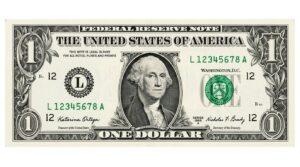
Picture yourself sorting through a stack of circulated notes and suddenly stopping cold. The green Federal Reserve seal on the face of what looks like an ordinary $1 bill is printed perfectly upside down, rotated 180 degrees, and the serial numbers flanking it are inverted right along with it. Your pulse quickens. You are holding one of the most visually arresting error types in all of United States paper money collecting: the inverted third printing error. On Series 1974 and 1977 Federal Reserve Notes, these mistakes surfaced in multiple denominations and across several of the twelve Federal Reserve districts, creating a rich collecting specialty that rewards patient research and sharp eyes in equal measure.
How the Bureau of Engraving and Printing Creates an Inverted Third Printing
To understand this error you need to understand the BEP’s multi-pass production process as it operated during the 1970s. Federal Reserve Notes were printed in three distinct stages. The first printing applied the green back design. The second printing laid down the black face design, including the portrait, vignettes, fine-line engraving, and the district numeral and letter designators. The third printing, applied by a separate letterpress operation, added the two serial numbers, the green Federal Reserve Bank seal on the left side of the face, and the green Treasury seal on the right side of the face.
An inverted third printing occurs when an entire sheet of already-printed notes is fed into the third-printing press upside down relative to the normal orientation. The result is mathematically precise: everything applied during pass three, both serial numbers and both seals, appears rotated exactly 180 degrees. The portrait of Washington, Lincoln, Hamilton, or Jackson remains perfectly correct because it was applied during the second printing. This is precisely what makes the error so visually jarring and unmistakable to even a casual observer. One side of the note looks completely normal while the other side announces its mistake in green ink.
Always confirm that both the serial numbers AND both seals are inverted together. A note with only one element rotated suggests a different and typically less valuable production anomaly. True inverted third printings show all four third-printing elements rotated simultaneously at exactly 180 degrees, never at an angle.
The Series 1974 Examples: District by District
Series 1974 notes entered production beginning in late 1974 and continued through 1977, with the signature combination of Treasurer Francine Irving Neff and Secretary of the Treasury William E. Simon appearing on all examples. The Friedberg numbers for Series 1974 $1 notes run from Fr. 1908-A through Fr. 1908-L, corresponding to the twelve Federal Reserve districts from Boston through San Francisco.
Confirmed inverted third printing errors on Series 1974 notes have been documented most frequently from the Federal Reserve Bank of Richmond (District E, the fifth district), the Federal Reserve Bank of Kansas City (District J), and the Federal Reserve Bank of Atlanta (District F). The Richmond examples are the most studied, with at least a handful of consecutive-serial-number survivors suggesting they came from the same sheet or adjacent sheets within a single 32-subject production run. Serial numbers on confirmed Richmond examples cluster in the E-block runs of 1975 and early 1976 production.
On Series 1974 $5 notes (Fr. 1974-series), inverted third printings are considerably rarer. Only a small number of confirmed examples exist from Chicago (District G) and one or two examples attributed to the New York district (District B). The $10 denomination in Series 1974 presents a similar picture of extreme scarcity, with authenticated examples appearing at major currency auctions roughly once every three to five years. The $20 Series 1974 inverted third printing is in a class by itself for rarity, with fewer than ten examples across all districts considered confirmed by professional graders as of the most recent population surveys.
Population reports from PCGS Currency and PMG are your best resource for confirming the current census of authenticated examples. Because these errors are individually trackable by serial number, a note that has previously appeared at major auctions will often have a documented sale history you can research through Heritage Auctions or Stack’s Bowers archives before you bid.
The Series 1977 Examples: New Signatures, Same Dramatic Errors
Series 1977 notes carry the signatures of Treasurer Azie Taylor Morton and Secretary of the Treasury W. Michael Blumenthal, and production ran from approximately 1978 into 1981. The Friedberg numbers for Series 1977 $1 notes are Fr. 1909-A through Fr. 1909-L. Inverted third printing errors in Series 1977 are, if anything, slightly better documented than the 1974 examples simply because more collectors were actively watching the market by the late 1970s and early 1980s, and more notes were caught before circulation thinned them out.
The most famous group of Series 1977 inverted third printings involves the Federal Reserve Bank of Chicago (District G), where a block of $1 notes with serials in the G-A block was released into circulation in the Chicago metropolitan area around 1979. Several of these notes were caught by local coin dealers and collectors at the time, and a number of them survive in grades ranging from Fine-12 to Choice Uncirculated-64, allowing the careful collector to appreciate the full visual drama of the error without the distraction of heavy wear.
Series 1977 $1 inverted errors from the Federal Reserve Bank of New York (District B) are also confirmed, though in smaller numbers. Boston (District A) examples are extremely rare, with only two or three authenticated pieces known in the major grading company census data. The San Francisco district (District L) has yielded at least one confirmed $1 example as well.
Moving up in denomination, Series 1977 $5 inverted third printings are documented from at least three districts: Chicago, New York, and Dallas (District K). The $10 Series 1977 inverted third printing is similarly elusive, and the $20 denomination remains a genuine major rarity regardless of district. Any $20 inverted third printing from either Series 1974 or 1977 in original Uncirculated condition would be considered a landmark offering at any major currency auction.
Authentication and the Problem of Fakes
The inverted third printing error is visually obvious, which creates a paradox: it is both easy to spot as an error and relatively straightforward for a skilled counterfeiter to attempt to replicate using acid washing, bleaching, and re-printing techniques. The numismatic community refers to these fabrications as “washed and reprinted” notes, and they appear periodically on online marketplaces and at shows where authentication services are not being utilized.
Professional third-party grading is not optional with this error type; it is essential. Both PCGS Currency and PMG have developed specific expertise in distinguishing genuine inverted third printings from altered notes. Examiners look at paper fiber integrity under magnification and ultraviolet light, the precise registration of the inverted printing relative to the face design, ink chemistry consistency, and subtle characteristics of the BEP letterpress impression that are essentially impossible to replicate with non-BEP equipment. Any example offered without a PCGS Currency or PMG holder should be treated with considerable skepticism regardless of the seller’s reputation.
Under ultraviolet light, genuine BEP third-printing ink on Series 1974 and 1977 notes exhibits a specific fluorescence signature that differs from the second-printing black ink. If you are examining an unholdered example, this UV test will not by itself authenticate the note, but it can quickly flag a potential re-print job where the “inverted” elements were applied with ink of a different chemical composition than the originals.
Grading Considerations Specific to This Error
Grading inverted third printing errors follows standard PMG and PCGS Currency technical grading scales, but there are nuances worth understanding. Because many of these notes entered circulation before anyone recognized them as errors, circulated grades are genuinely common in the census data. A Very Fine-30 example is not a consolation prize; it is a legitimate collectible at a fraction of the cost of an Uncirculated example and often far more attainable for a collector building a type set of major BEP errors.
Centering matters more than usual with this error because the inversion sometimes causes the serial numbers to appear slightly misaligned relative to the note borders, an artifact of feed tolerances in the letterpress machinery. Notes graded Choice Uncirculated-63 or better with strong margins and vivid original color represent the pinnacle of the specialty. A PCGS Currency graded Gem New-65 PPQ (Premium Paper Quality) $1 Series 1977 Chicago inverted third printing represents the kind of note that crosses auction blocks at strong multiples of catalog estimates when condition-conscious specialists compete for it.
| Series / Denomination | District or Variety | Est. Survivors Known | Rarity |
|---|---|---|---|
| 1974 $1 | Richmond (E) | 10-15 | Scarce |
| 1974 $1 | Kansas City (J) | 6-10 | Rare |
| 1974 $1 | Atlanta (F) | 5-8 | Rare |
| 1974 $5 | Chicago (G) | 3-5 | Rare |
| 1974 $5 | New York (B) | 1-2 | Key Date |
| 1974 $20 | All Districts Combined | Fewer than 10 | Key Date |
| 1977 $1 | Chicago (G) | 15-25 | Scarce |
| 1977 $1 | New York (B) | 8-12 | Scarce |
| 1977 $1 | Boston (A) | 2-3 | Key Date |
| 1977 $5 | Dallas (K) and Chicago (G) | 4-6 combined | Rare |
| 1977 $10 | All Districts Combined | Fewer than 8 | Key Date |
Market Values and Recent Auction Results
The market for inverted third printing errors on 1970s Federal Reserve Notes has strengthened steadily over the past fifteen years as the overall error note specialty has attracted broader collector interest. For context, a Series 1977 $1 inverted third printing from the Chicago district in a grade of Very Fine-25 to Extremely Fine-45 has sold in the range of $1,500 to $3,500 at major currency auctions in recent years. The same note in Choice Uncirculated-63 or Gem New-65 PPQ has commanded prices from $6,500 to well over $12,000 when two or more serious collectors compete for it.
Series 1974 Richmond $1 examples in circulated grades tend to trade at slight discounts to comparable 1977 Chicago examples simply because the Chicago notes have a better-documented discovery history and slightly stronger collector recognition. However, the intrinsic rarity of the Richmond pieces means that Uncirculated examples are actually somewhat more competitive when they appear. Any $5 inverted third printing from either series in Fine or better condition is a genuine four-figure note at minimum, and the $20 examples occupy rarefied territory where individual auction results have exceeded $20,000 for a single note in high grade.
Building a Collection Around This Error Type
A focused collection of inverted third printing errors on Series 1974 and 1977 notes can be built around several logical frameworks. The most ambitious approach is a district set: attempting to acquire one confirmed example from each of the twelve Federal Reserve districts across both series. This is a lifetime pursuit, and completing it in Uncirculated grades would be essentially impossible given current census data. However, a district set that includes circulated examples and unholdered but well-attributed pieces is a realistic long-term goal.
A more accessible entry point is a denomination set within a single series: acquiring one $1, one $5, and if budget allows, one $10 example from Series 1977. This gives a collector the full visual range of the error across denominations while keeping the project within reach. Many advanced error note collectors also pursue a companion set pairing the inverted third printing with other major third-printing errors from the same era, such as missing third printing errors (where the seals and serial numbers are entirely absent) and misaligned third printings, creating a thematic grouping that tells the complete story of the letterpress third-printing operation.
Conclusion
Inverted third printing errors on Series 1974 and 1977 Federal Reserve Notes represent the intersection of dramatic visual impact, genuine historical significance, and the kind of scarcity that gives a collection lasting numismatic importance. Whether you are encountering this error type for the first time or refining a collection you have been building for years, the combination of district-by-district variation, denomination rarity differentials, and the authentication challenges involved makes this one of the most intellectually satisfying specialties in United States error currency. The next step is straightforward: consult the current PCGS Currency and PMG population reports, review the Heritage and Stack’s Bowers archives for recent sales, and start watching the market. These notes do not come up often, but when they do, the prepared collector is the one who wins.