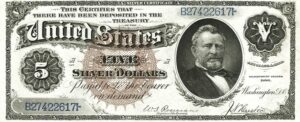
Walk into any serious currency dealer’s back room and you will find climate-controlled storage, archival-grade holders, and a healthy respect for the invisible forces that can turn a crisp, high-grade note into a worthless relic overnight. Environmental degradation does not announce itself. It creeps in slowly, working at the molecular level through the cotton-linen fibers of your banknotes until one morning you open a storage box and find brown spots, a musty smell, or worse, a web of white fuzz across the face of a note that once graded PMG 65. Understanding the science behind this destruction is the first step toward preventing it.
The Paper Itself: Why Currency Is Uniquely Vulnerable
United States currency has been printed on a cotton-linen blend since the Civil War era, when the Bureau of Engraving and Printing standardized the formula that continues to this day. The current supplier, Crane Currency (formerly Crane and Company of Dalton, Massachusetts), has provided paper stock since 1879. This composition gives notes their distinctive feel and extraordinary durability under normal handling conditions, but it also creates specific vulnerabilities that pure wood-pulp paper does not share.
Cotton and linen fibers are hygroscopic, meaning they actively absorb and release moisture from the surrounding atmosphere. When relative humidity rises above approximately 65 percent, the fibers swell measurably, weakening the bonds between individual strands. When humidity drops sharply below 35 percent, the fibers contract and become brittle. A note cycled repeatedly through these extremes develops microscopic stress fractures along fold lines and at the edges. Over years or decades, those stress points become visible splits, tears, and the characteristic fragility of an improperly stored note.
The ink formulations used in intaglio printing, the deeply raised process responsible for the tactile quality of Federal Reserve Notes, also react to moisture. The oil-based inks used in earlier series, particularly those printed before the widespread adoption of water-based formulas in the mid-twentieth century, can separate from the paper substrate when repeatedly wetted and dried, resulting in surface flaking that no conservation effort can reverse.
Purchase a digital hygrometer and thermometer combination unit for every storage location you use, including safe deposit boxes. Bank vaults often run at humidity levels that fluctuate seasonally, and many collectors have discovered significant moisture damage in notes stored at their bank for years. Units accurate to plus or minus 2 percent RH are available for under twenty dollars and are essential tools for any serious collection.
Foxing: The Brown Plague of Paper Collections
Foxing refers to the reddish-brown or tan spots and patches that appear on aged paper, and it is one of the most common and visually damaging forms of environmental deterioration that currency collectors encounter. The term itself dates to eighteenth-century book collecting, though its cause remained debated for centuries. Modern research has established that foxing results from a combination of biological and chemical processes, and the relative contribution of each depends on the specific conditions of storage.
The biological component involves fungal microorganisms, primarily species of Aspergillus and Penicillium, that feed on organic compounds present in the paper and in residual sizing agents. These fungi produce pigmented metabolic byproducts that create the characteristic brown discoloration. Under a magnifying loupe, biologically caused foxing spots typically show a slightly raised, irregular edge and may have a faint texture.
The chemical component involves iron and copper impurities present in both the paper pulp and the water used in manufacturing. These metal ions catalyze oxidation reactions in the cellulose fibers when moisture is present, producing brown ferrous and ferric compounds. Early twentieth-century notes, including the 1923 Silver Certificates in the $1, $5, and $10 denominations, and the 1922 Gold Certificates in denominations from $10 through $1,000, are particularly susceptible because paper manufacturing quality control of that era left higher residual metal content than modern production standards permit.
For collectors, the practical reality is devastating. A 1928 $1 Legal Tender Note graded PMG 64 Choice Uncirculated in original, clean condition catalogues at approximately $125 to $150 in current retail. The same note with moderate foxing, perhaps exhibiting five to ten visible brown spots across the face, will be designated PMG 30 Very Fine with a foxing notation, collapsing its value to the $25 to $40 range. High-denomination notes suffer proportionally more. A 1934 $500 Federal Reserve Note from the Chicago district (catalog FR-2201) graded PMG 63 without problems currently trades for $1,800 to $2,200. With foxing sufficient to earn a qualifier notation, expect values to drop by 40 to 60 percent.
When examining notes at shows or purchasing raw notes online, use a UV or black light to detect early-stage foxing that is not yet visible to the naked eye. Foxing spots absorb UV light differently than clean paper and will appear as dark patches under ultraviolet illumination before they become brown enough to see clearly in normal light. This technique can help you avoid paying problem-free prices for notes that will develop visible issues within a few years of purchase.
Active Mold Growth: The Most Urgent Threat
While foxing develops over years or decades, active mold can visibly colonize a banknote within 48 to 72 hours under the right conditions. Mold requires four things to thrive: a food source, moisture, warmth, and time. Paper currency provides all the organic nutrition mold spores need. When relative humidity rises above 65 to 70 percent and temperatures sit between 70 and 90 degrees Fahrenheit, airborne spores that are present in virtually every indoor environment will germinate on the surface of notes and begin consuming the cellulose fibers directly.
Active mold appears as white, gray, or black fuzzy growth on the surface of notes. The white, powdery variety (often Aspergillus or Rhizopus species) can sometimes be carefully removed by a professional conservator without permanent damage to the paper substrate, but only if caught very early. Black mold (commonly Stachybotrys chartarum) penetrates the paper fibers deeply and typically cannot be removed without causing further destruction. Notes with advanced black mold growth are generally considered conservation losses for grading purposes; PMG and PCGS Currency both note mold damage clearly on their holders and such notes receive reduced numerical grades or are body-bagged entirely.
The collections most at risk for mold events are those stored in basements, in garages, in wooden boxes or cabinets without proper ventilation, and in geographic regions with high ambient humidity. Collectors in the American Southeast, the Gulf Coast states, and the Pacific Northwest face elevated baseline risk. A collection stored in a Gulfport, Mississippi, home without climate control during August is operating at genuine risk of mold germination on any unprotected notes.
Notes from the pre-Federal Reserve era, including National Bank Notes issued between 1863 and 1935 under the National Currency Act, are especially poignant casualties of mold damage. These notes cannot be reprinted. When a Territory of New Mexico National Bank Note from the First National Bank of Santa Fe, chartered in 1870, develops mold damage, a piece of irreplaceable financial and regional history is permanently degraded. The 1882 Brown Back series National Bank Notes and the 1902 Plain Back series are among the most frequently encountered mold-damaged large-size notes at major auctions because they circulated widely and were casually stored by generations of owners before their numismatic significance was recognized.
Acid Migration and Paper Breakdown Over Time
Beyond biological threats, pure chemistry works against your collection. The cellulose in cotton and linen paper undergoes a slow hydrolysis reaction in the presence of moisture and atmospheric pollutants, gradually breaking the long polymer chains that give paper its strength. This process produces organic acids as byproducts, which then accelerate the hydrolysis further in a self-reinforcing cycle. The result is a note that becomes progressively more brittle, yellowed, and fragile over decades.
Acid migration is the related phenomenon that destroys notes stored in contact with acidic materials. PVC (polyvinyl chloride) plastic sleeves, common in inexpensive currency albums sold through hobby shops and office supply stores throughout the 1970s and 1980s, plasticize over time and transfer chlorine compounds directly into the note’s paper. This creates the characteristic greenish, oily residue visible on many notes from collections assembled during that era. The 1976 $2 Federal Reserve Notes issued for the Bicentennial, which were frequently stored in PVC albums as commemorative pieces, are today among the most commonly encountered PVC-damaged notes in the hobby, often presenting with that distinctive green tinge across portions of the face.
Wooden storage boxes, particularly those made from pine or oak, off-gas lignin compounds and acetic acid that attack paper over time. A note stored in a cedar chest for thirty years will show measurable paper degradation that a note stored in an archival polypropylene holder will not.
Audit your existing storage materials immediately if you have not done so recently. Squeeze any plastic sleeve or album page between your fingers: if you detect a faint vinegary or chemical smell, or if the plastic feels oily or unusually soft, it is likely PVC and should be replaced with archival-grade Mylar (polyester), polypropylene, or polyethylene holders. Never store currency in direct contact with wood, newspaper, rubber bands, or standard adhesive tape of any kind.
Environmental Factors Unique to Specific Note Types
Not all notes age identically. The printing processes, ink formulations, and paper batches varied considerably across different series and eras, creating specific vulnerabilities that experienced collectors learn to anticipate.
The Series of 1934 and 1934-A Federal Reserve Notes, printed in enormous quantities to fund World War II-era economic activity, used ink formulations that are more susceptible to offset smearing under high humidity than later series. The 1934-A $10 Federal Reserve Note from the San Francisco district is frequently found with offset ghosting visible on the reverse, caused by moisture activating the inks during storage in stacked condition.
Hawaii Overprint Notes, specifically the Series 1935-A $1 Silver Certificates and the Series 1934 and 1934-A Federal Reserve Notes overprinted with brown serial numbers and the word HAWAII for use in the Pacific Theater during World War II, saw combat zone storage conditions that created chronic humidity damage. These notes were carried by military personnel in tropical environments for months. Today, finding a Hawaii overprint note in truly original high grade without any environmental damage is a genuine challenge, which contributes to the premium that problem-free examples command. A clean PMG 65 EPQ 1935-A $1 Hawaii note currently trades at $550 to $700, while a comparable note with humidity staining may struggle to bring $150.
Confederate States of America currency, while outside the Federal Reserve system, appears in many US collections and is extraordinarily vulnerable to environmental damage. The CSA printed notes on varying paper stocks of inconsistent quality between 1861 and 1865, including some issues on paper that already contained high acid content at manufacture. The 1864 $500 Confederate note (Criswell Type-64) survives in truly high grades in very small numbers partly because environmental attrition has destroyed so many examples over the past 160 years.
| Series / Issue | Note Type or Variety | Problem-Free High Grade Examples Known | Rarity |
|---|---|---|---|
| 1882 Brown Back | National Bank Notes, various states | Very few per bank charter | Key Date |
| 1923 Silver Certificate | $1 Porthole Note (FR-237) | Estimated under 3,000 in all grades | Rare |
| 1934 / 1934-A Hawaii Overprint | $20 FRN, San Francisco | Under 500 in PMG 63 or better | Rare |
| 1935-A Hawaii Overprint | $1 Silver Certificate | Several thousand, many with issues | Scarce |
| 1902 Plain Back | National Bank Notes, Southern states | Highly variable by charter | Scarce |
| 1976 $2 Bicentennial | All districts, especially PVC-stored | Millions printed, clean examples common | Common |
| 1934 $500 FRN | All twelve districts | Fewer than 800 known across all districts | Rare |
| Series 1928 $1 Legal Tender | Red Seal (FR-1500) | Thousands graded, foxing common | Common |
| 1864 $500 Confederate | Criswell Type-64 | Fewer than 50 in problem-free VF or better | Key Date |
Building a Climate-Stable Storage Environment
Prevention is categorically more effective than remediation. Once foxing spots form, once mold has consumed paper fibers, and once acid migration has yellowed a note, the damage is permanent. Professional conservation can sometimes arrest ongoing degradation and stabilize a note, but it cannot restore lost fibers or bleach foxing without creating new chemical vulnerabilities in the process. Third-party grading services including PMG and PCGS Currency will note any signs of cleaning or chemical treatment on their holders, typically resulting in a details or net grade designation that reduces the note’s market value substantially.
The practical storage goal is to maintain relative humidity between 45 and 55 percent and temperature between 60 and 70 degrees Fahrenheit at all times. Fluctuation itself is damaging, so consistency matters as much as hitting the target range. A note stored at a steady 58 percent RH will fare better than one oscillating between 40 and 70 percent, even though 58 percent is slightly above ideal.
For large or particularly valuable collections, dedicated storage rooms with a combination dehumidifier and humidifier on an integrated controller represent the gold standard. Purpose-built collector safes with interior climate control are available from manufacturers including Liebherr and Brown Safe, though these represent significant investments. For most collectors, a quality fireproof safe or filing cabinet combined with silica gel desiccant packs replaced every three to six months, stored in a climate-conditioned interior room away from exterior walls, provides adequate protection for notes in archival holders.
Notes in raw, ungraded condition benefit enormously from individual archival Mylar flips or hard acrylic holders before going into storage. The physical barrier of an appropriate holder dramatically reduces the rate at which atmospheric moisture, pollutants, and mold spores can interact with the paper surface. Submitting your most valuable raw notes to PMG or PCGS Currency provides the additional benefit of a sealed, inert holder that offers excellent environmental protection while establishing a certified grade for insurance and resale purposes.
What to Do If You Find Damage
If you discover what appears to be active mold on notes in your collection, isolate the affected notes immediately in individual sealed polypropylene bags. Do not place them in contact with any other notes, albums, or storage materials. Move them to a dry environment with humidity below 50 percent, which will arrest active spore germination. Do not attempt to wipe, brush, or wash the mold, as doing so will spread spores to other surfaces and may push the biological material deeper into the paper fibers.
For notes with possible conservation value, contacting a professional paper conservator affiliated with the American Institute for Conservation is the appropriate next step. The AIC maintains a directory at culturalheritage.org. Be aware that currency conservation is a specialized subspecialty; not every paper conservator has experience with intaglio-printed documents. Some auction houses including Heritage Auctions and Stack’s Bowers maintain relationships with conservators who have specific banknote experience and can provide referrals.
For notes with foxing that has not progressed to active mold, improving storage conditions will prevent further development but will not reverse existing spots. The pragmatic decision for many collectors is to have these notes professionally graded with their existing condition accurately documented, then decide whether to keep them as affordable collection representatives of otherwise scarce types, or to sell them and reinvest in problem-free examples.
Insurance and Documentation
Environmental damage events, particularly flooding, which introduces explosive humidity, are covered under some homeowner insurance riders for collectibles but require documented values before the loss event. Photograph your collection annually, store those photographs offsite or in a cloud service, and maintain a written inventory that includes grade, catalog number, and current estimated value for each significant note. Certified notes from PMG and PCGS Currency already have their own documentation, but raw notes need collector-generated records. The American Numismatic Association offers resources on collection insurance through its member benefits program, and several specialty insurers including Hugh Wood and Collectibles Insurance Services offer policies specifically designed for numismatic collections.
The notes in your collection are physical artifacts of American economic and political history, some of them surviving against considerable odds from the Civil War era, the Great Depression, or World War II. Protecting them from the slow, invisible work of humidity, biology, and chemistry is not merely a matter of financial preservation; it is an act of historical stewardship. With the right environment, the right materials, and regular monitoring, notes that have survived 150 years can survive another century without losing a single grade point to preventable environmental damage.