📷 Image source: banknote.ws (World Banknote Gallery). Images are selected by AI to represent the article topic and may not depict the exact note(s) described.
Walk into almost any serious currency auction and you will find bidders crowding around the Series 1907 $10 Gold Certificate, with its dramatic portrait of Superintendent of Finance Michael Hillegas set inside a bold circular vignette that earned the note its famous “Porthole” nickname. The $10 gets the glory, the catalog write-ups, and the breathless lot descriptions. Meanwhile, its larger sibling, the Series 1907 $20 Gold Certificate, sits quietly in dealer cases, priced at a fraction of its rarity-adjusted worth, largely ignored by the same collectors who would mortgage a car for a high-grade Hillegas. That quiet patience may not last forever.
Understanding the Series Landscape for Large-Size $20 Gold Certificates
Before drilling into the 1906 and 1905 series notes that numismatists loosely group under the “Porthole” design era, it helps to understand how large-size Gold Certificates evolved for the $20 denomination. The Treasury issued $20 Gold Certificates across several design types in the late 19th and early 20th centuries. The Series 1882 notes (Fr. 1174 through Fr. 1178) featured a portrait of President James Garfield and a bold orange-gold Treasury seal. Those are legitimately rare coins in any grade and command strong prices from type collectors.
The design shift came with Series 1905 (Fr. 1179), which introduced the now-iconic circular portrait of George Washington on the face, surrounded by an intricate geometric lathe-work border that mirrors, in principle, the design concept used on the $10 Porthole note. The back of the 1905 issue is where the denomination truly distinguishes itself: the reverse features a vivid orange-gold and black color scheme that is arguably one of the most visually arresting backs in all of large-size American currency. Collectors who dismiss the $20 as “just the $10 with a bigger number” have clearly never held a high-grade 1905 example under proper lighting.
The Design: Washington in the Round
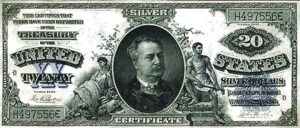
The face of these notes centers on a finely engraved bust portrait of George Washington, encircled by a medallion of intricate engine-turned geometric work. Surrounding the central medallion are ornate scrollwork panels, the denomination spelled out in large “TWENTY DOLLARS” text, and the gold Treasury seal positioned to the right. The overall effect is formal, authoritative, and genuinely beautiful.
The Series 1905 reverse is the design that separates the early notes from the more common later issues. Bureau of Engraving and Printing engravers used a rich combination of deep gold-orange ink against black, creating a two-tone contrast that was unusual for the period and extraordinarily difficult to counterfeit. When the series was updated to 1906, the reverse was revised to the more conventional green color used on the later issues (Fr. 1180 onward), sacrificing visual drama for standardization. If you want the full “look at me” display piece, the 1905 orange-back is the one to find.
When examining a Series 1905 $20 Gold Certificate, inspect the reverse orange ink carefully under UV light. Genuine examples show a warm, slightly fluorescent orange-gold tone that differs noticeably from any period alterations or restorations. Any note with bright, artificially uniform color on the reverse should be sent to PCGS Currency or PMG for authentication before purchase.
Signature Varieties and Their Catalog Numbers
The large-size $20 Gold Certificates spanning Series 1905 through the final large-size issue of Series 1922 encompass a meaningful range of Treasurer and Register signature combinations. Each pairing was authorized for a specific window of time, and survival rates vary considerably across them.
The earliest note, Fr. 1179 (Series 1905), carries the Lyons-Roberts signature combination, with William S. Lyons as Register of the Treasury and Ellis H. Roberts as Treasurer of the United States. This note also bears the distinctive orange-gold back described above. Surviving examples in any grade are genuinely scarce, and in Very Fine or better condition they are legitimately rare. PCGS and PMG population reports as of recent years show fewer than 60 graded examples across all grades for Fr. 1179, with perhaps 12 to 15 grading VF-25 or higher.
Moving to Series 1906, the Friedberg numbers run from Fr. 1180 through Fr. 1186, representing six distinct signature pairings on the now-green-backed design. The Lyons-Treat (Fr. 1180), Vernon-Treat (Fr. 1181), Vernon-McClung (Fr. 1182), Napier-McClung (Fr. 1183), Napier-Thompson (Fr. 1184), Parker-Burke (Fr. 1185), and Teehee-Burke (Fr. 1186) pairings all exist, though with very different levels of accessibility. The Napier-Thompson combination (Fr. 1184) is particularly elusive, with a reported print run believed to be among the lowest of the 1906 group.
The final large-size $20 Gold Certificate, Series 1922 (Fr. 1187), carries the Speelman-White signatures and represents the most commonly available note in the group, though “common” is entirely relative for large-size gold certificates in any grade above Fine.
Building a complete signature variety set of the Series 1906 $20 Gold Certificates (Fr. 1180 through Fr. 1186) is an achievable long-term goal that most collectors never attempt precisely because the $10 Porthole dominates the conversation. A dedicated type set across all seven 1906 signature combinations, even in Fine to Very Fine grades, would represent a genuinely impressive and historically complete collection at a cost far below an equivalent $10 set.
Why the $10 Porthole Steals the Spotlight
The Series 1901 $10 “Bison” note and the Series 1907 $10 Gold Certificate Porthole are arguably the two most celebrated large-size type notes among American currency collectors. The Hillegas portrait on the $10 Gold Certificate is widely regarded as one of the finest engraved portraits on any US banknote, and the subject himself, the nation’s first Superintendent of Finance, adds historical intrigue that George Washington, being ubiquitous on American currency, simply cannot match for novelty.
That portrait novelty factor drives premiums that have little to do with actual rarity. In many signature combinations, the $20 is no more available than the $10, and in several pairings it is demonstrably scarcer by population report counts. Yet dealer ask prices and realized auction results for comparable grades routinely show the $10 commanding 30 to 60 percent premiums over the $20 across mid-grade examples. For a collector who cares about value relative to scarcity, this gap is difficult to justify on purely numismatic grounds.
Grading Realities for the $20 Gold Certificate
Large-size Gold Certificates present specific grading challenges that newer collectors should understand before buying. The gold Treasury seal on these notes is printed with a metallic ink that is prone to flaking and abrasion. A note that appears to grade Very Fine based on paper quality and fold count may carry a net grade reduction from PCGS or PMG due to seal wear or ink loss. Always examine photographs of the seal area at high resolution before bidding on raw, ungraded examples.
Centering is another persistent issue. The Bureau of Engraving and Printing’s sheet-cutting tolerances during the large-size era were not as precise as modern production, and many examples, including notes that have never been circulated, show margins that are noticeably uneven. PCGS Currency uses a specific centering notation in its grading, and a note graded 63 PPQ (Premium Paper Quality) with a centering notation may still be a beautiful, highly desirable coin. Do not let imperfect margins talk you out of an otherwise superior example.
For the Series 1905 orange-back variety specifically, examine the paper surface under a loupe for signs of cleaning or pressing. The distinctive orange ink on the reverse was sometimes targeted by early “restorers” who attempted to brighten faded examples using solvents that leave a telltale flatness to the paper fibers under magnification. Third-party grading is strongly recommended for any 1905 purchase above $1,500.
Current Market Values and What to Expect at Auction
Pricing on large-size $20 Gold Certificates spans a wide range depending on series, signature combination, and grade. As a general framework based on recent Heritage Auctions and Stack’s Bowers realized prices:
The Series 1905 Fr. 1179 in Good-10 to Fine-15 range has realized between $1,800 and $3,500, with VF examples pushing $6,000 to $9,500 and the rare Extremely Fine example approaching $15,000 or more. The orange-back design commands meaningful premiums over equivalent-grade 1906 examples.
Common Series 1906 examples like Fr. 1183 (Napier-McClung) or Fr. 1186 (Teehee-Burke) in Fine-12 condition generally trade in the $400 to $650 range, with Very Fine examples reaching $900 to $1,400. This is genuinely reasonable pricing for an attractive, century-old gold certificate in a major denomination.
The Series 1922 Fr. 1187 in circulated grades Fine through Very Fine is the most accessible entry point, with well-circulated Fine examples sometimes available for under $300, making it an excellent first purchase for collectors new to the type.
| Friedberg No. | Series / Signatures | Est. Known / Graded | Rarity |
|---|---|---|---|
| Fr. 1179 | 1905, Lyons-Roberts (Orange Back) | Approx. 55-65 graded | Key Date |
| Fr. 1180 | 1906, Lyons-Treat | Approx. 80-100 graded | Rare |
| Fr. 1181 | 1906, Vernon-Treat | Approx. 120-150 graded | Rare |
| Fr. 1182 | 1906, Vernon-McClung | Approx. 150-180 graded | Scarce |
| Fr. 1183 | 1906, Napier-McClung | Approx. 200-250 graded | Scarce |
| Fr. 1184 | 1906, Napier-Thompson | Approx. 60-80 graded | Key Date |
| Fr. 1185 | 1906, Parker-Burke | Approx. 130-160 graded | Scarce |
| Fr. 1186 | 1906, Teehee-Burke | Approx. 180-220 graded | Scarce |
| Fr. 1187 | 1922, Speelman-White | Approx. 400-500 graded | Common |
Building a Collection Around the $20 Gold Certificate
There are several compelling ways to approach collecting within this series. The most straightforward is a single type-note approach: acquire one example of the orange-back 1905 and one example of the green-back 1906 design to represent both reverse varieties. This gives you the full visual story of the denomination’s design evolution at a cost accessible to most serious collectors.
A more ambitious goal is the complete signature variety set across Fr. 1179 through Fr. 1187. This nine-note set spanning 1905 through 1922 would take years to complete at a thoughtful pace, but it documents a fascinating period of American monetary policy, including the years surrounding the Federal Reserve Act of 1913, which fundamentally changed how currency was issued and backed. The Teehee-Burke signature pairing (Fr. 1186), for example, was in use precisely during the transition years when the new Federal Reserve system was being implemented, lending the note an interesting historical dimension beyond its face value.
Collectors interested in gold certificate history more broadly might also consider pairing the $20 series with the corresponding $10 Porthole (Fr. 1167 through Fr. 1172) and the $50 Gold Certificate Series 1913 (Fr. 1197 through Fr. 1200) to create a thematic large-size gold certificate display spanning three denominations.
A Final Word on Opportunity
The Series 1907 $20 Gold Certificate, and the broader family of large-size $20 gold issues from 1905 through 1922, represents one of those genuine collecting opportunities that emerges when a note is objectively scarce but culturally overshadowed. The notes are beautiful, historically significant, and available at prices that, measured against their actual population report numbers, look conservative by comparison to better-publicized issues in the large-size catalog.
Whether you are a new collector looking for an achievable entry into large-size gold certificates or a seasoned numismatist filling a gap in a thematic collection, the $20 Porthole-era notes deserve serious attention. The $10 Hillegas will continue to attract the crowds. But the quiet, regal Washington portrait inside its circular medallion, printed on a piece of paper that once promised the bearer twenty dollars in gold coin, has its own story to tell, and right now, that story is available at a reasonable price.