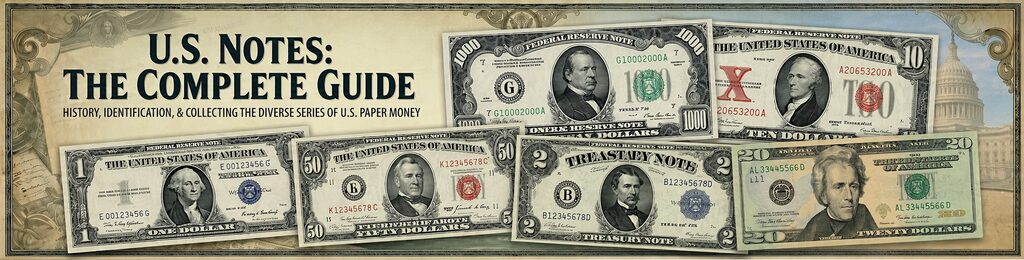
On April 6, 1917, the United States declared war on Germany and stepped into the bloodiest conflict the world had yet seen. Within weeks, the financial machinery of the federal government shifted into overdrive. At the heart of that machinery sat the Bureau of Engraving and Printing, a sprawling complex on Fourteenth Street in Washington, D.C., suddenly asked to do far more than it had ever done before. The BEP would spend the next eighteen months printing Liberty Bonds by the billions, war savings stamps by the trillions of impressions, and currency that had to keep pace with a wartime economy expanding at a dizzying rate. The story of the BEP during World War I is one of the most compelling chapters in American printing history, and it left a distinct fingerprint on the paper money of the era that collectors can still identify and cherish today.
The Scope of the Challenge
Before the war, the BEP operated on a demanding but predictable schedule. It printed Federal Reserve Notes authorized under the landmark Federal Reserve Act of 1913, National Bank Notes, Legal Tender Notes (United States Notes), and a variety of internal revenue and postage stamps. The institution was respected for the exquisite intaglio craftsmanship of its master engravers, men who spent months on a single die. War changed everything about that rhythm.
The Liberty Loan Acts came in rapid succession. The First Liberty Loan Act was passed on April 24, 1917, authorizing $5 billion in bonds at 3.5 percent interest. The Second Liberty Loan followed in October 1917. The Third in April 1918, and the Fourth in September 1918. Each drive required the BEP to design, engrave, and produce an entirely new series of bond certificates, with denominations ranging from $50 all the way up to $100,000 for institutional purchasers. The $50 and $100 denominations were produced in the largest quantities because they were targeted at ordinary American citizens. A $50 First Liberty Loan bond, for instance, bears the issue date of June 15, 1917, and carries a coupon booklet that was itself a printing achievement, requiring precise registration on thin paper stock.
Unissued or lightly circulated Liberty Bond certificates from the First and Second Liberty Loan drives are still very collectable at modest prices. Look for complete coupon sheets still attached, as bonds with coupons removed, meaning interest was collected, are considerably more common. A complete First Liberty Loan $50 bond in Fine condition typically trades between $40 and $90 today, while a $100,000 institutional denomination can command several hundred dollars even in worn condition simply due to its visual drama and historical weight.
Currency Production Under Strain: The Series of 1914 and 1917
The Federal Reserve Notes of the Series of 1914 are the currency most directly tied to the wartime BEP story. Authorized under the Federal Reserve Act, these notes came in two major varieties: the Red Seal notes (issued before the war) and the Blue Seal notes that dominated circulation from 1915 onward. The Blue Seal 1914 Federal Reserve Notes were produced by all twelve Federal Reserve districts in denominations of $5, $10, $20, $50, and $100, with the $500 and $1,000 denominations existing in much smaller quantities.
The wartime pressure showed up in the signature combinations found on these notes. The Blue Seal 1914 series carries four distinct signature pairs: Burke-McAdoo (the most common), Burke-Glass, Burke-Houston, and White-Mellon (the rarest, bridging the war and immediate postwar period). William Gibbs McAdoo served as Secretary of the Treasury from 1913 to 1918, meaning any 1914 Federal Reserve Note bearing his signature spans the entire arc of American involvement in the Great War. Register of the Treasury John Burke signed alongside McAdoo through most of the war years. Collectors who focus on wartime signatures should specifically seek out Burke-Glass notes from 1919, which represent the post-Armistice transition period.
Simultaneously, the BEP was producing the Series of 1917 Legal Tender Notes in $1 and $2 denominations. These small-denomination notes, often called “Legal Tender” or colloquially by collectors as “United States Notes,” served a critical everyday circulation function as silver was diverted to industrial and military uses. The $1 Series of 1917 note (Friedberg catalog number Fr. 36 through Fr. 39, depending on signature combination) features the distinctive large red serial numbers and red Treasury seal. The Burke-McAdoo signature combination (Fr. 36) is the most frequently encountered, while the Speelman-White pairing (Fr. 39) represents notes printed slightly after the Armistice and is somewhat scarcer in high grade.
The $2 Series of 1917 Legal Tender Note (Fr. 60 through Fr. 63) is one of the most affordable wartime collectibles in American numismatics. In circulated grades like Very Fine, these notes can be purchased for $30 to $60 depending on signature combination. However, a Gem Uncirculated (PMG 65 EPQ or better) example of any signature variety represents genuine quality that commands $200 to $500 or more, because wartime currency saw heavy circulation and pristine survivors are scarcer than the print run numbers suggest.
War Savings Stamps: A Printing Marathon
No discussion of the BEP in wartime is complete without addressing War Savings Stamps and Thrift Stamps, which represented one of the most audacious mass-printing challenges in American history. Authorized under the War Savings Act of December 1917, the program asked Americans to purchase $5 War Savings Certificates (WSCs) at a discount, with a maturity value payable on January 1, 1923. Smaller Thrift Stamps, sold for 25 cents each, could be collected sixteen to a card and exchanged for a WSC.
The BEP printed the 1917 series WSCs in massive quantities, followed by the 1918 series. The design featured a female allegorical figure representing America, engraved in the classical BEP style. By the time the program ended, the BEP had printed over $1 billion worth of these instruments. Postal savings stamp booklets, War Savings Stamp sheets, and Thrift Stamp cards from this period are cross-collectibles that appeal to both philatelists and financial paper collectors. Complete War Savings Certificate booklets from 1918 with stamps intact are increasingly hard to find and represent genuinely undervalued historical documents.
The Human Element: Workforce Expansion and Innovation
The BEP’s workforce grew from roughly 4,000 employees in 1916 to over 6,000 by the peak of wartime production in 1918, a dramatic expansion that required hiring and training workers at a pace entirely foreign to an institution that prided itself on craft apprenticeship. Women entered BEP production roles in significantly larger numbers during the war years, taking on press operation and inspection duties that had been predominantly male domains. This workforce transformation had a direct effect on note quality variation that modern collectors occasionally notice: the hand-cut sheets and manual inspection processes of the era resulted in more centering variation in 1917 and 1918 issues than in notes produced during quieter periods.
The BEP also accelerated adoption of high-speed rotary presses during this period. Traditional flat-plate intaglio printing, which produced the sharpest impressions but at slower speeds, was supplemented by adapted rotary processes for some stamp and bond work, though currency continued to rely on flat-plate printing for its security and quality. The tension between speed and quality during the war years is a fascinating subtext that helps explain why some 1917-series notes display slightly weaker impression characteristics than pre-war equivalents.
When examining Series of 1914 Federal Reserve Notes or Series of 1917 Legal Tender Notes for purchase, pay close attention to centering and margins. Wartime production pressures led to higher rates of off-center cutting than notes from the 1920s. A well-centered wartime note in VF-EF condition is often more desirable and no more expensive than a technically higher-grade note with poor margins, and it photographs far better in a collection display.
The Fourth Liberty Loan and the Armistice Notes
The Fourth Liberty Loan drive, launched September 28, 1918, raised approximately $6.99 billion, the single largest of the four drives. Bond certificates from the Fourth Loan are distinguished by their 4.25 percent coupon rate, the highest of the four issues, reflecting the Treasury’s need to incentivize continued public participation after nearly two years of war fatigue. The BEP produced these certificates in a compressed timeline: Germany’s military collapse was accelerating, and the Armistice came on November 11, 1918, just weeks after the Fourth Loan closed.
Currency printed in the immediate Armistice period carries a particular resonance for historically minded collectors. Federal Reserve Notes bearing the Burke-Glass signature combination, with Carter Glass having succeeded McAdoo as Treasury Secretary in December 1918, represent the fiscal transition from war to peace. These notes circulated alongside returning soldiers and through the economic disruptions of 1919 and 1920. The Series of 1918 Federal Reserve Bank Notes, a separate and often overlooked issue, were printed on blue-seal federal authority and bear specific district charter numbers that make district-by-district collecting a rich subspecialty.
| Series / Issue | Denomination or Variety | Approx. Print Run or Quantity | Rarity |
|---|---|---|---|
| Fr. 36 Legal Tender 1917 | $1 Burke-McAdoo | Hundreds of millions | Common |
| Fr. 39 Legal Tender 1917 | $1 Speelman-White | Lower production run | Scarce |
| Fr. 60 Legal Tender 1917 | $2 Burke-McAdoo | Tens of millions | Common |
| Fr. 63 Legal Tender 1917 | $2 Speelman-White | Significantly fewer | Scarce |
| Series 1914 FRN Blue Seal | $50 or $100 Burke-Houston | Limited by late-war sig. tenure | Rare |
| Series 1914 FRN Blue Seal | $500 or $1,000 any district | Under 100,000 total most districts | Key Date |
| First Liberty Loan Bond 1917 | $50, complete coupons | Millions issued | Common |
| Fourth Liberty Loan Bond 1918 | $100,000 institutional | Very few printed | Rare |
| War Savings Certificate 1918 | Complete booklet with stamps | Survivors a fraction of issued | Scarce |
| Series 1918 FRBN | $2 any district (Fr. 750-763) | Under 8 million most districts | Scarce |
Collecting the BEP’s Wartime Legacy Today
For collectors, the World War I era BEP output represents a sweet spot: historically profound, visually compelling, and still affordable across most grades. A beginner can assemble a meaningful thematic collection centered on the war years for well under $500. A core holding might include a circulated Series of 1917 $1 Legal Tender Note (Fr. 36), a $2 of the same series, a Series of 1914 Blue Seal $5 or $10 Federal Reserve Note from any district, and a Liberty Bond certificate from at least two of the four loan drives. That quartet tells the complete story of how the BEP financed and supplied America’s war effort through ink, paper, and extraordinary human labor.
Advanced collectors often chase the Series of 1918 Federal Reserve Bank Notes (distinct from Federal Reserve Notes), which are distinguished by having both the name of the issuing bank and specific bank officer signatures printed on the face, alongside the U.S. Treasury signatures. The $1 denomination of this series (Friedberg Fr. 708 through Fr. 746) is particularly popular because it represents the only $1 Federal Reserve Bank Note ever issued, making it a unique artifact of this specific wartime moment.
Conclusion: Paper Money as a War Document
There is a tendency to treat paper money as mere economic infrastructure, anonymous and interchangeable. The story of the BEP during World War I corrects that view decisively. Every Series of 1917 Legal Tender dollar that passed through a soldier’s hands at Camp Dix, every Liberty Bond certificate purchased by a factory worker in Pittsburgh or a farmer in Iowa, every War Savings Stamp licked and pressed into a Thrift booklet by a schoolchild asked to “do their part” was a product of an institution under extraordinary pressure, staffed by men and women working longer hours for higher stakes than any peacetime printing schedule demanded. When you hold one of these notes today, you are holding a document of that pressure, that purpose, and that remarkable national moment. That is what makes them worth collecting.