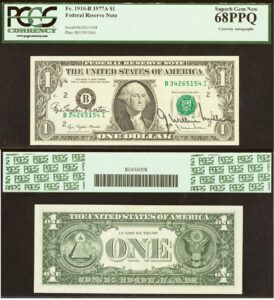
Walk through any major currency show and you will find stacks of Series 1950 $10 Federal Reserve Notes filling dealer cases at modest prices. Move three issues forward to the 1950C, however, and the picture changes considerably. This particular series, authorized under the signatures of Treasurer Ivy Baker Priest and Secretary of State Robert B. Anderson, represents a transitional moment in Federal Reserve Note production, falling between the higher-run 1950B and the more commonly encountered 1950D. The 1950C was printed from 1961 into 1962, and its total output was significantly lower than most adjacent series, a fact that collectors are still catching up to decades later.
Background: The Priest-Anderson Signature Combination
Ivy Baker Priest served as Treasurer of the United States from January 1953 through January 1961, making her one of the longer-tenured treasurers of the mid-twentieth century. Robert B. Anderson was Secretary of the Treasury from July 1957 through January 1961. Their combined signatures appear across the Series 1953C Silver Certificates, the 1957 and 1957A Silver Certificates, and several Federal Reserve Note series including the 1950B, 1950C, and transitionally, some 1950D notes depending on district and plate schedules. For the Series 1950C $10 specifically, the Priest-Anderson pairing is the only signature combination that exists, which simplifies authentication considerably.
The face design follows the standard small-size Federal Reserve Note layout introduced in 1928, with Hamilton’s portrait at center, the black Federal Reserve seal to the left, and the green Treasury seal to the right. The series designation appears on the face above the serial number on the right side. District numerals and letters in the Federal Reserve seal identify which of the twelve banks issued the note, a detail that drives the entire value differential discussed in this article.
Plate Varieties: What to Look For
The Bureau of Engraving and Printing maintained separate face and back plate schedules, and for the Series 1950C $10, collectors have documented a meaningful range of plate numbers worth examining under magnification. Face plates for this series run from relatively low numbers into the 300s depending on district, while back plates span a range that overlaps with both the 1950B and early 1950D production. The back design, featuring the United States Treasury building, used plates numbered primarily in the 500 to 900 range during this production window.
Plate number position on these notes falls in the lower right corner of the face (face plate) and lower right of the back (back plate). Notes with plate number 1 on either face or back are particularly desirable to specialists who collect by plate position. Several districts show documented single-digit back plates on the 1950C series, though finding a matched low-plate note in high grade is genuinely challenging.
Always record the face plate number and back plate number separately when cataloging your Series 1950C notes. A face plate 1 from any district in Fine or better condition is worth meaningful premium, and a back plate 1 paired with a star serial number from a low-mintage district could represent a significant find. Use a loupe of at least 5x magnification to read faint plate numbers on circulated examples.
District-by-District Production: The Numbers That Matter
The twelve Federal Reserve districts each received allocations of Series 1950C $10 notes, but those allocations were far from equal. The New York district (B, district 2) predictably received the largest share given the volume of commerce flowing through that bank, with regular issue notes running well into the hundreds of millions of dollars face value. Boston (A, district 1), Philadelphia (C, district 3), and Cleveland (D, district 4) also saw substantial printings that keep their regular-issue notes affordable today.
The story shifts dramatically as you move west and south. The Minneapolis district (I, district 9), Kansas City (J, district 10), and Dallas (K, district 11) all received comparatively modest allocations in the 1950C series. Minneapolis regular-issue notes are scarce but findable. Dallas notes turn up occasionally at shows. Kansas City regular issues are genuinely uncommon in grades above Very Fine. And when you cross over to star notes from these same districts, the population numbers become almost startling in their scarcity.
If you are building a district set of Series 1950C $10 star notes, do not underestimate how long finding a Kansas City example in Extremely Fine or better condition might take. Population reports from PCGS Currency and PMG combined show fewer than two dozen graded examples across all grades as of recent census data. Budget accordingly and do not pass up a VF example just because you are holding out for a higher grade.
Why Kansas City Stars Command Premium Prices
Star notes, the replacement notes printed by the BEP to substitute for misprinted or damaged notes before a sheet leaves the printing facility, were produced in quantities proportional to the regular issue for each district. When a district receives a relatively small regular-issue allocation to begin with, the star note replacement run is proportionally tiny. Kansas City’s Series 1950C $10 star notes carry the prefix letter J and the star suffix symbol, with serial numbers beginning at J00000001 and running through what census evidence suggests was a print run of approximately 576,000 notes.
That sounds like a large number in isolation, but context is everything. When you factor in the sixty-plus years of circulation, spending, pulping by the Federal Reserve, and attrition across the population, the surviving census of notes in collectible condition becomes very small indeed. PMG-graded examples in VF20 or better sell regularly in the $400 to $800 range at auction, and a gem Uncirculated example (MS65 or higher) could realistically exceed $1,500 to $2,000 depending on the bidding environment and the specific grade. A PCGS Currency 66 PPQ example sold for just over $1,800 at a Heritage auction in 2022, illustrating exactly where the market sits for top-grade survivors.
Compare this to a Series 1950C $10 star note from the New York district (B-star), where print runs were large enough that Uncirculated examples trade regularly in the $75 to $150 range, and the value disparity becomes obvious. District matters enormously in this series, and Kansas City matters most of all among the western districts.
Grading Considerations for the Series 1950C $10
Notes from this era that circulated heavily often show characteristic folds at the four corners, a central horizontal fold from wallet carry, and edge wear that can be deceptive. The green treasury seal and green serial numbers on these notes hold up reasonably well in circulation, but the black ink in the Federal Reserve seal and district letter can show rubbing that knocks a note from Fine into Very Good territory quickly. Paper quality on BEP production of this period is excellent, and genuinely uncirculated examples will display crisp paper with full original wave and bright ink on all seal elements.
When submitting Series 1950C notes for grading, be aware that both PCGS Currency and PMG recognize the PPQ (Premium Paper Quality) and EPQ (Exceptional Paper Quality) designations respectively, which confirm the note has not been cleaned, pressed, or chemically treated. A 1950C Kansas City star in PMG VF30 EPQ will outperform an equivalent raw note at auction consistently, and the premium is usually worth the grading fee for any note likely worth $200 or more in raw condition.
When examining a potential 1950C purchase at a show or online, hold the note at an oblique angle to a light source and look for evidence of pressing along fold lines. A pressed note will show a slight sheen along former folds and may have fibers that appear slightly matted. Legitimate high-grade survivors from this era will have paper that feels uniformly firm with no suspicious smoothness in any area.
Building a Type Set vs. a District Set
New collectors often approach the Series 1950C as a type note, meaning they want one example to represent the series in a broader collection of twentieth-century Federal Reserve Notes. For that purpose, a circulated New York or Chicago district note in Very Fine grades can be acquired for $25 to $50 in raw condition, making it one of the more accessible mid-century type notes. Collectors who go this route should prioritize paper quality over grade, as a crisp Fine note outshines a well-traveled Very Fine every time on the display table.
Experienced collectors building district sets face a much more demanding and rewarding challenge. A complete set of all twelve districts in star note form for the Series 1950C $10 is a multi-year, multi-thousand-dollar undertaking. The eastern districts can be assembled at reasonable cost, but the western trio of Minneapolis, Kansas City, and Dallas will test your patience and your budget. Several accomplished collectors have noted publicly that the Kansas City star was the last piece to fall into place in their district sets, sometimes taking three to five years to locate in the target grade.
Authentication and Known Counterfeits
The Series 1950C $10 predates the sophisticated security features of modern Federal Reserve Notes, relying primarily on distinctive paper composition with embedded red and blue security fibers and the quality of BEP intaglio printing for authentication. Genuine notes will show the characteristic raised feel of intaglio ink on Hamilton’s portrait and lettering, a tactile quality that even heavily worn notes retain to some degree. Color-copied fakes lack this entirely and feel flat under the fingertip.
Altered notes are the more pressing concern for collectors. Some unscrupulous sellers have attempted to add star symbols to serial numbers of common district regular-issue notes to simulate star notes. Examine the star character carefully under magnification: on genuine BEP-printed star notes, the star is printed in the same ink run as the serial number and shows identical ink density and registration. Added stars often show slightly different ink color, inconsistent line weight, or offset positioning relative to the serial number digits.
| District | Type | Est. Print Run | Rarity |
|---|---|---|---|
| New York (B) | Regular Issue | ~180,000,000+ | Common |
| New York (B) | Star Note | ~2,880,000 | Common |
| Chicago (G) | Regular Issue | ~120,000,000+ | Common |
| Chicago (G) | Star Note | ~1,440,000 | Common |
| San Francisco (L) | Regular Issue | ~80,000,000 | Common |
| Dallas (K) | Regular Issue | ~28,800,000 | Scarce |
| Dallas (K) | Star Note | ~720,000 | Rare |
| Minneapolis (I) | Regular Issue | ~21,600,000 | Scarce |
| Minneapolis (I) | Star Note | ~576,000 | Rare |
| Kansas City (J) | Regular Issue | ~18,000,000 | Scarce |
| Kansas City (J) | Star Note | ~576,000 | Key Date |
Where to Find Series 1950C $10 Notes Today
Heritage Auctions, Stack’s Bowers, and Lyn Knight Currency Auctions all offer Series 1950C material regularly, with Heritage’s online archives providing an invaluable free resource for researching realized prices on specific district and grade combinations going back to the early 2000s. For raw notes, the major currency shows including the Memphis Paper Money Show each June and the various regional SPMC events offer dealer tables where patient searching pays dividends. Online, eBay remains a viable source for common district examples, though buyers should scrutinize seller feedback carefully and request detailed scan images of both face and back before bidding on any note claimed to be in Fine or better condition.
Currency dealer networks such as those maintained through the Professional Currency Dealers Association (PCDA) membership lists are worth consulting when hunting for specific district star notes. A dealer who specializes in small-size Federal Reserve Notes from the 1950s and 1960s will often have access to inventory that never appears publicly and may hold a Kansas City 1950C star that fits your grade and budget requirements.
Conclusion: The Understated Appeal of the 1950C
The Series 1950C $10 Federal Reserve Note rewards collectors who are willing to go beyond surface-level type collecting and engage with the details. The Priest-Anderson signature combination grounds these notes in a specific and identifiable moment of American economic history. The plate variety collecting angle offers a lifetime of research for those who enjoy the technical side of the hobby. And the Kansas City district star note question, with its tiny surviving population and meaningful premium over common district equivalents, gives this series a genuine collector narrative that holds up under scrutiny.
Whether you are acquiring your first 1950C as a type note or hunting down the last western district star to complete a twelve-piece set, this series has more depth than its modest catalog prices might suggest. The collectors who understand that depth tend to be the ones who find the best examples at the right prices, precisely because the less-informed market has not fully caught up to what these notes represent.