
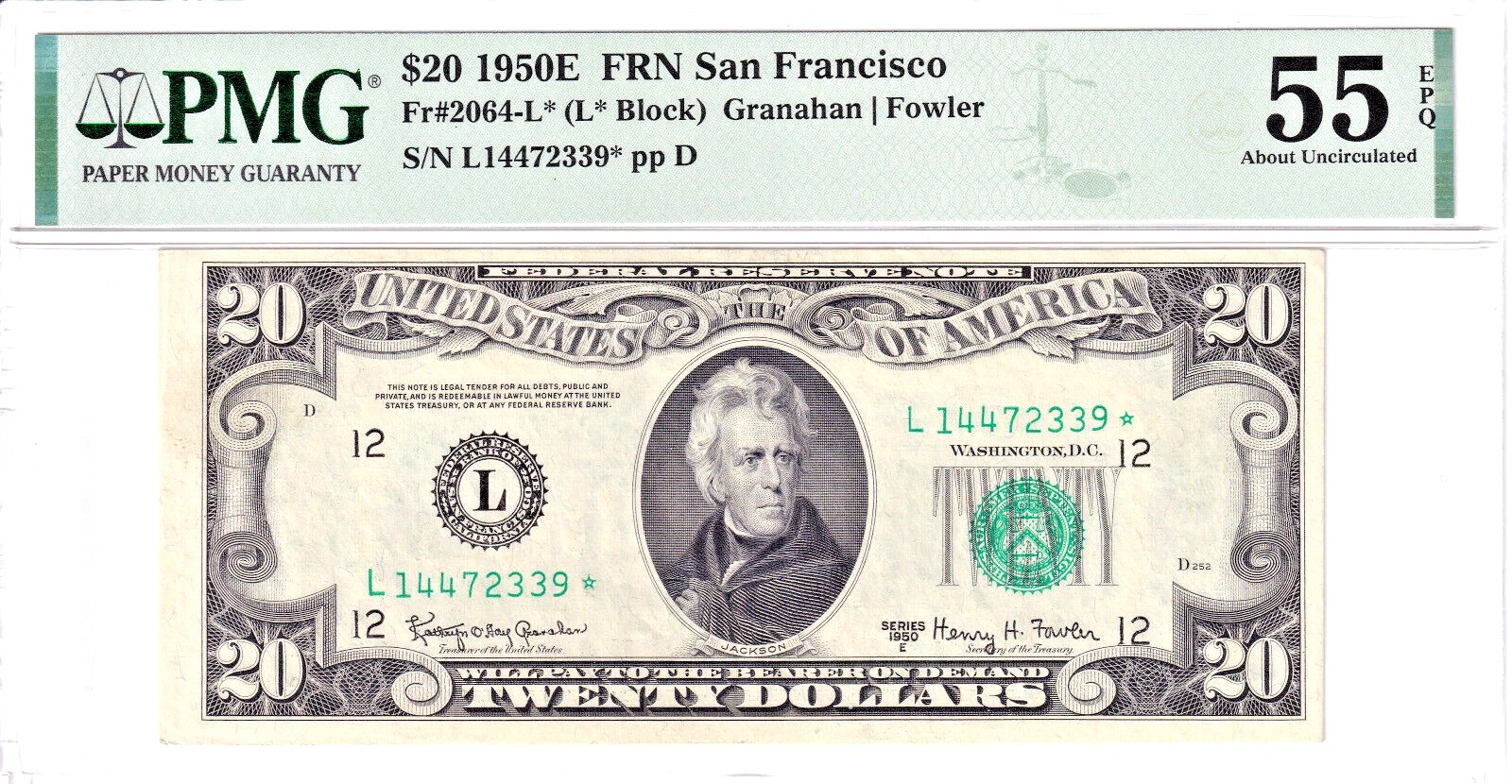
📷 Image source: eBay. Images are selected by AI to represent the article topic and may not depict the exact note(s) described.
Pull out a price guide from the early 1960s and you will find the Series 1950E $20 Federal Reserve Note listed almost as an afterthought, lumped in with the other suffix-letter issues of the postwar era. That was a mistake that savvy collectors corrected quickly. The 1950E is not just the final chapter of the 1950 series design story. For several Federal Reserve districts, it is one of the most elusive regularly issued $20 notes of the entire postwar period, with print runs so small they border on the accidental. This article breaks down exactly why that happened, which districts matter most to collectors, and what to look for when you are searching for a presentable example.
The 1950 Series Family: A Brief Orientation
To appreciate the 1950E, you first need to understand where it sits within the broader 1950 series family. The original Series 1950 design was introduced following the currency resizing stabilization of 1928 and carried the familiar small-size format that collectors know today. What distinguished the 1950 series from its predecessors was the move to a new, tighter layout on the face of the note, with revised engraving on the Federal Reserve seal area and a slightly modified Treasury seal placement.
The suffix letters A through E were applied each time the signature combination on the notes changed, reflecting a new Treasurer of the United States or Secretary of the Treasury taking office. The sequence ran as follows: Series 1950 carried signatures of Georgia Neese Clark and John W. Snyder; 1950A had Georgie Neese Clark and George M. Humphrey; 1950B featured Ivy Baker Priest and Humphrey; 1950C used Priest and Robert B. Anderson; 1950D bore Elizabeth Rudel Smith and Dillon; and finally 1950E carried Kathryn O’Hay Granahan paired with C. Douglas Dillon. By the time Granahan was confirmed as Treasurer in April 1962, the Bureau of Engraving and Printing was already deep into planning the redesign that would add the motto “IN GOD WE TRUST” to the reverse of all Federal Reserve Notes, a change that would manifest as the Series 1963. The window for printing 1950E notes was therefore extremely narrow.
Why the Print Runs Were So Small
The Bureau of Engraving and Printing does not print notes on a speculative basis. Orders come from the individual Federal Reserve Banks based on their projected currency needs, and those projections in 1962 were colored by the knowledge that a new series was imminent. Several district banks placed only minimal orders for 1950E notes, essentially bridging their inventory needs until the 1963 series plates were ready. Others, particularly the larger districts serving high-transaction urban centers, ordered somewhat more generously. The result is a series with extraordinary variation in scarcity from one district to the next, a characteristic that makes district-set collecting both frustrating and deeply rewarding.
When building a district set of Series 1950E $20 notes, start by securing the high-print-run issues from New York (B) and Chicago (G) in the grade you want. These establish your budget baseline and are easy to upgrade later. Reserve your patience and budget for the scarce districts like Minneapolis (I) and Dallas (K), which may require months of watching auction results before a presentable example surfaces.
Signature Combination and How to Confirm Authenticity
Every genuine Series 1950E $20 will carry the engraved signature of Kathryn O’Hay Granahan as Treasurer and C. Douglas Dillon as Secretary of the Treasury. Granahan’s signature appears on the right side of the face below the portrait of Andrew Jackson, while Dillon’s appears on the left. The series designation “Series 1950E” is printed in small text to the right of the portrait. The green Federal Reserve seal appears to the left of the portrait, and the black Federal Reserve district seal is in the upper-left area. The back design is identical across the 1950 family: the White House vignette centered on the reverse, executed in green ink with the denomination ornaments in the corners.
One authentication point worth noting: the back plate numbers on 1950E notes are typically in a higher range than earlier suffix issues, reflecting the progression of plate usage at the BEP. While face plate numbers in themselves are not a primary rarity indicator for this series, they can help confirm printing sequence when cross-referenced with BEP records.
Do not confuse Series 1950D and 1950E notes in lower grades where the suffix letter is partially obscured by folds or staining. Always examine the signature combination first: Granahan and Dillon together confirm 1950E, while Smith and Dillon together confirm 1950D. The suffix letter printed on the note is a secondary confirmation.
District by District: Where the Scarcity Lives
The twelve Federal Reserve districts each issued their own 1950E $20 notes, identified by the district letter prefix in the serial number and the corresponding letter and number on the black Federal Reserve district seal. Here is how the districts break down in terms of relative availability.
Boston (A) and New York (B) represent the most available issues. New York in particular, as the largest currency-issuing district in the country, printed several million 1950E $20 notes. Finding a New York 1950E in Very Fine or better is a routine exercise at major currency shows.
Philadelphia (C) and Cleveland (D) are moderately available, with enough examples in circulation among collectors that completing a type set is achievable. These districts serve as the workhorses of many a district-set effort.
Richmond (E) and Atlanta (F) move into the moderately scarce category. Print runs were lower than the northeastern districts, and finding choice uncirculated examples requires some patience.
Chicago (G) benefits from its status as the nation’s second-largest commercial hub, producing a respectable print run that puts it closer to New York than to the scarce end of the spectrum.
St. Louis (H) and Minneapolis (I) are where collectors begin to encounter genuine difficulty. Minneapolis in particular had an extremely limited issue, and population reports from major grading services consistently show fewer than a hundred examples certified across all grades. Finding a Minneapolis 1950E $20 in Extremely Fine or above is a legitimate achievement.
Kansas City (J) and Dallas (K) round out the scarce issues. Dallas is frequently cited alongside Minneapolis as the two most challenging districts for this series, with many experienced collectors reporting multi-year waits between auction appearances of presentable examples.
San Francisco (L) is a pleasant middle-ground district, more available than the plains states issues but not as common as New York or Chicago.
Star Notes: An Even More Rarified Target
Star notes for the Series 1950E $20 take the scarcity conversation to another level entirely. These replacement notes, identified by a star symbol preceding the serial number, were printed in very small quantities for most districts, and for some districts they were apparently not issued in any measurable quantity at all. The star note for Minneapolis (I*) is considered a major rarity and has commanded significant premiums when genuine examples have appeared at auction. Even the more accessible star notes for New York and Chicago are meaningfully scarcer than their regular-issue counterparts and deserve a premium in any honest price negotiation.
Star notes for the 1950E series were printed in the same narrow production window as regular issues, making them proportionally rarer than stars for most other postwar series. If you encounter a raw, uncertified 1950E star note at a show or estate sale, have it authenticated by PCGS Currency or PMG before purchasing at a significant premium. Altered serial numbers and counterfeit stars, while uncommon, have appeared in this series.
Grading Considerations for the 1950E
Because many 1950E notes entered circulation before collectors recognized the series’ scarcity, truly high-grade examples are proportionally more difficult to find than raw rarity numbers alone suggest. The series was printed during the early 1960s, a period when currency handling at commercial banks was rougher than today’s polyester-pocket era. Notes in Very Fine 30 to Extremely Fine 45 represent the most commonly encountered circulated grade range. Anything grading Choice Uncirculated 63 or above should be considered a premium example worthy of serious attention, and Gem Uncirculated 65 notes for the scarce districts are genuinely trophy pieces.
Paper quality is a particular concern with this series. The BEP’s cotton-linen substrate from the early 1960s is susceptible to corner rounding in circulation and to moisture absorption that creates waves in storage. Look for notes with original paper brightness, sharp corner tips, and ink that retains its depth. A note with vivid green ink on the back and strong embossing on the face portrait is far preferable to a technically high-grade example with washed-out color.
The Transition to Series 1963: Why 1950E Ended When It Did
The Public Law 88-36, signed by President Kennedy in June 1963, triggered a broader currency redesign effort that included mandating the addition of “IN GOD WE TRUST” to Federal Reserve Notes. The Series 1963 $20, carrying signatures of Granahan and Dillon (the same pair as 1950E, notably), incorporated the motto on the reverse and used updated plate designs. Production of 1950E notes ceased as the new plates came online, cementing the narrow production window that defines the series’ collectibility. The irony that the 1963 series carried identical signatures to the 1950E is not lost on collectors, and it raises an interesting display possibility: pairing a 1950E and a 1963 $20 from the same district as a signature-combination diptych.
| District | Bank Letter / City | Approx. Print Run | Rarity |
|---|---|---|---|
| A – Boston | Federal Reserve Bank of Boston | 1,440,000 | Common |
| B – New York | Federal Reserve Bank of New York | 5,760,000 | Common |
| C – Philadelphia | Federal Reserve Bank of Philadelphia | 1,440,000 | Common |
| D – Cleveland | Federal Reserve Bank of Cleveland | 1,080,000 | Common |
| E – Richmond | Federal Reserve Bank of Richmond | 720,000 | Scarce |
| F – Atlanta | Federal Reserve Bank of Atlanta | 720,000 | Scarce |
| G – Chicago | Federal Reserve Bank of Chicago | 2,880,000 | Common |
| H – St. Louis | Federal Reserve Bank of St. Louis | 360,000 | Scarce |
| I – Minneapolis | Federal Reserve Bank of Minneapolis | 180,000 | Key Date |
| J – Kansas City | Federal Reserve Bank of Kansas City | 360,000 | Scarce |
| K – Dallas | Federal Reserve Bank of Dallas | 180,000 | Key Date |
| L – San Francisco | Federal Reserve Bank of San Francisco | 1,080,000 | Common |
Building a Complete District Set: Practical Advice
A complete twelve-district set of Series 1950E $20 notes in matched grades is a long-term project even for well-resourced collectors, and it demands a clear strategy. Begin by deciding on your target grade range. Many collectors aim for a uniform Very Fine 25 to Extremely Fine 45 presentation for circulated sets, while others pursue a fully uncirculated set and accept that Minneapolis and Dallas may eventually require compromise on grade. Either approach is legitimate.
Monitor major currency auction houses including Heritage Auctions, Stack’s Bowers, and Lyn Knight for the scarce districts. PMG and PCGS Currency population reports are valuable tools for understanding how many certified examples exist at each grade level. Cross-referencing auction records against population data gives you a realistic sense of market depth before you commit to a purchase price.
For the common districts, dealer inventory and currency shows are efficient sourcing channels. You can often acquire Boston, New York, Chicago, and San Francisco examples in a single afternoon at a well-attended show. For Minneapolis and Dallas, patience and relationships with specialist dealers who track this series will serve you better than passive watching.
Conclusion: Scarcity Hiding in Plain Sight
The Series 1950E $20 is a perfect example of a collectible that rewards careful research over casual browsing. On the surface, it looks like any other postwar Federal Reserve Note: the same Andrew Jackson portrait, the same White House reverse, the same green ink. But beneath that familiar exterior lies a production history shaped by bureaucratic timing and minimal ordering, one that created genuine key-date rarities in the Minneapolis and Dallas districts and a thoroughly satisfying challenge for collectors willing to engage with the series on its own terms. Whether you are assembling a district set, chasing a star note, or simply want a single high-grade representative example of the scarcest postwar $20 suffix issue, the 1950E deserves a prominent place in your research and your collection.