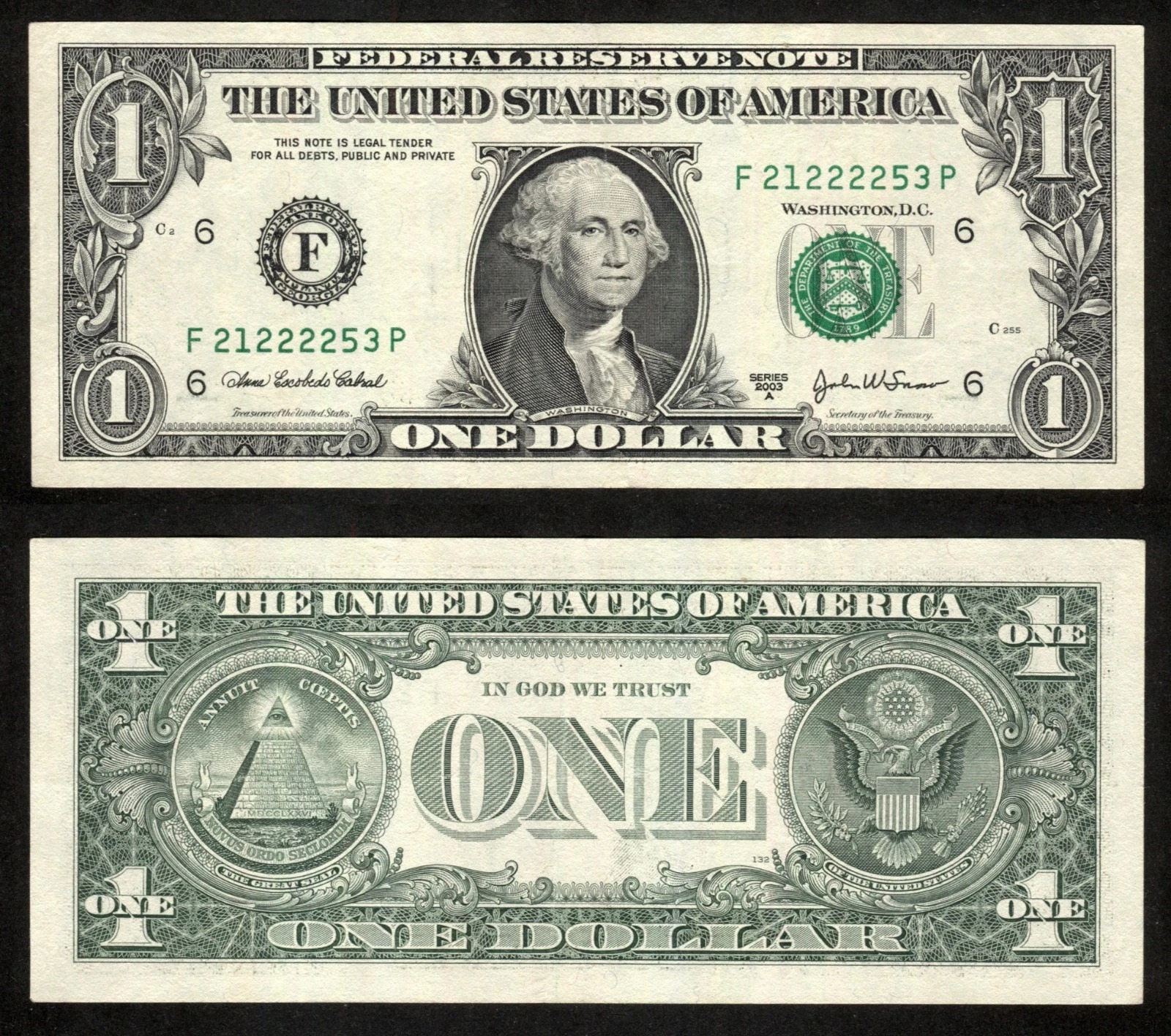
📷 Image source: eBay. Images are selected by AI to represent the article topic and may not depict the exact note(s) described.
Pull a handful of dollar bills from your wallet right now and look at the serial numbers. If any start with a star symbol instead of a letter, you are holding a replacement note, commonly called a star note, printed to substitute for sheets damaged during the Bureau of Engraving and Printing’s production process. Most star notes from recent decades are common enough that collectors barely glance at them. But within the Series 2003A $1 Federal Reserve Note, a perfect storm of production timing, regional printing allocations, and Federal Reserve ordering patterns created some of the lowest star note print runs in modern small-size currency history. A few of those district runs are genuinely scarce, and the collector market has noticed.
Why Series 2003A Matters for Star Note Collectors
The Series 2003A designation was applied when Anna Escobedo Cabral replaced Rosario Marin as Treasurer of the United States in 2004, while John Snow remained Secretary of the Treasury. Under standard BEP practice, any change in either signature triggers a new series letter suffix, so the underlying design remained identical to Series 2003 notes signed by Marin and Snow. What changed was the production volume ordered by each Federal Reserve Bank district, and those volumes varied wildly.
Federal Reserve Banks order currency based on projected circulation needs. In a given series, one district might order hundreds of millions of notes while another orders far fewer, and the star note allotment scales proportionally. When a district’s total print run is small, its corresponding star note print run can drop to levels that make individual notes genuinely difficult to find in circulation or even through dealer inventories. Series 2003A is a textbook example of this dynamic, with some districts printing so few star notes that collectors who understood the numbers early were able to cherry-pick examples from bank rolls and dealer lots at face value.
When evaluating any modern star note, always cross-reference the Federal Reserve district letter (the prefix letter in the serial number) with published BEP production records. The Star Note Lookup tool at moneyfactorystore.gov and the independently maintained resource at USmoneyfun.com both list official print run data by series, district, and block. Never rely on rarity assumptions alone.
The Twelve Districts and Their Serial Number Prefixes
Each of the twelve Federal Reserve Banks is assigned a letter and corresponding number: Boston (A-1), New York (B-2), Philadelphia (C-3), Cleveland (D-4), Richmond (E-5), Atlanta (F-6), Chicago (G-7), St. Louis (H-8), Minneapolis (I-9), Kansas City (J-10), Dallas (K-11), and San Francisco (L-12). On star notes, the prefix letter is replaced by the same district letter followed by a star symbol as the suffix, making identification straightforward once you know what to look for.
For Series 2003A $1 notes printed at the Washington D.C. facility, the back plate numbers tend to fall in different ranges than Fort Worth production, giving advanced collectors an additional layer of variety to attribute. Fort Worth notes can be identified by a small “FW” appearing to the left of the back plate number on the reverse of the note. This distinction matters because some district and facility combinations are rarer than others even within the same series.
The Rarest Districts: Where the Numbers Get Interesting
Minneapolis (I) and Kansas City (J) districts consistently generate collector attention in Series 2003A because their total currency orders were modest relative to high-volume districts like New York and Atlanta. The Minneapolis star note run of approximately 640,000 notes is widely cited as the single lowest print run among the twelve districts for this series. To put that in context, the Atlanta district’s star note run for the same series exceeded 3.2 million notes, making an Atlanta star more than five times more common than a Minneapolis example.
The St. Louis (H) district also produced a notably low star note run in the 2003A series, estimated at around 1,280,000 notes. Boston (A) and Philadelphia (C) rounds out the short list of districts where collector competition is most intense. Condition is the critical variable at this end of the rarity spectrum. A Minneapolis 2003A star note in circulated VF-20 condition commands a modest premium, but a crisp Gem CU-65 EPQ example graded by PMG or PCGS Currency can bring prices that surprise collectors accustomed to thinking of dollar bills as pocket change.
Grading matters enormously for low-print-run modern star notes. A Series 2003A Minneapolis star note in circulated condition might sell for $5 to $15, while the same note in PMG Gem Uncirculated 65 EPQ has realized $100 to $175 at auction. Submitting high-grade examples to a third-party grading service is worthwhile when the print run is under one million notes.
Current Market Values: What Collectors Are Actually Paying
The secondary market for Series 2003A $1 star notes has matured considerably since the mid-2000s when many of these notes were still entering circulation. Here is a realistic breakdown of current retail and auction values by condition and district rarity tier, based on recent Heritage Auctions, eBay completed listings, and dealer price lists.
For the key-date Minneapolis (I) district: circulated examples in Fine-12 to VF-30 typically trade between $8 and $20. Extra Fine to About Uncirculated examples (EF-40 to AU-58) bring $25 to $50. Gem Uncirculated examples graded CU-65 or better by PMG or PCGS Currency have sold from $100 to over $175, with the highest prices reserved for EPQ (Exceptional Paper Quality) designations that confirm originality.
Kansas City (J) and St. Louis (H) star notes occupy the next rarity tier. Circulated examples sell for $4 to $12, while gems in third-party holders reach $40 to $90. Boston (A) and Philadelphia (C) stars are approaching scarce territory; uncirculated raw examples sell for $6 to $20, with certified gems reaching $35 to $65.
At the common end, New York (B), Atlanta (F), and Chicago (G) district star notes from Series 2003A are abundant enough that uncirculated examples rarely exceed $5 to $8 in raw condition. Unless you find a consecutively numbered pair or a solid serial number (such as 00000001 through 00000100), high-volume district stars are essentially face value collectibles from this series.
Consecutive pairs and runs of star notes command a meaningful premium beyond individual note values. A set of ten consecutive Minneapolis 2003A stars in gem condition is substantially rarer than ten individual examples and will attract bidding from both type collectors and registry set builders. Keep runs intact whenever possible.
Printing Facility Breakdowns and Attribution
Not every district ordered 2003A notes from both BEP facilities. Some districts are Washington D.C. only for this series, while others exist in Fort Worth production as well. Identifying the printing facility requires examining the note’s reverse for the “FW” designation near the back check letter and quadrant number. Washington D.C.-produced notes carry no such indicator. When a scarce district like Minneapolis has star notes from only one facility, the already-low print run is effectively the entire population. There is no parallel Fort Worth run to supplement collector supply.
This facility attribution adds a layer of complexity that rewards careful examination. Two Minneapolis 2003A stars that look identical face-to-face might be distinguished by their printing facility, with one being marginally scarcer than the other. At current price levels this distinction matters most to advanced specialists building comprehensive type sets by district and facility.
How to Find Series 2003A Star Notes Today
Circulation hunting for 2003A star notes remains viable, though the odds drop every year as older notes are retired from circulation. Bank rolls of dollar coins sometimes still contain circulated star notes from this era. Online, eBay remains the most liquid marketplace, with PCGS Currency and PMG-certified examples also appearing regularly in major auction houses including Heritage, Stack’s Bowers, and Lyn Knight Currency Auctions. Dealer inventories at major shows such as the ANA World’s Fair of Money frequently include sorted modern star note accumulations where cherry-picking by district is straightforward.
One underappreciated sourcing strategy is buying uncut sheet sections. The BEP offered certain Series 2003A sheets through its retail program, and star note uncut sheets from low-print-run districts occasionally surface at auction. These represent the finest possible examples, since they were never circulated, and the novelty factor adds collector premium beyond the individual note value.
When searching eBay or dealer listings for Series 2003A star notes, filter by the specific district prefix letter and confirm the series date on the face of the note near Washington D.C. or the portrait. Series 2003 (signed by Marin/Snow) and Series 2003A (signed by Cabral/Snow) are distinct issues with different print runs. Mislabeled listings are common, and spotting them can mean buying a key-date note at a common-note price.
| District / Prefix | Federal Reserve Bank | Approx. Star Print Run | Rarity |
|---|---|---|---|
| I (Minneapolis) | Minneapolis, MN | 640,000 | Key Date |
| H (St. Louis) | St. Louis, MO | 1,280,000 | Rare |
| J (Kansas City) | Kansas City, MO | 1,280,000 | Rare |
| A (Boston) | Boston, MA | 1,920,000 | Scarce |
| C (Philadelphia) | Philadelphia, PA | 1,920,000 | Scarce |
| D (Cleveland) | Cleveland, OH | 2,560,000 | Scarce |
| K (Dallas) | Dallas, TX | 2,560,000 | Scarce |
| E (Richmond) | Richmond, VA | 3,200,000 | Common |
| L (San Francisco) | San Francisco, CA | 3,200,000 | Common |
| G (Chicago) | Chicago, IL | 3,840,000 | Common |
| B (New York) | New York, NY | 4,480,000 | Common |
| F (Atlanta) | Atlanta, GA | 3,200,000 | Common |
Building a Complete Set: The Collector’s Challenge
Assembling a complete set of Series 2003A $1 star notes from all twelve Federal Reserve districts in Gem Uncirculated condition is a realistic long-term project for an intermediate collector. The common-district notes can be sourced for a few dollars each from any major currency dealer. The mid-tier scarce districts require patience and occasional competitive bidding. Minneapolis (I) is the wall that tests every builder of this set. Budget $125 to $175 for a certified gem example, and do not compromise on grade just to check the box. A circulated key date in a set of otherwise gem notes is an aesthetic and value mismatch that experienced collectors will notice immediately.
The Series 2003A $1 star note set is often recommended to collectors transitioning from casual currency interest into more systematic numismatic collecting. The notes are affordable at most grade levels, the data needed to make informed purchasing decisions is publicly available and free, and the challenge scales appropriately from easy acquisitions to a genuinely difficult key date. It is, in short, one of the better entry points into the world of Federal Reserve Note specialization that modern currency collecting has to offer.