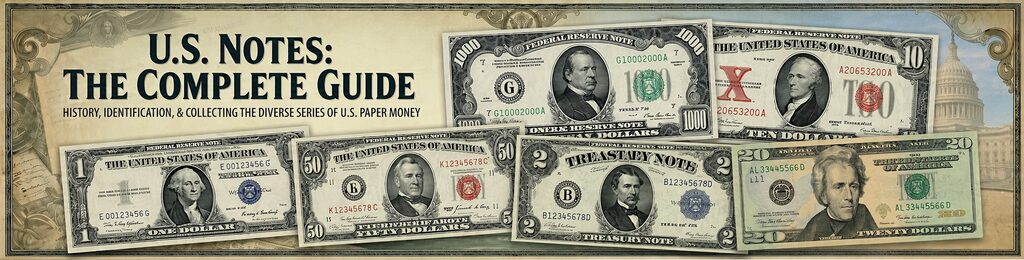
Walk into any major currency show today and you will hear the same shorthand tossed around between dealers and advanced collectors: “What does the pop report say?” Population reports, or “pop reports,” from Paper Money Guaranty (PMG) and PCGS Currency have quietly revolutionized how collectors approach small-size Federal Reserve Notes. Where earlier generations built collections based on catalog completeness and personal aesthetic, today’s registry collectors are tracking census rankings, chasing “finest known” designations, and making acquisition decisions based on the number of graded examples that sit above their own notes in the holder. The competition is real, the stakes are financial, and the strategy is genuinely fascinating.
What Is a Registry Set and Why Does It Matter?
A registry set is a collection of certified currency notes formally enrolled in a grading service’s online competitive registry, where it is publicly ranked against other collectors’ enrolled sets. PMG’s Set Registry and PCGS Currency’s Set Registry each maintain hundreds of competitive categories covering everything from complete type sets of small-size Legal Tender Notes to highly specialized runs of district-specific Federal Reserve Notes by denomination and series.
The appeal is multilayered. First, there is the objective competitive element: your set’s score is calculated by adding the numeric grades of every note in the set, then dividing by possible slots (or simply summing, depending on the registry format). A collector who holds the No. 1 ranked set in “Series 1934 $20 Federal Reserve Notes by District” has documented bragging rights that the entire community can verify. Second, registry competition creates a market feedback loop: notes that occupy high registry positions command premiums because acquiring them means displacing a current leader. A PMG 67 EPQ 1934 $20 from the Federal Reserve Bank of Boston (A-block) might trade for two to three times what an identical-looking, ungraded example would fetch simply because the pop report shows only four examples graded at that level or above.
Understanding the Population Report: How to Read the Census
Both PMG and PCGS publish freely accessible online population reports that break down every certified note by series, denomination, district, and grade. Learning to read these reports is the single most important skill for a registry-oriented collector.
On the PMG Census, you will find columns showing the number of notes graded at each level from 10 (Very Good) through 70 (Superb Gem Uncirculated), with separate tallies for notes carrying the EPQ qualifier. For competitive purposes, the critical column is “EPQ at or above” a given grade. If a census shows that a 1934-A $5 FRN from the Federal Reserve Bank of Richmond (E-block) has been graded as follows: two in PMG 65 EPQ, one in PMG 66 EPQ, and zero above that, then acquiring a PMG 66 EPQ example instantly places you in condition census territory and any EPQ example above 66 would be a unique finest known.
Always check the PMG and PCGS population reports separately before purchasing a note for registry purposes. The two services have graded different notes and their populations do not overlap, so a note can be “finest known” on one census while several higher examples exist on the other. Serious registry collectors track both simultaneously.
PCGS Currency’s “Lookup” tool functions similarly but includes a useful “Pop Higher” column that immediately tells you how many certified examples exist above a given grade. A Pop Higher of zero is the golden number for condition-census hunters. Both services allow you to filter by district for Federal Reserve Notes, which is essential because district rarity varies dramatically within a single series. A 1935-A $1 Silver Certificate may be common from some districts but the FRN equivalent in a given series from the Kansas City (J) or Minneapolis (I) districts may have a population of three or fewer at high grades.
Which Series Offer the Best Registry Competition for FRNs?
Not all registry categories are created equal. Some attract dozens of enrolled competitive sets, while others have no competition at all. Here is a breakdown of the most active and strategically interesting categories for small-size Federal Reserve Note collectors.
Series 1928 Through 1934-D: The Deep End of the Pool
The earliest small-size FRNs, issued beginning in 1929 to replace the large-size notes, are the most aggressively contested registry territory. The Series 1928 $100 Federal Reserve Notes, for instance, are scarce at grades above PMG 64 EPQ for most districts. The 1928 $100 from the Boston (A) district has a combined PMG population in gem uncirculated territory of fewer than a dozen notes. Collectors chasing these sets often spend years waiting for the right auction appearance.
The 1934-A $500 and $1,000 FRNs occupy an entirely separate tier. With original print runs for high-denomination notes in specific districts sometimes under 10,000 notes, and most of those long since redeemed by the Federal Reserve, the certified populations are tiny. A PMG 58 EPQ 1934 $500 FRN from Chicago (G-block) is genuinely rare, and examples at 63 EPQ or above have sold at Heritage, Stack’s Bowers, and Lyn Knight Currency Auctions for figures well into five digits.
Series 1950 Through 1963: Underappreciated Registry Targets
Mid-century FRNs are often overlooked by casual collectors who assume common print runs mean common high-grade survivors. In fact, the handling and circulation patterns of postwar currency mean that gem survivors from the Series 1950, 1950-A, and 1950-B issues are surprisingly scarce with EPQ designations. A 1950 $50 FRN from the Minneapolis (I) district has a PMG population in the 65 EPQ-and-above range that can be counted on one hand. Registry sets built around denomination-specific runs of these mid-century notes are competitive with relatively modest investment compared to the 1928-1934 era.
When evaluating mid-century FRNs for registry potential, pay close attention to the back plate number. Certain back plate numbers are associated with specific printing runs that showed better ink strike and paper quality. Notes from low back plate numbers on 1950-series notes, particularly plates used early in the press run, tend to exhibit sharper detail and cleaner margins, factors that contribute to EPQ designation and higher numeric grades.
Star Notes: The Registry Collector’s Obsession
Replacement notes, identified by a star symbol at the beginning or end of their serial numbers, have always attracted collector attention. In the registry context, they are particularly compelling because their print runs are documented, small, and verifiable through Bureau of Engraving and Printing (BEP) production records. The 1988-A $1 FRN star notes from the Atlanta (F) district had a print run of only 128,000 notes. The 1995 $1 FRN star from the same district had a print run of just 128,000 notes as well, making it one of the key dates in modern FRN collecting. Even in circulated grades, these notes command strong premiums; in PMG 65 EPQ or above, the populations are tiny and registry competition can be fierce.
The Federal Reserve Bank of Minneapolis consistently produces smaller star note runs than major cities like New York and Chicago, making Minneapolis stars from any series of the 1980s through 2000s attractive registry targets. Collectors who built Minneapolis star note type sets in the early 2010s at modest cost have seen those sets appreciate dramatically as population awareness increased.
Building a Competitive Registry Set: Practical Strategy
Entering registry competition without a strategy is an expensive way to learn hard lessons. The collectors who build top-ranked sets consistently follow a few core principles.
Define Your Set Parameters First
The most important decision is which registry category to enter. Competing in “Series 1928 $100 FRNs by District” against entrenched collectors with decade-long head starts is very different from entering a category like “Series 1977-A $50 FRNs Complete District Set” where the competition may be thin. Use the registry leaderboards themselves as intelligence: a category where the No. 1 set has a score of 840 out of a possible 880 is nearly impenetrable, while one where the leader has a score of 650 is an invitation to compete.
Build From the Middle, Not the Top
New registry collectors often make the mistake of acquiring the most spectacular note first, the PMG 68 EPQ key date that will anchor their set, while leaving common slots unfilled with merely average grades. Experienced registry builders fill the common slots with strong but attainable grades (PMG 65 or 66 EPQ for most modern series) before spending aggressively on the genuinely scarce pieces. A complete set of PMG 66 EPQ notes will outscore a set with one 68 EPQ and several empty slots every time.
PMG’s Set Registry allows you to enter notes from specific signature combinations within a series, which can be strategically useful. The Series 1963-A $100 FRN carries the Granahan-Fowler signature combination and was the last series before the 1969 introduction of wording changes. Building a complete district set in this series is achievable but requires patience for the Minneapolis and Kansas City districts, which had lower print allocations and thus fewer high-grade survivors in the census.
Attend Auctions With Census Data in Hand
Major currency auction events, including the January FUN show sales, the summer ANA auctions, and the Memphis IPMS show auction, regularly feature notes with registry significance. Going in with the current PMG and PCGS populations for your target notes printed out (or pulled up on your phone) allows you to bid intelligently. If a note appearing at auction would move your set from No. 4 to No. 1 in your category, paying a significant premium over “catalog value” may be entirely rational given the long-term appreciation registry position can generate.
| Series / Date | Denomination and District | Approx. Print Run or PMG Pop (65 EPQ+) | Rarity |
|---|---|---|---|
| 1928 | $100, Boston (A) | Pop: ~8 in PMG 64 EPQ or above | Key Date |
| 1934 | $500, Chicago (G) | Print run est. under 15,000; Pop: ~5 in PMG 58 EPQ+ | Key Date |
| 1934-A | $1,000, Minneapolis (I) | Print run est. under 5,000; Pop: ~3 graded any grade | Key Date |
| 1950 | $50, Minneapolis (I) | Pop: ~6 in PMG 65 EPQ or above | Rare |
| 1963-A | $100, Kansas City (J) | Pop: ~11 in PMG 65 EPQ or above | Scarce |
| 1988-A | $1 Star, Atlanta (F) | Print run: 128,000; Pop: ~15 in PMG 65 EPQ or above | Rare |
| 1995 | $1 Star, Atlanta (F) | Print run: 128,000; Pop: ~18 in PMG 65 EPQ or above | Rare |
| 1977-A | $50, Minneapolis (I) | Pop: ~22 in PMG 65 EPQ or above | Scarce |
| 1934-D | $5, Richmond (E) Star | Print run est. under 24,000; Pop: ~9 in PMG 64 EPQ+ | Rare |
| 1969-C | $100, San Francisco (L) | Pop: ~30 in PMG 66 EPQ or above | Common |
The Financial Dimension: Registry Position and Market Value
It would be naive to ignore the financial incentives embedded in registry collecting. When a note holds a “Finest Known” designation on the PMG Census, that status is reflected in realized prices at major auctions. Heritage Auctions, Stack’s Bowers, and Lyn Knight Currency Auctions all include census population data in their catalog descriptions, and sophisticated bidders use that information actively. The 2021 sale of a PMG 68 EPQ 1928-B $100 FRN from the Chicago district for over $14,400, against a gray sheet bid of roughly $3,500 for a gem 65, illustrates how dramatically condition census position can inflate realized values.
This creates both opportunity and risk for registry collectors. Opportunity because notes that are genuinely rare at high grades can appreciate substantially as more collectors discover census data and compete for finite supply. Risk because population reports are living documents: a single dealer submitting a previously ungraded hoard can dramatically shift the census and deflate the premium associated with your notes. This happened notably in the early 2010s when dealer submissions of previously uncirculated 1950s and 1960s FRNs from institutional sources expanded populations and softened values for some once-scarce census positions.
Conclusion: Registry Collecting as Intellectual Sport and Long-Term Strategy
Registry set collecting for small-size Federal Reserve Notes is not simply about owning the nicest notes possible. It is a structured, data-driven pursuit that rewards careful research, patient acquisition, and strategic thinking about where populations are thin and where genuine scarcity exists. For new collectors, the best starting point is to spend a week simply reading PMG and PCGS population reports across several series and denominations, looking for categories where populations thin out dramatically above a grade you could realistically target. For experienced collectors, the opportunity lies in identifying registry categories that the community has not yet fully discovered, where a modest investment in grading fees and smart acquisitions can establish a competitive position before prices reflect the scarcity the census already documents.
The census is not infallible, and registry position is not permanence. But as a discipline for focusing a collection, establishing measurable goals, and connecting with a community of equally serious collectors, registry set competition for FRNs remains one of the most rewarding pursuits in American numismatics today.