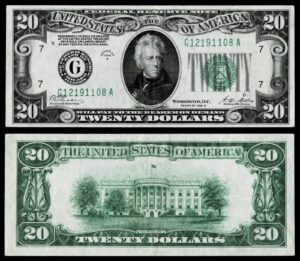
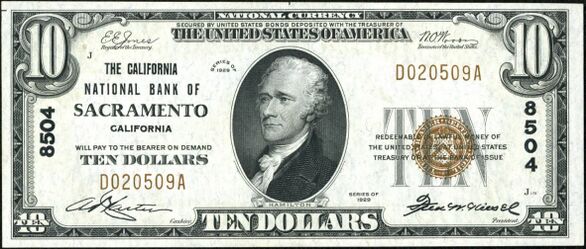
Pull out a Series 1929 National Bank Note Type 1 from your collection and hold it up to the light. Chances are you have looked at the bank name, the charter number, the signature combination, and the condition without ever pausing to study the margins themselves. Yet for a small but devoted corner of the national bank note hobby, those margins tell a story that goes straight back to the Bureau of Engraving and Printing’s press rooms during one of the most turbulent decades in American financial history.
A New Era of Small-Size Nationals
When the Federal Reserve Board and the Treasury Department jointly mandated a changeover to small-size currency in 1929, the National Currency system faced a radical mechanical transformation. The oversized “horse blanket” nationals that had circulated since the Civil War era were replaced overnight by standardized 6.14 x 2.61 inch notes. For the Bureau of Engraving and Printing, this meant designing entirely new plate layouts for the thousands of issuing banks still active under the National Bank Act.
The solution was elegant in its efficiency: a single master design would be overprinted with each bank’s name, charter number, and officer signatures. Printing would be done on 12-subject sheets arranged in a 6-row by 2-column configuration, with each column designated as either the left (A-B-C-D-E-F position) or right (G-H-I-J-K-L position) half of the sheet. The plate numbers were engraved into the lower corners of each sheet, and it is those plate numbers, cross-referenced against surviving BEP records, that allow researchers today to reconstruct exactly which plates produced wide-margin versus narrow-margin examples.
Defining the Two Varieties
The terms “wide margin” and “narrow margin” describe the amount of unprinted paper border surrounding the printed design on a fully cut note. On Type 1 notes, wide-margin examples typically show 3 mm or more of clear border on all four sides when cut precisely to center. Narrow-margin examples, by contrast, frequently show 1.5 mm or less on one or more sides, and notes from narrow-margin sheets cut slightly off-center can appear nearly frameless on one edge.
This difference was not accidental or a quality-control failure. It arose directly from two generations of plate engraving at the BEP. The earliest Type 1 plates, produced in 1929 and early 1930, were laid out with slightly more generous spacing between subjects on the 12-subject sheet. As production pressure mounted during the bank-failure crisis of 1930 to 1933, the BEP re-engraved a number of replacement plates with marginally tighter subject spacing to allow for minor adjustments in cutter registration. The cumulative difference between a first-generation plate and a late replacement plate could amount to as little as 1.8 mm per subject, but across six rows that added up to a visibly different note.
When examining a Series 1929 Type 1 note, measure the bottom margin from the bottom of the printed border to the cut edge using a millimeter ruler. A measurement of 3 mm or more is a strong indicator of an early wide-margin plate. Document your measurement before any cleaning or pressing, as even light handling can shift a raw note in its holder.
Reading the Plate Numbers
Every Series 1929 National Bank Note carries a face plate number printed in the lower right corner of the note face (for Type 1, usually appearing as a small numeral following the series designation). The BEP’s plate certification records, portions of which were published by Don C. Kelly in his landmark reference “National Bank Notes: A Guide with Prices” and expanded upon by researchers including James Simek and Frank Clark, allow collectors to correlate specific plate number ranges with the wide or narrow layout.
In general terms, face plates numbered below approximately 550 in the early BEP sequences tend to correspond to wide-margin layouts. Plates numbered in the 550 to 900 range represent a transitional zone where both layouts appear depending on denomination and district. Plates numbered above 900 lean toward the narrow-margin configuration, though exceptions exist for certain denominations where plates were re-certified at different points in the production cycle.
The $5 denomination shows the clearest separation between generations because it was the highest-volume note and therefore required the most plate replacements. On $10 and $20 notes, the two varieties are more intermixed within the same plate number ranges. The $50 and $100 denominations, with their far smaller print runs, rarely show the narrow-margin characteristic at all, since fewer replacement plates were needed.
The face plate number on a Series 1929 National Bank Note is distinct from the back plate number. When building a plate study collection, record both numbers for every note. Back plate numbers follow a separate but equally informative sequence and can help you confirm whether a face and back were printed on the same production run or assembled from different plate generations.
Why Cutting Matters as Much as Printing
One complication that serious collectors must confront is that margin width on a finished note reflects both the original plate spacing and the accuracy of the guillotine cut at the BEP. Federal Reserve Banks received sheets of 12 subjects and cut them into individual notes using mechanical guillotines. Minor variations in sheet feeding could shift the cut by a millimeter or two in any direction.
This means a wide-margin plate note that was cut slightly off-center can superficially resemble a narrow-margin plate note that was cut dead center. The only reliable way to distinguish the two is to reference the plate number rather than relying on margin measurement alone. A wide-margin plate note cut off-center is still a wide-margin plate note, and its plate number will confirm that heritage regardless of how the scissors fell.
For grading purposes, Professional Currency Grading Service (PCGS Currency) and Paper Money Guaranty (PMG) both note centering as a factor in grade assignment, but neither service currently designates wide versus narrow margin plate variety on their holders. This creates an opportunity for collectors to build specialized sets that go beyond what the third-party grading services currently recognize.
The Sheet Position Factor
Another layer of complexity comes from sheet position. On a 12-subject sheet, notes in the top row (positions A and G) and bottom row (positions F and L) naturally show larger margins at the outer edges because those positions sit at the physical borders of the sheet. Notes from interior positions (B through E and H through K) are surrounded on all sides by other subjects and thus rely entirely on inter-subject spacing for their margins.
Collectors who specialize in Series 1929 nationals and have access to uncut or partially cut sheets have confirmed that the wide-margin versus narrow-margin distinction is most clearly visible when comparing interior-position notes from different plate generations. A position-B note from a wide-margin plate shows noticeably more breathing room than a position-C note from a narrow-margin plate, independent of cutting variation. This is the purest expression of the plate study at work.
If you have the opportunity to purchase an uncut pair or strip of Series 1929 National Bank Notes, examine the inter-subject spacing before breaking up the piece. The spacing between adjacent notes on the sheet is the most direct evidence of plate generation and is destroyed the moment the sheet is cut. Uncut strips from well-documented banks command substantial premiums precisely because they preserve this evidence.
Practical Identification Guide
Here is a step-by-step approach to attributing a Type 1 note to its plate generation:
Step 1: Record the face plate number from the lower right of the note face. Cross-reference against published BEP plate records in Kelly’s guide or the Society of Paper Money Collectors (SPMC) research archives.
Step 2: Measure the bottom and right-side margins on the note face using a millimeter ruler. Average both measurements to account for any rotational cut error.
Step 3: Check the denomination. Remember that $5 plates show the clearest generational split, while $50 and $100 notes are almost exclusively wide-margin regardless of plate number.
Step 4: If the note is in a PMG or PCGS Currency holder, note the centering descriptor on the label (such as “Well Centered” or “Off-Center”) and factor that into your margin interpretation.
Step 5: Compare with census data from Heritage Auctions, Stack’s Bowers, and the PCGS CoinFacts population reports to determine how frequently the plate number appears in graded examples. Rare plate numbers may indicate a short-lived replacement plate with its own collecting interest independent of the margin question.
Signature Combinations and Their Overlap with Plate Generations
Series 1929 National Bank Notes were issued under a single series designation throughout their production life, but the Treasury signature combination on the lower left and right of the note face changed with each new Treasurer and Secretary of the Treasury. The combinations most commonly encountered on Type 1 notes are Jones-Woods (Walter O. Jones as Treasurer, Ogden L. Mills as Secretary, 1932 to 1933) and Woods-Woodin (Walter O. Woods as Treasurer, William H. Woodin as Secretary, 1933). Earlier notes carry the Jones-Mellon combination from 1929 to 1932.
Because plate production dates roughly correspond to signature combination periods, wide-margin plates disproportionately appear with Jones-Mellon signatures, while narrow-margin plates are more frequently paired with Jones-Woods or Woods-Woodin combinations. This is not a hard rule, since plates were sometimes held in inventory and used across signature transition periods, but it provides a useful cross-check when plate number records are ambiguous.
| Denomination | Plate Generation / Variety | Approx. Plate Count | Rarity |
|---|---|---|---|
| $5 | Wide Margin, plates below 550 | Approx. 480 plates | Common |
| $5 | Narrow Margin, plates 900+ | Approx. 310 plates | Scarce |
| $10 | Wide Margin, plates below 550 | Approx. 390 plates | Common |
| $10 | Narrow Margin, plates 900+ | Approx. 210 plates | Scarce |
| $20 | Wide Margin, plates below 550 | Approx. 350 plates | Common |
| $20 | Narrow Margin, plates 700+ | Approx. 180 plates | Scarce |
| $50 | Wide Margin only (all plates) | Approx. 95 plates | Rare |
| $100 | Wide Margin only (all plates) | Approx. 70 plates | Rare |
| $5 | Transitional zone, plates 550-900 | Approx. 350 plates | Scarce |
| Any denom. | Confirmed uncut 12-subject sheet | Fewer than 20 known | Key Date |
Building a Plate Study Collection
The most systematic approach to collecting this variety is to assemble a single denomination, such as the $5, across documented plate number ranges. Target one confirmed wide-margin example (plate number below 550), one transitional example (550 to 900), and one narrow-margin example (above 900). If all three notes come from the same issuing bank or same Federal Reserve district, the comparison is even more instructive because the design elements are identical and the margin difference becomes the sole variable.
The SPMC’s Paper Money journal has published several plate studies of Series 1929 nationals over the decades, and the organization’s research library maintains photocopies of BEP plate certification ledgers that are invaluable for this work. Membership in the SPMC and access to its digital archive is arguably the single most important resource investment a Series 1929 specialist can make.
When buying Series 1929 Type 1 notes specifically for plate study purposes, condition matters less than documentation. A VF-25 note with a confirmed plate number and margin measurement is far more useful to a plate researcher than an uncirculated example purchased without plate number notation. Prioritize sellers who photograph the plate numbers clearly and include them in their lot descriptions.
Conclusion: Margins as Windows into Depression-Era Production
The wide versus narrow margin distinction on Series 1929 National Bank Note Type 1 notes is not a glamorous variety in the way that a famous error or a low-serial-number example might attract bidding wars at auction. It is instead the kind of variety that rewards patience, careful measurement, and a willingness to engage with the documentary record left behind by the Bureau of Engraving and Printing’s plate engravers during one of the most dramatic periods of American banking history.
Between 1929 and 1935, over 6,000 national banks issued notes under this series. The plates that printed those notes went through multiple generations of engraving, certification, use, and replacement, and every subtle change in layout is preserved in the paper of surviving notes. For collectors willing to look past the bank name and the grade and down into the millimeters of margin at the note’s edge, the Series 1929 Type 1 offers a genuine archaeological record of how American currency production adapted under pressure. That is a story worth measuring.