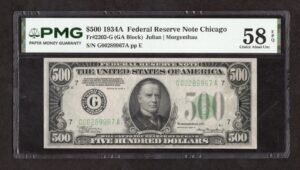
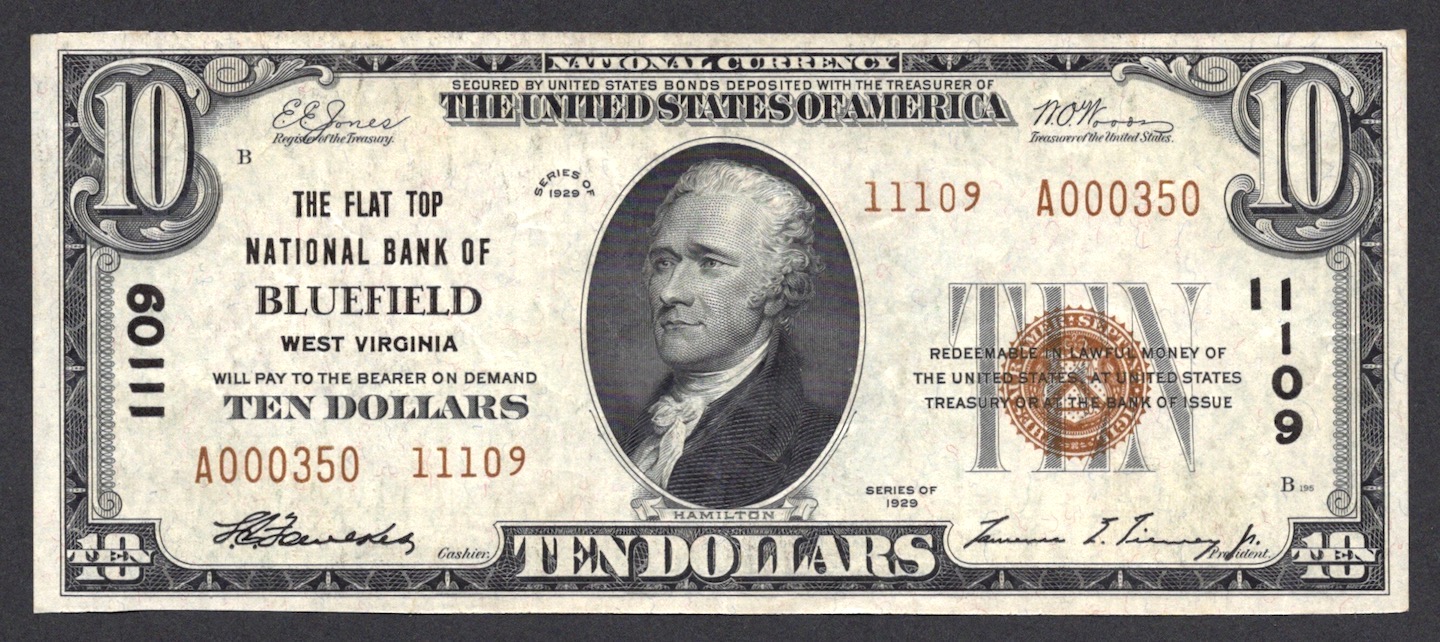
📷 Image source: Bureau of Engraving and Printing (via Wikimedia Commons). Images are selected by AI to represent the article topic and may not depict the exact note(s) described.
On the morning of February 7, 1904, a fire broke out in the Hurst and Company dry goods warehouse on the corner of Hopkins Place and German Street in Baltimore, Maryland. What followed over the next thirty-plus hours was one of the most catastrophic urban conflagrations in American history, second only to the Great Chicago Fire of 1871 in terms of property destruction. When the smoke finally cleared on February 8, more than 1,500 buildings across 140 city blocks had been reduced to rubble, and the financial district at the heart of Baltimore lay in ruins. For numismatists, the disaster carries a particular sting: the fire consumed banking records, charter documentation, and note issuance ledgers that historians and collectors have been trying to reconstruct ever since.
Baltimore in 1904: A Banking Capital in the Making
By the turn of the twentieth century, Baltimore was the seventh-largest city in the United States and home to a dense concentration of national banks operating under charters granted by the Office of the Comptroller of the Currency (OCC). The National Banking Acts of 1863 and 1864 had created the framework for these institutions, each of which was authorized to issue circulating national banknotes backed by United States government bonds deposited with the Treasury. Maryland, with its historically mercantile economy centered on the Chesapeake Bay trade, was fertile ground for such institutions.
The banks clustered in the financial district bounded by Baltimore Street, Charles Street, Calvert Street, and Lombard Street. Their vaults held specie, their offices held ledgers, and their correspondence files held the detailed records of every note series they had issued. These records were the lifeblood of accountability under the National Banking System, and many were maintained locally rather than at the OCC in Washington. That geographic concentration would prove catastrophic.
The Fire and the Financial District
The blaze moved with terrifying speed, driven by a southwestern wind and accelerated by the balloon-frame and cast-iron construction common to late Victorian commercial buildings. By Sunday evening on February 7, it had crossed Liberty Street and begun consuming the heart of the financial district. The Continental Trust Building, then one of Baltimore’s tallest structures, burned from the inside out. The Equitable Building, home to numerous financial offices, was gutted. The Maryland National Bank, the Merchants National Bank, and the National Bank of Commerce all suffered severe damage to their premises and records.
Critically, some bank presidents and managers had attempted to remove records as the fire advanced, loading ledgers and correspondence into wagons and transport vehicles. But the fire spread faster than anticipated, and many of those salvage attempts were only partially successful. Records that did make it out were sometimes damaged by smoke or water from the roughly 1,500 firefighters who eventually battled the blaze, including companies called in from Washington, D.C., Philadelphia, New York, and as far away as Wilmington, Delaware.
When evaluating Maryland national banknotes from Series 1882 or early Series 1902, pay close attention to the issuing bank and charter number. Notes from banks that operated in Baltimore’s fire-damaged financial district, such as the Merchants National Bank (Charter 1413) or the National Mechanics Bank (Charter 1215), may have issuance records that are incomplete or reconstructed from OCC files rather than original bank ledgers. This documentation gap can make provenance research both challenging and rewarding.
What Records Were Actually Lost
Understanding what was destroyed requires understanding how national bank records were maintained. Each national bank kept its own internal ledgers recording note serial numbers issued, notes redeemed, outstanding circulation figures, and correspondence with the OCC and the Treasury Department’s Bureau of Engraving and Printing (BEP). The OCC in Washington maintained its own parallel records, which survived because they were housed in the federal capital. However, the bank-level records, which often contained finer granular detail about specific note shipments, signature combinations for individual officers, and date-specific issuance data, were lost for numerous Baltimore institutions.
At least fourteen national banks operating in or near the burned district suffered significant record losses. The National Howard Bank, chartered in 1864 as one of Baltimore’s oldest national banking institutions, lost virtually all of its pre-1890 issuance records. The Drovers and Mechanics National Bank, which had been issuing notes since the 1870s, saw its correspondence files destroyed entirely. The Baltimore City National Bank’s board minutes and note register for the period 1882 through 1900 were confirmed as total losses by the bank’s subsequent reorganization committee.
What this means for collectors today is that certain questions simply cannot be answered from primary sources. Exactly how many Original Series or Series 1875 notes the Drovers and Mechanics National Bank issued, or precisely which signature combinations appear on the rarest surviving examples, must be inferred from surviving notes in collections rather than confirmed against bank records. This transforms the surviving notes themselves into primary historical documents of unusual importance.
Notes from Baltimore national banks in Very Fine or better condition are historically significant beyond their grade. Because the bank records that would document original issuance quantities were destroyed in 1904, high-grade survivors from institutions like the National Bank of Commerce (Charter 1490) or the Second National Bank of Baltimore (Charter 1384) are literally part of the evidentiary record numismatists use to reconstruct issuance history. Photograph both faces thoroughly and record provenance carefully before any purchase.
The OCC Records That Survived and What They Tell Us
Fortunately, the Comptroller of the Currency’s Washington office maintained circulation records, bond deposit ledgers, and periodic examination reports for every nationally chartered bank in the country. These federal records, now held at the National Archives in College Park, Maryland (Record Group 101), provide the skeletal framework for understanding what Baltimore’s national banks issued. Researchers like Don Kelly, whose landmark reference National Bank Notes: A Guide with Prices drew extensively on such records, have used OCC data to compile charter-by-charter issuance statistics.
The OCC data confirms, for instance, that the Merchants National Bank of Baltimore (Charter 1413) had an authorized circulation of $450,000 at the time of the fire, operating under the Series 1882 Brown Back and Date Back designs. The National Bank of Commerce (Charter 1490) was actively issuing Series 1902 Plain Back notes, with the familiar blue Treasury seal and signatures of Comptroller William B. Ridgely and either Register Judson Lyons or later Register William T. Vernon. These federal snapshots help collectors understand the denominational mix and approximate quantities, even if the bank-level detail is gone forever.
Rebuilding Baltimore Banking: The Post-Fire Reorganization
The fire did not merely destroy records; it fundamentally reshaped Maryland’s banking landscape. Several institutions that had survived as independent entities since the Civil War era were too financially weakened by the disaster to continue independently. The chaos of fire claims, disrupted commerce, and temporary displacement of business operations forced a wave of consolidations between 1904 and 1908 that transformed the character of Baltimore banking.
The National Howard Bank merged with the Continental Trust Company in 1905. The Drovers and Mechanics National Bank was absorbed into the larger Farmers and Merchants National Bank by 1907. These consolidations created new charter combinations and, in some cases, note issuance continued under successor institutions bearing different charter numbers. For collectors, this means that a Series 1902 Red Seal or Date Back note from a predecessor institution that was later absorbed may represent the final issues before that charter ceased independent operation, adding a layer of historical context to an already interesting note type.
Congress responded to the broader disaster by accelerating discussions about municipal fire codes and, more relevantly for our purposes, about the adequacy of national bank examination procedures. The Federal Reserve Act of 1913 was still nearly a decade away, but the Baltimore catastrophe provided reformers with compelling ammunition for centralized financial regulation and improved record-keeping standards that would eventually be housed in more fireproof federal facilities.
Series 1902 Plain Back notes from Maryland banks that reorganized or consolidated between 1904 and 1910 often show interesting officer signature combinations reflecting post-fire leadership changes. A note signed by a president who took over after the fire-driven merger carries historical weight that pure grade-focused collectors frequently overlook. Cross-reference charter numbers against Kelly’s reference or the Standard Catalog of United States Paper Money to identify these transitional issues.
Numismatic Significance: The Rarity Landscape of Baltimore Nationals
The combination of record destruction and post-fire banking consolidation has created a distinct rarity landscape for Maryland national banknotes. Some Baltimore-area charter numbers are represented by only a handful of confirmed survivors, not necessarily because few notes were issued, but because the fire disrupted the business continuity that might otherwise have preserved more examples in local circulation or bank archives.
The Series 1882 Brown Back $5 note from the National Howard Bank of Baltimore (Charter 2092) is a prime example. Kelly’s census data identifies fewer than six confirmed examples across all grades, yet OCC records indicate the bank had an authorized circulation sufficient to have produced hundreds of such notes over the life of that series. The gap between presumed issuance and known survivors is partly attributable to the general attrition of heavily circulated small denomination notes, but the fire’s disruption of the institutional continuity that might have preserved specimens in uncirculated condition as bank keepers cannot be dismissed.
| Charter / Series | Institution | Approx. Survivors Known | Rarity |
|---|---|---|---|
| Charter 1215, Series 1882 Brown Back | National Mechanics Bank, Baltimore | 4-6 examples | Key Date |
| Charter 1413, Series 1882 Date Back | Merchants National Bank, Baltimore | 8-12 examples | Rare |
| Charter 1490, Series 1902 Red Seal | National Bank of Commerce, Baltimore | 10-15 examples | Rare |
| Charter 2092, Series 1882 Brown Back $5 | National Howard Bank, Baltimore | Under 6 examples | Key Date |
| Charter 1384, Series 1902 Date Back | Second National Bank of Baltimore | 15-20 examples | Scarce |
| Charter 3425, Series 1902 Plain Back | Drovers and Mechanics National Bank | 20-30 examples | Scarce |
| Charter 4 (Maryland state predecessor notes) | First National Bank of Baltimore | 40+ examples across series | Scarce |
| Charter 1490, Series 1902 Plain Back $10 | National Bank of Commerce, Baltimore | 35-50 examples | Common |
Collecting Maryland Nationals in the Shadow of 1904
For the modern collector, the 1904 Baltimore Fire creates both challenges and opportunities. The challenges are evident: reconstructing the full issuance history of affected charters requires more legwork, relying on OCC microfilm records, published censuses, and auction records rather than clean institutional documentation. The opportunities are equally real: because the fire’s numismatic implications are not widely understood outside specialist circles, notes from affected Baltimore charters sometimes appear at auction without their full historical context being reflected in the catalog description or realized price.
A Series 1882 Brown Back from a charter number associated with a fire-disrupted bank should prompt a collector to research whether that institution’s records survived at all. If the charter was consolidated into a successor bank by 1907, the note may represent one of the final issues before the charter went dark. That kind of contextual rarity, distinct from but complementary to census rarity, adds genuine historical weight to the piece.
Researchers interested in pursuing this area should start with the National Archives Record Group 101 OCC records, the Maryland State Archives in Annapolis (which holds some pre-fire banking commission records that were housed in Annapolis rather than Baltimore), and the published work of Kelly and the Society of Paper Money Collectors. The SPMC’s Paper Money journal has run several Maryland-specific articles over the decades that provide charter-by-charter analysis worth tracking down.
A City Reborn, A Record Lost Forever
Baltimore rebuilt with remarkable speed. Within two years of the fire, much of the destroyed financial district had been reconstructed with wider streets, better fire codes, and more fireproof building materials. The banking community reconstituted itself, the consolidations shook out, and by the time the Federal Reserve System was established in 1913, Baltimore was home to a Federal Reserve Branch Bank under the Richmond Federal Reserve District, a status that reflected the city’s continued financial importance.
But the records that burned in February 1904 never came back. The ledgers that might have told us exactly how many Series 1882 Brown Back $10 notes the National Mechanics Bank shipped into circulation, or the precise date the Merchants National Bank exhausted its last allotment of Original Series notes, are gone. What remain are the notes themselves: worn, faded, occasionally crease-free survivors of a banking era that ended in fire and reorganization. Each one is a document the bank itself can no longer speak to. That responsibility has passed to collectors, and it is a responsibility worth taking seriously.