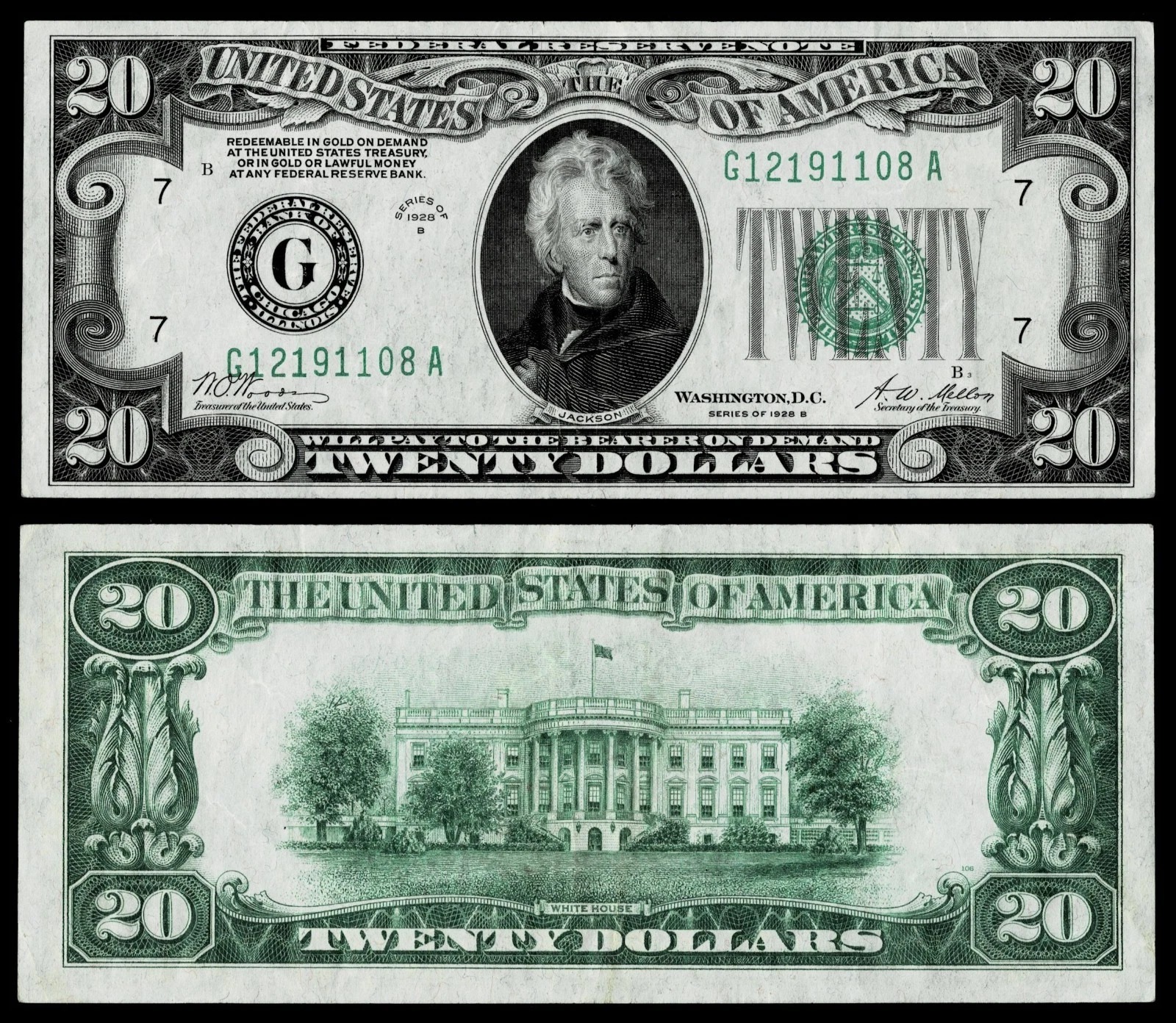
📷 Image source: eBay. Images are selected by AI to represent the article topic and may not depict the exact note(s) described.
Pull a Series 1928B $20 Federal Reserve Note from an old collection and you might think you are holding a fairly ordinary early small-size note. The green Treasury seal, the portrait of Andrew Jackson, the familiar Federal Reserve Bank obligation language across the top, all present and accounted for. But look more closely at the spacing around the vignette frame, and you may be holding a note that catalogues at a significant premium over its nearly identical twin. The wide face and narrow face plate varieties of the 1928B $20 have generated more heated forum debates, more disagreed attributions, and more split opinions at club tables than almost any comparable small-size variety. Here is what you need to know.
Setting the Stage: The 1928 Small-Size Transition
When the Bureau of Engraving and Printing introduced small-size currency in 1928, replacing the large-size notes that Americans had carried since the Civil War era, the new 6.14 by 2.61 inch format required entirely new engraved face and back plates. The BEP produced these plates in batches, and as production ramped up through 1928 and into the early 1930s, tooling adjustments and plate re-engravings introduced measurable differences between early and later impressions.
The Series 1928B $20 Federal Reserve Note, bearing the signature combination of Walter O. Woods as Register of the Treasury and Andrew W. Mellon as Secretary of the Treasury, was issued from 1929 through approximately 1933 across all twelve Federal Reserve Bank districts. During that production window, two distinct face plate configurations were used, and those configurations are what collectors now argue over endlessly.
What Exactly Is the Wide Face vs. Narrow Face Distinction?
The terms “wide face” and “narrow face” refer to the measurable horizontal distance between the outer border of the central vignette frame and the inner edge of the surrounding fine-line border pattern on the face of the note. On wide face examples, this margin is visibly broader, typically measuring approximately 1.5 mm or slightly more on each side under magnification. On narrow face examples, the vignette frame sits closer to the surrounding border, compressing that margin to roughly 0.9 to 1.1 mm.
This difference arose because the BEP re-engraved or retooled certain face plates midway through the Series 1928B production run. The earlier wide face plates produced notes with a slightly more open, airy look around Jackson’s portrait, while the later narrow face plates created a somewhat tighter, more compressed appearance. Neither version was a production error in the traditional sense. Both were intentional working plates certified for use. The distinction only became a collecting category retroactively, as numismatists studying the series began documenting the physical differences.
Use a quality loupe of at least 5x magnification and a digital caliper or micrometer reticle when attempting to attribute wide versus narrow face plates. Eyeballing the difference under normal lighting is unreliable, and misattribution is the single most common error affecting resale value on these notes.
Why the Attribution Debate Gets So Heated
The core problem is measurement variability. Paper currency shrinks and expands with humidity, age, and the pressing or cleaning a note may have received. A note that measures firmly in the wide face range fresh from a BEP press might measure ambiguously after ninety years in an album or wrapped in a rubber band in a shoebox. Third-party grading services have themselves been inconsistent in their variety attribution on these notes over the years, with PCGS Currency and PMG both revising their internal standards at various points, meaning that holders from different certification eras may carry conflicting attributions for similar-looking examples.
Beyond measurement drift, the distinction between wide and narrow is not binary with a sharp cutoff. There appears to be a transitional range, notes produced during the plate changeover period that fall into neither camp cleanly. Experienced collectors disagree about whether these transitional notes should be attributed to the more common narrow face category by default, lumped into a separate unlisted variety, or simply left unattributed. The major reference works, including Robert Friedberg’s “Paper Money of the United States” and the more specialized Schwartz-Lindquist guides, handle this transitional zone differently, which only deepens the argument.
When purchasing a 1928B $20 wide face example from a dealer or auction, always request documentation of the measurement methodology used for attribution, or insist on a third-party certified note. Uncertified wide face attributions carry real risk of misidentification, particularly on circulated examples where paper compression has occurred.
District-by-District Rarity Differences
Not every Federal Reserve Bank district issued both varieties in equal quantities, which is where the collecting story gets genuinely fascinating. The wide face variety appears to be considerably more scarce for certain districts than others, and for a handful of districts, confirmed wide face examples in collectible grades are legitimately rare. The Boston (A), Minneapolis (I), and Dallas (K) districts produced relatively modest Series 1928B $20 print runs to begin with, and documented wide face survivors from these districts in grades of Very Fine or better can command significant premiums when properly attributed and certified.
By contrast, the large-district banks such as Chicago (G), New York (B), and San Francisco (L) issued far greater quantities of Series 1928B $20 notes, and wide face examples from these districts, while still scarcer than narrow face, turn up with enough frequency that well-heeled collectors can realistically pursue them. The rarity differential between districts makes district set building for this variety genuinely challenging, with some collectors spending years searching for a properly attributed wide face example from a low-output district.
How Face Plates Were Numbered and What That Tells Us
BEP face plates for small-size notes were numbered sequentially, and the plate number appears in small print in the lower right area of the note face. Researchers have correlated specific plate number ranges with the wide and narrow face configurations, providing a more objective attribution tool than measurement alone. Wide face plates generally correspond to lower plate numbers in the early 1928 through 1930 production period, while higher plate numbers from the later production period correspond to narrow face impressions.
However, this correlation is not absolute. Some plates were reworked, relapped, or reused across different production periods, which can break the plate number to variety correlation. Additionally, not every plate number is represented in known survivors, making it impossible to build a complete plate-to-variety map from existing census data. The Numismatic Bibliomania Society and various specialized study groups have published partial plate number attributions, but a definitive comprehensive reference does not yet exist, which itself sustains the collector debate.
Record the plate number from any 1928B $20 you examine, even if you cannot immediately attribute it to wide or narrow face. Reporting your findings to the Paper Money Research Center or contributing to online variety registries helps build the collective database that will eventually resolve the attribution ambiguities still clouding this series.
Grading Considerations Specific to These Varieties
Because the margin measurement is critical to attribution, grade matters more for variety confirmation than for most small-size notes. A heavily circulated example with significant fold compression along the edges may have its margin measurement altered enough to make attribution genuinely impossible, even under professional examination. For this reason, the wide face variety commands its strongest premiums in grades of Extremely Fine or better, where paper integrity is sufficient to produce reliable measurements.
In gem uncirculated grades of MS-65 or higher, properly attributed and certified wide face examples from scarce districts represent serious collector items with real scarcity behind them. In circulated grades below Very Fine 20 to 25, the premium for wide face attribution narrows considerably, both because of measurement uncertainty and because the collector market for heavily circulated variety notes is thinner.
| District / Bank | Variety | Est. Known Wide Face Survivors | Rarity |
|---|---|---|---|
| A – Boston | Wide Face | Fewer than 20 confirmed in VF+ | Key Date |
| B – New York | Wide Face | Moderate survivors, 60-80+ known | Scarce |
| C – Philadelphia | Wide Face | Approximately 30-40 known in VF+ | Scarce |
| D – Cleveland | Wide Face | Approximately 25-35 known in VF+ | Scarce |
| G – Chicago | Wide Face | 50-70 known, largest district supply | Scarce |
| I – Minneapolis | Wide Face | Fewer than 15 confirmed in VF+ | Key Date |
| K – Dallas | Wide Face | Fewer than 15 confirmed in VF+ | Key Date |
| L – San Francisco | Wide Face | 40-55 known in VF+ | Scarce |
| All Districts | Narrow Face | Many thousands surviving | Common |
What the Market Has Done with These Varieties
Heritage Auctions, Stack’s Bowers, and Lyn Knight Currency Auctions have all handled significant wide face 1928B $20 examples over the past two decades, and the realized price record reflects the genuine collector demand for properly attributed pieces. A PMG 64 EPQ Boston wide face example realized over $2,800 at a 2019 Heritage session, compared to a narrow face Boston example in similar grade that brought under $300 in a concurrent sale. That spread is not unusual for the key-date districts.
Even for the more common districts, a gem uncirculated wide face note with an EPQ or PPQ designation for exceptional paper quality will typically bring three to five times the catalogue value of a comparable narrow face note. The market has clearly decided that the variety is real, collectible, and worth a premium. The debate is not about whether the wide face is more valuable, but rather about whether any given note truly qualifies for the designation.
Building a Complete Wide Face District Set
For collectors with the patience and budget to pursue a complete twelve-district wide face set of Series 1928B $20 notes, the enterprise is a genuine long-term project. Most experienced collectors in this specialty estimate that assembling all twelve districts in Extremely Fine or better condition, with solid attribution, would take a minimum of five to ten years of active searching at major auction venues and through specialized dealer networks. The Boston, Minneapolis, and Dallas districts are the bottlenecks that make the set possible to define but genuinely difficult to complete.
A more accessible goal for many collectors is a partial set concentrating on the larger-district examples in mid-range circulated grades, supplemented by one or two key-date districts in lower circulated grades where the scarcity is demonstrated by simple survival rather than grade. Either approach puts you into contact with one of the most technically interesting variety collecting areas in all of small-size paper money.
Join the Society of Paper Money Collectors (SPMC) and connect with the small-size Federal Reserve Note study group members who have published variety research on the 1928 series. Their accumulated census data and attribution guidelines are far more granular than what appears in general catalogues, and member-to-member knowledge sharing can save you costly misattribution mistakes.
The Broader Lesson for Variety Collectors
The 1928B $20 wide versus narrow face debate is, in microcosm, the story of variety collecting itself. It requires technical knowledge, good reference materials, access to measurement tools, and a tolerance for ambiguity. It rewards careful study with real financial and intellectual satisfaction. And it reminds every collector that the most interesting story in a note is sometimes invisible until you know exactly where to look and what you are measuring.
Whether you land firmly in the camp of those who insist on certified third-party attribution or among those who trust a good loupe and a steady hand, the Series 1928B $20 wide face variety deserves a place in any serious collection of early small-size Federal Reserve Notes. Just be ready to defend your attribution when you bring it to the next club meeting, because someone across the table will almost certainly want to measure it themselves.