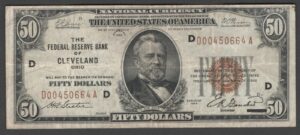
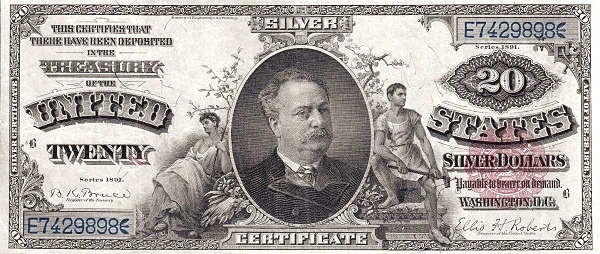
📷 Image source: banknote.ws (World Banknote Gallery). Images are selected by AI to represent the article topic and may not depict the exact note(s) described.
There are rare notes, and then there are notes so scarce that their very existence feels like a rumor. The Series 1891 $100 Silver Certificate bearing the portrait of Civil War naval hero Admiral David Glasgow Farragut falls firmly into the second category. Catalogued by Friedberg as Fr. 344, this note occupies a singular position in large-size type collecting: it is simultaneously one of the most historically significant and one of the most practically unattainable pieces in all of American paper money. Whether you are a seasoned collector who has spent decades assembling large-size type sets or a newcomer who just encountered the note in a reference book, understanding what makes this issue so extraordinary is essential groundwork.
Admiral Farragut on American Currency
David Glasgow Farragut (1801-1870) was the United States Navy’s first Admiral and full Admiral, best remembered for his audacious command at the Battle of Mobile Bay in August 1864. His legendary order, commonly paraphrased as “Damn the torpedoes, full speed ahead,” captured the American imagination and cemented his status as a national hero. When the Treasury Department redesigned the $100 Silver Certificate for the Series 1891 issue, Farragut was a natural choice to grace the obverse. His portrait, engraved by the Bureau of Engraving and Printing (BEP) with the fine detail characteristic of the era, dominates the left side of the note’s face. The engraving is widely considered one of the most handsome portrait vignettes to appear on any large-size currency.
It is worth noting that Farragut also appeared on the Series 1863 and 1864 fractional currency issues, making him one of a small group of military figures whose likenesses appeared across multiple currency types. His placement on the high-denomination $100 Silver Certificate, however, represented a significant elevation in numismatic prominence.
Design and Physical Characteristics
The Series 1891 $100 Silver Certificate measures 7.375 inches by 3.125 inches, consistent with all large-size notes of the period. The obverse features Farragut’s portrait at left, with an elaborate lathe-work geometric design filling the remainder of the face. The obligation text reads “This certifies that there have been deposited in the Treasury of the United States One Hundred Silver Dollars payable to the bearer on demand.” A bold red Treasury seal appears to the right of center, which is a defining characteristic of the 1891 Silver Certificate series across all denominations.
The reverse design is equally striking. An intricate dark green geometric pattern fills the back, a style sometimes called “tombstone” design by collectors due to its architectural, monument-like framing elements. The word “SILVER” appears prominently in large letters. The combination of the deep green reverse and the red seal on the obverse makes this one of the most visually arresting large-size notes ever produced.
When examining an 1891 $100 Silver Certificate, inspect the red Treasury seal closely under magnification. Genuine seals show sharp, fine serrations around the perimeter. Blunt or uneven serrations can indicate a cleaned or improperly restored note, which will significantly affect professional grading and resale value.
Signature Combinations and the Fr. 344 Variety
Silver Certificates of the 1891 series were signed by the Register of the Treasury and the Treasurer of the United States. For the $100 denomination, only one signature combination is known: Rosecrans-Nebeker (William S. Rosecrans as Register and James W. Nebeker as Treasurer). William S. Rosecrans, the former Civil War general turned politician, served as Register from April 1881 through May 1893. James W. Nebeker served as Treasurer from June 1891 through May 1892, giving this note an extremely narrow window of production. The Friedberg catalog lists this single combination as Fr. 344, and no other signature pairings are known to exist for this type, meaning the entire known population of 1891 $100 Silver Certificates falls under a single catalog number.
This narrow production window is a primary driver of the note’s scarcity. Nebeker’s tenure lasted less than a year, and it appears the Treasury printed $100 Silver Certificates bearing this combination in very limited quantities before currency needs shifted or production moved to other denominations. Surviving Treasury Department records from the period are incomplete, making it difficult to establish a precise print run figure, but population data from the major grading services strongly suggests the total original printing was in the low thousands at most, with the vast majority long since redeemed and destroyed.
The Scarcity in Context: Just How Rare Is It?
The Professional Currency Dealers Association (PCDA) and major grading services including PCGS Currency and PMG have certified fewer than ten examples of Fr. 344 in their combined records. Some numismatic researchers, including those who have worked on population studies for large-size Silver Certificates, suggest the true surviving universe may be as low as seven or eight distinct notes when duplicates and resubmissions are accounted for. To put this in perspective, even the famous 1880 $1,000 Legal Tender Note (Fr. 187k, the “Grandwater” variety) has a somewhat larger confirmed population.
The 1891 $100 Silver Certificate is therefore not simply a condition rarity, where common notes are scarce only in high grades. It is an absolute rarity: there simply are not many notes to find regardless of grade. Most major collections of large-size type notes, including some assembled over decades by the most well-capitalized collectors in the hobby, either lack this note entirely or represent it by a single circulated example.
If you are building a large-size Silver Certificate type set and cannot locate or afford Fr. 344, consider placing a want list with at least three major currency dealers simultaneously. Notes of this rarity rarely appear at public auction and are more often sold privately. Relationships with specialist dealers are invaluable for tracking down absolute rarities.
Auction Records and Collector Values
Because so few examples exist and sales are infrequent, establishing a precise current market value for Fr. 344 is inherently difficult. The note has appeared at major auction houses including Stack’s Bowers, Heritage Auctions, and Spink on only a handful of occasions over the past two decades. A PMG Fine 12 example offered by Heritage Auctions in the early 2010s realized over $180,000. A subsequent example in a higher grade, PMG Very Fine 25, brought over $350,000 at a major currency sale circa 2019, setting a benchmark that reflects both absolute rarity and growing collector demand for investment-grade large-size type.
In lower circulated grades (Good 4 through Fine 15), examples have historically traded in the $100,000 to $200,000 range when they surface. In Very Fine or better, the sky is effectively the limit. No example certified above Extremely Fine is publicly recorded, which itself speaks to the note’s circulation history: the high face value meant these notes circulated heavily in commercial banking environments before being redeemed.
Condition Census and Grading Realities
The condition census for Fr. 344 is informally maintained by specialist researchers, and the finest known example at the time of writing is believed to grade in the Very Fine to Extremely Fine range, though precise details shift as notes are periodically resubmitted for grading. Collectors should be aware that large-size $100 notes of this era are especially susceptible to certain condition problems: corner folds (given the size of the note), counting creases running horizontally through the center of the face, and ink oxidation affecting the red seal are the most commonly encountered issues.
Professional grading is absolutely essential for any transaction involving this note. Both PCGS Currency and PMG have extensive experience with large-size Silver Certificates, and their holders provide authentication assurance that is non-negotiable at this value level. Unholdered examples, regardless of apparent grade, should be treated with extreme caution and submitted to a grading service before any purchase is finalized.
Paper restoration and cleaning are persistent concerns with high-denomination large-size notes. Under a UV (ultraviolet) light source, restored or washed paper often fluoresces differently than original paper, sometimes appearing brighter or showing uneven tonal patches. This is a useful preliminary check before submitting any expensive large-size note for professional grading.
Historical Companions: Other 1891 Silver Certificate Rarities
The Series 1891 Silver Certificates were produced in denominations from $1 through $1,000, and the higher denominations are uniformly scarce. The $500 (Fr. 345, Marcy portrait) and $1,000 (Fr. 346, DeWitt Clinton portrait) from the same series are equally elusive, but the $100 Farragut stands out because the $100 denomination represented a more practical transaction amount than the ultra-high face values, meaning more notes were actually issued and circulated, yet far fewer survived proportionally. This paradox, more issued but fewer surviving, results from the fact that high-circulation notes wear out and are redeemed, while the $500 and $1,000 notes were often retained and stored rather than passed through daily commerce.
For collectors assembling a comprehensive large-size Silver Certificate type set, Fr. 344 is typically the single hardest note to acquire, even compared to the $500 and $1,000 denominations of the same series. Budget planning for any serious large-size type set must account for the reality that this note alone may represent a six-figure acquisition.
| Series / Fr. Number | Denomination and Portrait | Est. Surviving Population | Rarity |
|---|---|---|---|
| Fr. 344 (1891) | $100, David Farragut | 7-10 known | Key Date |
| Fr. 345 (1891) | $500, William Marcy | 6-8 known | Key Date |
| Fr. 346 (1891) | $1,000, DeWitt Clinton | 4-6 known | Key Date |
| Fr. 342 (1880) | $100, James Monroe | 15-20 known | Rare |
| Fr. 343 (1891) | $50, Edward Everett | 20-30 known | Rare |
| Fr. 340 (1880) | $50, Edward Everett | 25-35 known | Rare |
| Fr. 337 (1880) | $20, Stephen Decatur | 50-75 known | Scarce |
| Fr. 338 (1886) | $20, Daniel Manning | 60-80 known | Scarce |
Why This Note Matters Beyond Its Price Tag
It would be easy to reduce the 1891 $100 Silver Certificate to a dollar figure, and the dollar figures are certainly impressive. But the note’s importance to American numismatics runs deeper. It represents a pivotal moment in the history of Silver Certificates, a currency class born from the political battles of the Bland-Allison Act of 1878 and expanded through the Sherman Silver Purchase Act of 1890. The Silver Certificate program was a direct result of Western silver mining interests pressuring Congress to monetize silver, and the beautiful large-size notes produced under this program are tangible artifacts of one of the most contentious monetary debates in American history.
Farragut himself, as the chosen portrait subject, connects this monetary history to the military history of the Civil War era. The Treasury’s selection of a naval hero for the largest commonly circulated Silver Certificate denomination was a deliberate statement of national confidence and pride. Owning an example, even a circulated one with the honest wear of commerce, means holding a piece of that statement in your hands.
Practical Advice for Aspiring Owners
If acquiring Fr. 344 is a goal, patience and preparation are the two most important tools you have. Monitor major auction house schedules, particularly Heritage Auctions and Stack’s Bowers, which handle the majority of important American paper money sales. Register as a bidder well in advance and set realistic budget expectations. Establish relationships with dealers who specialize in large-size type, including members of the PCDA and the Society of Paper Money Collectors (SPMC). Read the standard references: Friedberg’s “Paper Money of the United States” (currently in its 22nd edition) provides the foundational catalog data, while the Whitman Encyclopedia of U.S. Paper Money offers deeper contextual background.
For notes of this extreme rarity and value, always request a full provenance history from the seller if available. Documented ownership history from reputable collections or auction appearances adds an additional layer of authenticity confidence and can support value at resale. Keep all original holders, auction lot tags, and related paperwork as part of the note’s permanent record.
Conclusion: The Farragut $100 as a Cornerstone of Large-Size Collecting
The Series 1891 $100 Silver Certificate, Fr. 344, is not simply one of the hardest large-size type notes to find. It is a touchstone that defines the upper tier of American paper money collecting. Its combination of absolute rarity, historical significance, superb design, and the enduring mystique of Admiral Farragut’s portrait makes it a note that commands respect at every level of the hobby. For those fortunate enough to encounter one at auction or through a private transaction, the decision calculus is straightforward: notes of this caliber rarely surface, and when they do, they deserve the serious attention of any collector with the means and the passion to bring them home.
For everyone else, study it in the reference books, follow the auction results, and keep your want list active. In this hobby, persistence and preparation have a way of being rewarded, even when the prize seems impossibly out of reach.