A Conspiracy That Rewrote the Rules of American Money
In May 1875, Treasury Secretary Benjamin Bristow unleashed one of the most dramatic law enforcement operations in American history. Working in secrecy to avoid tipping off corrupt officials within his own department, Bristow coordinated simultaneous raids on distilleries across St. Louis, Chicago, and Milwaukee, exposing a network of whiskey producers, revenue agents, and Republican Party operatives who had defrauded the federal government of an estimated $3 million in excise tax revenue, a figure that translates to roughly $80 million in modern purchasing power. The Whiskey Ring ultimately ensnared more than 230 indictments, and the scandal’s shockwaves reached deep into the Treasury Department’s internal structure, reshaping the very offices responsible for producing and monitoring United States currency.
Corruption Inside the Treasury: More Than Just Whiskey
To understand why the Whiskey Ring mattered so profoundly to currency oversight, collectors must appreciate the institutional environment inside the Treasury Department during the early 1870s. The Bureau of Engraving and Printing, established as an independent entity in 1869 after decades of contracting currency production to private firms like the American Bank Note Company and the National Bank Note Company, was still finding its administrative footing. Oversight of printed currency, from serial number sequencing to the authentication of Treasury seal impressions, relied heavily on the integrity of mid-level Revenue Department officials, precisely the class of men the Whiskey Ring had so thoroughly corrupted.
When investigators began following the money trails of indicted revenue agents, they discovered that some of the same bookkeeping manipulations used to hide whiskey tax shortfalls were structurally identical to methods that could theoretically be used to mask discrepancies in currency print runs. No direct evidence emerged that currency printing records had been falsified, but the similarity was alarming enough that Secretary Bristow commissioned an internal audit of the Bureau of Engraving and Printing’s accountability procedures in late 1875. That audit, completed in February 1876, became the foundation for a new layer of documentary oversight that collectors can actually see reflected in the notes themselves.
When examining Series 1875 Legal Tender Notes, pay close attention to the placement and color intensity of the Treasury seal. Notes printed before the mid-1875 internal reforms occasionally show slightly inconsistent seal ink saturation, a byproduct of less rigorous quality checkpoints. These pre-reform printings are identifiable by their earlier serial number ranges and are subtly distinct from later 1875 printings, making condition-equivalent pairs from the same series genuinely interesting for side-by-side comparison.
The Series 1875 Legal Tender Notes: A Reform Era Snapshot
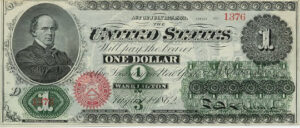
For currency collectors, the Series 1875 United States Notes represent the most tangible intersection of the Whiskey Ring fallout and everyday paper money. Issued under the authority of the Legal Tender Acts and bearing the signature combination of Treasurer Francis Spinner (who retired mid-year, succeeded by John C. New) and Secretary Benjamin Bristow himself, these notes carry the biography of the reform era on their face.
The $1 Series 1875 Legal Tender Note (Friedberg catalog number Fr. 30 through Fr. 36, depending on signature combination) is the entry point for most collectors interested in this period. The Spinner-Bristow signature pairing (Fr. 30) is the scarcest of the 1875 $1 combinations, with circulated examples in Very Fine-20 typically trading between $175 and $350, while Choice Uncirculated-63 examples can command $800 to $1,400 depending on originality and centering. The New-Bristow pairing (Fr. 31) is more available but still represents a genuine piece of reform-era Treasury history.
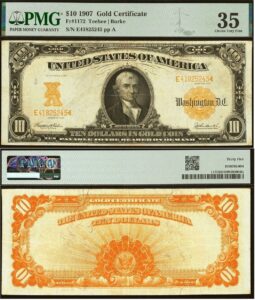
At the higher denominations, the Series 1875 $5 Legal Tender Note (Fr. 67 through Fr. 71) and the $10 (Fr. 103 through Fr. 107) show the most visible design changes attributable to the post-Whiskey Ring accountability push. Beginning with printings authorized after September 1875, the Bureau of Engraving and Printing introduced tighter tolerances on the red Treasury seal positioning and standardized the back plate check letter system to create an unbroken audit chain from plate to sheet to finished note. Collectors who examine high-grade examples under magnification can sometimes distinguish the pre- and post-reform printings by the precision of seal centering relative to the surrounding vignette border.
National Bank Notes and the Comptroller’s New Mandate
The Whiskey Ring scandal also left its mark on the National Bank Note series, which in 1875 was transitioning from the Original Series (commonly called First Charter) designs to what collectors now call the Series 1875 First Charter notes. The Comptroller of the Currency, who had direct oversight responsibility for National Bank Note production and the authentication of individual bank charter plates, had been operating with relatively informal verification procedures since the National Banking Act of 1863.
Bristow’s internal audit specifically criticized the Comptroller’s office for relying on a single-signature sign-off system for authorizing new bank charter plate orders, the same kind of single-point-of-failure that had allowed Whiskey Ring participants to falsify excise records for years without detection. By 1876, the Comptroller implemented a dual-authorization requirement for all new and replacement currency plates, and this procedural change is directly visible in the documentary record of First Charter Period notes produced after mid-1876.
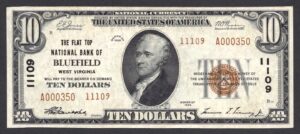
First Charter Period National Bank Notes from 1875 and 1876 are cataloged in the Friedberg reference by both denomination and issuing bank. When building a type set, prioritize notes from banks in Missouri, Illinois, and Wisconsin if you want geographic connection to the Whiskey Ring’s epicenter. St. Louis banks including the Merchants National Bank (Charter 1102) and the Third National Bank of St. Louis (Charter 3456) issued First Charter notes during this exact window, and a high-grade example from either institution is a genuinely conversation-worthy piece for any collection focused on the Gilded Age political era.
Benjamin Bristow and the Signature That Defined an Era
Benjamin Bristow served as Secretary of the Treasury from June 1874 through June 1876, a tenure that precisely brackets the Whiskey Ring investigation and the subsequent currency oversight reforms. His engraved signature appears on Legal Tender Notes across multiple series and denominations, and while his name is not as immediately recognizable to new collectors as those of Chase or Hamilton, his notes carry arguably more political and institutional weight than almost any other Treasury Secretary signature combination of the 19th century.
On the $2 Legal Tender Notes, the Bristow-signed Series 1874 (Fr. 47 through Fr. 50) and Series 1875 (Fr. 51 through Fr. 56) represent back-to-back years of his tenure. A complete signature run of Bristow-paired $2 notes across both series is an achievable and thematically powerful collecting goal. In circulated grades, most combinations are available for under $200 per note, though the Allison-New pairing on Fr. 52 is considerably scarcer and can exceed $500 in Fine-15 condition.
The Specie Resumption Act: Currency Policy in the Shadow of Scandal
The Whiskey Ring scandal did not occur in a policy vacuum. Just four months before Bristow’s raids, on January 14, 1875, Congress passed the Specie Resumption Act, which committed the United States to resuming gold-backed payments by January 1, 1879, and authorized the Treasury to reduce the outstanding volume of Legal Tender Notes (Greenbacks) by replacing them with National Bank Notes as new banks were chartered. The political atmosphere generated by the Whiskey Ring made these deflationary policies even more contentious, as soft-money Democrats and Greenback Movement advocates argued that a Treasury Department riddled with corruption was the last institution that should be trusted to contract the money supply.
For collectors, this policy context explains several interesting characteristics of notes dated to the 1875 to 1878 transition window. The reduction in Greenback supply means that certain denominations and series from this period have survivor populations lower than their nominal print runs might suggest, because fewer notes were preserved when active currency was being systematically retired and destroyed. The $10 and $20 Legal Tender Notes of Series 1875 are particularly affected by this dynamic.
When evaluating Series 1875 Legal Tender Notes of $10 and higher denominations, be aware that many surviving examples entered collector hands through early 20th century bank recycling programs rather than through ordinary commerce. Notes that show faint counting machine marks along their left edges, a characteristic fold pattern at the upper-left quadrant, and lightly toned but crisp paper may have been pulled from bank storage rather than circulated in trade. PCGS Currency and PMG graders treat these as legitimately high-grade original notes, and rightly so, as their preservation reflects the economic history of Specie Resumption rather than any artificial shielding from circulation.
Orville Babcock and the Limits of Reform
No discussion of the Whiskey Ring would be complete without Orville Babcock, President Grant’s personal secretary, who was indicted in December 1875 as a ring participant and who became the most politically explosive figure in the entire scandal. Grant’s insistence on submitting a deposition in Babcock’s defense infuriated reformers and directly contributed to Bristow’s eventual resignation in June 1876. Babcock was acquitted in February 1876, but the political damage was severe.
The significance for currency collectors is that Babcock’s acquittal effectively ended the momentum of Bristow’s most aggressive reform proposals, including a plan to centralize all currency authentication under a new Office of Currency Integrity that would have operated independently of both the Comptroller and the Secretary. Had that office been created as proposed, the institutional history of 1880s and 1890s currency production would look quite different. The notes we collect from the Series 1880 Legal Tender series onward reflect a more cautious, politically negotiated reform rather than the wholesale structural overhaul Bristow originally envisioned.
| Series / Fr. Number | Denomination and Type | Signature Combination | Rarity |
|---|---|---|---|
| 1875, Fr. 30 | $1 Legal Tender Note | Spinner-Bristow | Scarce |
| 1875, Fr. 31 | $1 Legal Tender Note | New-Bristow | Common |
| 1875, Fr. 52 | $2 Legal Tender Note | Allison-New | Scarce |
| 1875, Fr. 67 | $5 Legal Tender Note | Allison-New | Common |
| 1874, Fr. 47 | $2 Legal Tender Note | Spinner-Bristow | Scarce |
| 1875, Fr. 103 | $10 Legal Tender Note | Allison-Bristow | Rare |
| 1875 First Charter | $1-2-1-2 National Bank Note (St. Louis banks) | Various Comptroller pairings | Rare |
| 1875, Fr. 148 | $20 Legal Tender Note | Allison-New | Key Date |
| 1878, Fr. 16 | $1 Legal Tender Note | Allison-Gilfillan | Common |
| 1875 First Charter | $50 National Bank Note, Midwest charters | Post-reform dual authorization | Key Date |
Building a Whiskey Ring Era Collection: A Practical Framework
For collectors who want to build a thematically focused set around this remarkable historical moment, the good news is that a meaningful collection is achievable at virtually every budget level. A starter set might focus exclusively on $1 and $2 Legal Tender Notes bearing Benjamin Bristow’s signature, which can be assembled in Fine to Very Fine grades for a total investment under $600. An intermediate collector might expand to include a Series 1875 First Charter National Bank Note from an Illinois or Missouri bank, adding geographic specificity to the theme for a premium that rarely exceeds $400 to $800 for average-grade examples from well-documented charter banks.
Advanced collectors pursuing high-grade examples should be aware that third-party grading by PMG or PCGS Currency is particularly important for 1875 series notes because the paper quality and printing characteristics of the reform transition period can produce misleading visual assessments for the untrained eye. A PMG Very Fine-30 EPQ (Exceptional Paper Quality) designation on a Spinner-Bristow $1 is worth a meaningful premium over an ungraded example, both for authentication confidence and for long-term resale liquidity.
Conclusion: Scandal as a Collecting Lens
The Whiskey Ring scandal is remembered primarily as a political embarrassment for Ulysses Grant’s second term, but its true legacy for American financial history runs considerably deeper. The internal audits Bristow commissioned, the dual-authorization protocols adopted by the Comptroller’s office, and the abortive push for an independent currency integrity bureau all left permanent marks on how the Bureau of Engraving and Printing operated through the end of the 19th century. The notes produced in the 1875 to 1878 window are not merely attractive artifacts of the Gilded Age. They are documentary evidence of a government wrestling with the consequences of institutional corruption and trying, imperfectly but sincerely, to build accountability into the physical fabric of its currency. That story deserves a place in every serious collection of United States paper money.