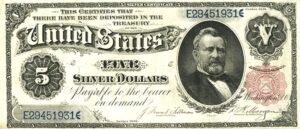
A Dollar Bill That Changed Everything
On July 10, 1929, the United States government completed one of the most significant transitions in the history of American paper money. The large-size notes that had defined US currency since the Civil War era gave way to a uniform small-size format, roughly 6.14 inches by 2.61 inches, that Americans still carry in their wallets today. At the center of that transformation was the Series 1928 $1 Federal Reserve Note and its successor, the Series 1928B, which became the first small-size dollar to truly saturate everyday commerce across the country.
While the 1928 and 1928A issues appeared first, their production runs were comparatively modest and their distribution uneven. The 1928B, by contrast, was printed in enormous quantities across all twelve Federal Reserve districts and arrived just as the public was growing accustomed to the new compact format. If you had a dollar bill in your pocket in 1929 or 1930, there was a strong chance it was a Series 1928B.
Historical Context: Why the Small-Size Transition Mattered
The shift to small-size currency was driven by economics and efficiency. The US Treasury and the Bureau of Engraving and Printing calculated that reducing note dimensions would save approximately $1.5 million annually in paper costs alone, not counting savings in printing, storage, and transportation. Congress authorized the change through legislation, and the BEP spent years retooling its presses and redesigning every denomination.
The new $1 notes featured a portrait of George Washington on the obverse, a design originally engraved by G.F.C. Smillie based on the Gilbert Stuart Athenaeum portrait. The reverse displayed a simple ONE within an ornate lathe-work frame, a design that would remain essentially unchanged for decades. Early small-size $1 bills did not yet feature the familiar Great Seal imagery of the eagle and pyramid; that iconic reverse design was not introduced until the Series 1935 Silver Certificates.
Series 1928 $1 Federal Reserve Notes were issued in three varieties before the design was retired: the 1928, 1928A, and 1928B. Each change in series letter corresponded to a change in the signature combination on the face of the note. The 1928B carries the signatures of Walter O. Woods as Register of the Treasury and Andrew W. Mellon as Secretary of the Treasury, making it the only Woods/Mellon pairing on a small-size $1 Federal Reserve Note.
The Twelve Districts: Not All 1928Bs Are Equal
Federal Reserve Notes are issued through one of twelve Federal Reserve Banks, and each district’s notes are identified by a letter and number seal on the face. For the Series 1928B $1, these ran from A-1 (Boston) through L-12 (San Francisco). The district letter also appears as a prefix letter in the serial number. This district system is one of the most compelling aspects of collecting early small-size notes because production quantities varied dramatically between districts.
The New York (B) and Chicago (G) districts printed the largest quantities, reflecting the commercial dominance of those cities in the late 1920s. Conversely, the Minneapolis (I) and Kansas City (J) districts produced far fewer notes. The Minneapolis district 1928B, cataloged as Fr. 1509, is considered a condition rarity today; while circulated examples surface regularly, finding one in Very Fine or better grade is genuinely challenging. The Dallas (K) district note, Fr. 1511, is similarly underrated by many collectors.
When building a district set of Series 1928B $1 notes, prioritize the Minneapolis (Fr. 1509) and Dallas (Fr. 1511) districts first, as these are the hardest to locate in grades above Very Fine. The Boston, New York, and Chicago districts are easiest to find and can be saved for last without significantly affecting your budget.
Reading the Note: Signatures, Seals, and Serial Numbers
Authenticating and attributing a 1928B $1 starts with the face of the note. The Woods/Mellon signatures appear below the portrait, with the Register’s signature on the left and the Secretary’s on the right. Walter O. Woods served as Register of the Treasury from 1928 to 1933, while Andrew Mellon held the Secretaryship from 1921 to 1932, one of the longest tenures in that office’s history.
The Treasury seal on Series 1928B $1 Federal Reserve Notes is a small, spiky design in gold or yellow-gold ink, positioned to the right of the portrait. This is sometimes described as a “yellow seal” by collectors, though the official term is gold. The Federal Reserve Bank seal, printed in black, appears to the left of the portrait and carries the district letter and name. The serial number appears twice, in green ink, a detail that helps distinguish genuine notes from later reprints or alterations.
Serial numbers on 1928B $1s follow the format: one letter (district prefix), six digits, and one suffix letter. The suffix letter advanced each time a block of serial numbers was exhausted. Most district notes show multiple serial number blocks, providing another layer of variety for advanced collectors who track specific block combinations.
On genuine Series 1928B $1 notes, the green serial numbers should show even, consistent ink with no evidence of added characters or re-inking. Under UV light, the paper will show a faint blue-purple glow from the embedded security fibers, a quick and reliable authenticity check that any collector can perform at home.
Star Notes: The Replacement Bills Collectors Prize
Like all Federal Reserve Notes of the era, the 1928B $1 was produced with star note replacements to substitute for sheets destroyed during the printing process. Star notes carry a star symbol at the end of the serial number rather than a suffix letter. For this series, star notes are cataloged separately (Fr. 1501* through Fr. 1512*) and command significant premiums over their regular-issue counterparts.
The rarest star notes from this series come from the Minneapolis and Kansas City districts, where regular-issue print runs were already modest and star note production proportionally small. A Minneapolis star note (Fr. 1509*) in Fine condition might bring $400 to $800 at auction, while the same note in Very Fine climbs well past $1,000. By comparison, a Boston or New York star note in Fine condition typically trades in the $50 to $150 range, making them accessible entry points for collectors new to the series.
It is worth noting that population reports from PCGS Currency and PMG, the two leading third-party grading services for paper money, show surprisingly few 1928B star notes in grades above Extremely Fine across all districts. High-grade examples of any district’s star note should be treated as genuine condition rarities, regardless of how common the regular issue might be.
Condition and Grading: What to Expect in the Market
Because the 1928B was the first widely circulated small-size dollar, the vast majority of surviving examples show heavy wear. Circulated grades dominate the market, with Very Good (VG-8) and Fine (F-12) being the most commonly encountered grades for common district notes. The paper of these early small-size notes is somewhat thicker and slightly stiffer than modern Federal Reserve Notes, which means the fold lines that accumulate during circulation tend to be more pronounced and harder to disguise.
Uncirculated (MS-63 and above) examples of common district 1928B notes do exist and appear regularly in major auction sales. A Boston or New York district note in PMG Gem Uncirculated 65 EPQ typically brings $150 to $350, depending on eye appeal. The same grade for a Minneapolis or Dallas note can reach $500 to $1,200, and certified Superb Gem (67 EPQ or higher) examples of any district are legitimately scarce.
When examining raw (ungraded) Series 1928B $1 notes, pay close attention to the corners and the center fold. These are the first areas to show weakness. A note with crisp corners and a light center fold is likely to grade Fine or better, while “dog-eared” corners almost always indicate a VG or lower grade regardless of overall paper quality. Consider submitting high-grade raw examples to PMG or PCGS Currency before purchasing at premium prices.
The 1928B in the Broader Context of Early Small-Size Collecting
Collectors who specialize in the transition-era small-size notes, roughly the Series 1928 through 1934 issues, often regard the 1928B $1 as the foundation of the series. It bridges the experimental scarcity of the 1928 and 1928A issues with the abundant production of the later 1928C and 1928D series. Completing a full twelve-district set of 1928B $1 notes in Fine or better condition is an achievable goal for most collectors with a modest budget, typically requiring $500 to $1,500 depending on the grades targeted.
The series also pairs naturally with its Silver Certificate contemporary, the Series 1928 $1 Silver Certificate (Fr. 1600 through 1602), which shared the same basic design and was issued simultaneously. Some collectors build companion sets of both types, comparing the gold Treasury seal of the Federal Reserve Notes against the blue seal of the Silver Certificates side by side. It is a visually striking display that also illustrates the parallel currency systems operating in the United States during the late 1920s and 1930s.
| Friedberg No. | District | Approx. Print Run | Rarity |
|---|---|---|---|
| Fr. 1501 | Boston (A) | 62,700,000 | Common |
| Fr. 1502 | New York (B) | 155,200,000 | Common |
| Fr. 1503 | Philadelphia (C) | 51,800,000 | Common |
| Fr. 1504 | Cleveland (D) | 54,600,000 | Common |
| Fr. 1505 | Richmond (E) | 47,300,000 | Common |
| Fr. 1506 | Atlanta (F) | 38,400,000 | Scarce |
| Fr. 1507 | Chicago (G) | 115,600,000 | Common |
| Fr. 1508 | St. Louis (H) | 34,200,000 | Scarce |
| Fr. 1509 | Minneapolis (I) | 18,900,000 | Rare |
| Fr. 1510 | Kansas City (J) | 27,600,000 | Scarce |
| Fr. 1511 | Dallas (K) | 21,400,000 | Rare |
| Fr. 1512 | San Francisco (L) | 29,700,000 | Scarce |
Where to Find 1928B $1 Notes Today
The good news for new collectors is that Series 1928B $1 notes appear consistently across all major marketplaces. Heritage Auctions, Stack’s Bowers, and Lyn Knight Currency Auctions all feature examples in their regular currency sales, and the notes show up frequently on eBay with enough regularity that patient buyers can find well-priced raw examples. Coin shows with currency dealers remain one of the best venues for handling notes before purchasing, and dealers affiliated with the Professional Currency Dealers Association (PCDA) or the International Bank Note Society (IBNS) are generally reliable sources.
For collectors who want certified examples, both PMG and PCGS Currency maintain online population reports that can guide purchasing decisions. Checking these reports before bidding on a high-grade example is especially valuable for the scarcer districts, where the certified population may be fewer than two dozen notes across all grades combined.
Final Thoughts: A Series Worth Taking Seriously
The Series 1928B $1 Federal Reserve Note is not a glamorous rarity in the way that a 1890 $1,000 Treasury Note or a rare large-size Serial Number One might be. But it is historically significant, genuinely collectable across a range of budgets, and rich with variety for collectors who enjoy the detective work of attributing districts, blocks, and serial number ranges. It represents the moment when the American dollar assumed the format it would carry for the next century, and that alone makes it worth a closer look.
Whether you are building a complete twelve-district set, hunting for high-grade star notes, or simply adding a historically important note to a type collection, the 1928B $1 rewards the attention you give it. Start with a common Boston or New York district note to get a feel for the series, then work toward the Minneapolis and Dallas keys. The satisfaction of completing that set, assembled one patient acquisition at a time, is exactly what makes this hobby worthwhile.